
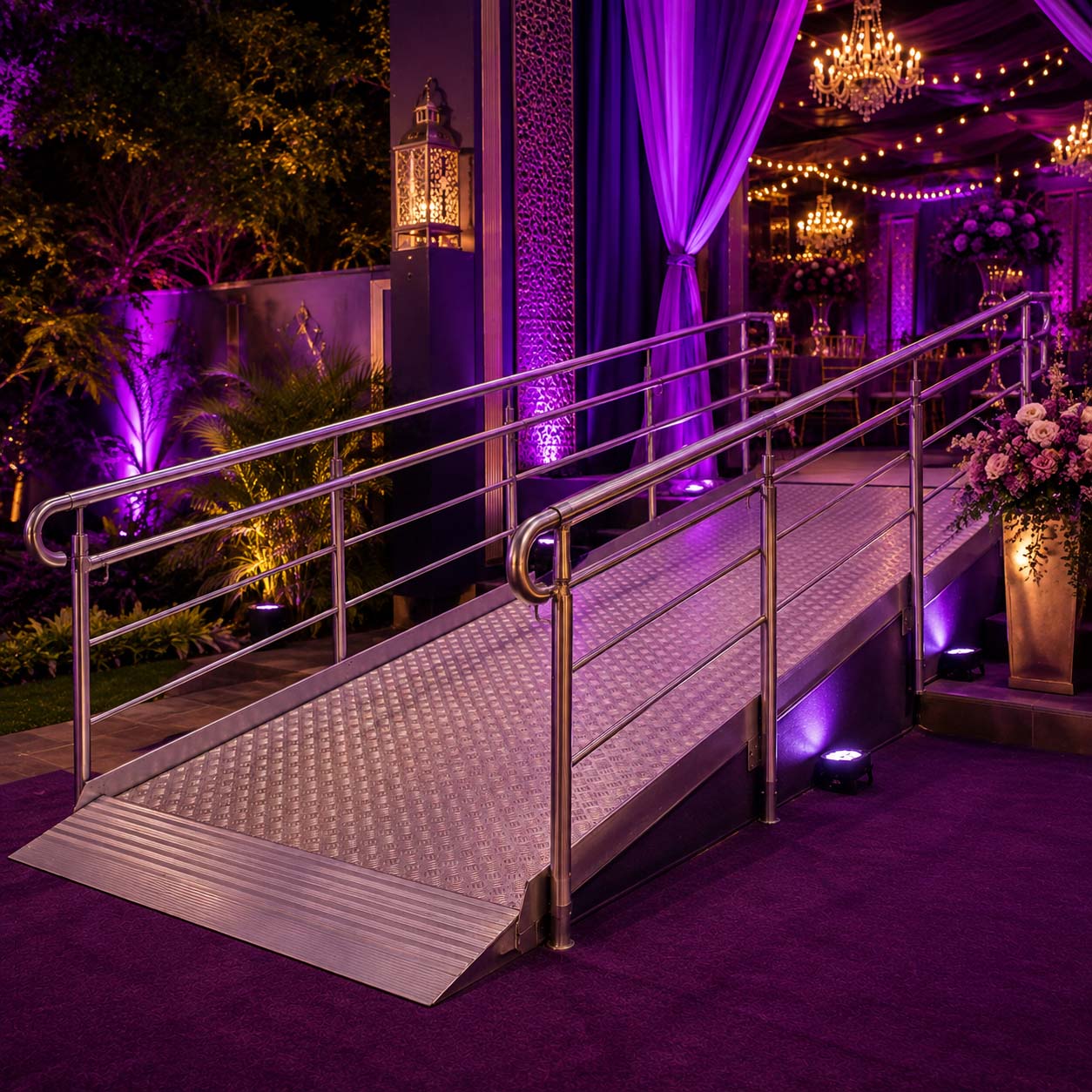
Wheelchair Ramps
Improve venue accessibility with wheelchair ramp solutions designed for accessible entry, mobility access, barrier-free spaces, public facilities, exhibitions, events, and temporary venues while supporting safer and more convenient movement.
Explore Event Rental & Infrastructure Services

Explore Other Experiences












Explore by Occasion






Wheelchair Ramps for Accessible Event Venues
◆Accessibility is an important part of creating inclusive venues and events. Guests using wheelchairs, mobility scooters, walking aids, or other mobility equipment should be able to enter and move through a venue safely and with dignity.
Wheelchair Ramps provide an alternative to steps and can support accessible movement between different levels. They can be useful at exhibitions, weddings, conferences, public gatherings, temporary structures, outdoor events, community functions, and other venues where permanent accessibility infrastructure may not be available.
Portable and temporary access solutions can be selected according to the entrance height, available space, surface conditions, expected usage, and venue configuration. Happiffie connects customers with experienced accessibility equipment providers offering practical ramp solutions across India.
Accessible Entry Solutions
An accessible entrance should allow people with mobility requirements to enter a venue without unnecessary barriers.
A suitable ramp can provide an alternative route where stairs or raised thresholds are present.
The entrance should also have sufficient width, stable ground conditions, and a clear pathway leading from the ramp into the venue.
Mobility Access
Mobility access involves more than installing a ramp at the main entrance.
Event organizers should consider accessible pathways, doorways, toilets, seating areas, registration counters, stages, dining spaces, and other frequently used areas.
A complete accessibility plan helps guests move through the venue with greater independence.
Portable Wheelchair Ramps
Portable wheelchair ramps can be useful when accessibility needs are temporary or when a venue does not have a permanent ramp.
They can be transported and positioned according to the event requirements.
Different portable designs may be suitable for door thresholds, short rises, vehicle access, temporary platforms, or longer elevated entrances.
Temporary Access Ramps
Temporary ramps can support events held in venues where permanent accessibility modifications are not practical.
They may be used for temporary stages, exhibition structures, marquees, outdoor venues, raised entrances, and event platforms.
The ramp should be selected according to the height and configuration of the specific access point.
Barrier-Free Venue Planning
A barrier-free venue should minimize obstacles that prevent independent movement.
Ramps can form part of a wider accessibility arrangement that includes suitable pathways, accessible entrances, elevators where available, appropriate restroom facilities, and clearly managed circulation areas.
Event planners should assess accessibility before guests arrive rather than treating it as an afterthought.
Event Accessibility
Accessibility planning is relevant to weddings, conferences, exhibitions, festivals, cultural programs, business events, public gatherings, and private celebrations.
Temporary venues can present additional challenges because structures may be installed on uneven ground or at different elevations.
A pre-event site assessment can help identify where accessible routes are needed.
Exhibition Accessibility
Exhibitions and trade fairs should provide accessible routes through entrance areas, booths, meeting spaces, and visitor facilities.
A ramp may be required where an exhibition booth, platform, or temporary structure has a raised floor.
Exhibitors should ensure that the accessible route does not become blocked by furniture, display equipment, storage materials, or promotional installations.
Wedding Venue Accessibility
Wedding venues may include steps at entrances, stages, mandaps, dining areas, lawns, or heritage properties.
Accessibility ramps can help guests using wheelchairs or mobility aids reach important areas more comfortably.
The route should be planned alongside the seating arrangement, décor, catering setup, and photography requirements.
Stage and Platform Access
Temporary stages and platforms can create accessibility challenges.
If guests or participants using wheelchairs need access to a raised platform, an appropriately designed ramp may provide a suitable route.
The ramp's dimensions, surface, gradient, stability, and connection to the platform should be evaluated before use.
Public Facility Access
Public-facing facilities may require accessible entry routes for visitors with different mobility needs.
Ramps can support access at temporary structures, community facilities, event spaces, exhibition areas, and other locations where a permanent accessible entrance is unavailable.
Local accessibility requirements and applicable building standards should always be considered.
Ramp Surface and Stability
The ramp surface should provide adequate traction for the intended conditions.
Wet weather, dust, outdoor surfaces, and high visitor traffic can affect ramp performance.
The ramp should remain stable during use and should not move, shift, or create an unexpected obstruction.
Ramp Width
Sufficient width is important for comfortable wheelchair movement.
The appropriate width depends on the design, venue configuration, traffic requirements, and applicable accessibility standards.
Where a ramp is intended for frequent or two-way movement, additional space may be necessary.
Ramp Gradient and Length
The required ramp length depends on the vertical height that needs to be overcome and the allowable gradient.
A steeper ramp may be difficult or unsafe for some wheelchair users.
For this reason, ramp selection should be based on appropriate accessibility guidance rather than simply choosing the shortest available option.
Handrails and Edge Protection
Depending on the height, length, design, and applicable requirements, ramps may need handrails, edge protection, or other safety features.
These elements can provide additional support and help prevent wheels or mobility equipment from moving beyond the ramp edge.
The specific requirements should be assessed by the equipment provider or qualified accessibility professional.
Accessible Pathways
A ramp is most useful when it connects to a continuous accessible pathway.
After reaching the top of the ramp, users should be able to continue toward the intended destination without encountering unnecessary steps, narrow passages, loose cables, furniture, or other obstacles.
Event layouts should therefore consider the entire route rather than only the ramp itself.
Outdoor Accessibility
Outdoor venues can require additional planning because of uneven ground, grass, gravel, temporary flooring, rain, and changing weather conditions.
Ramps should be installed on stable surfaces and positioned to provide a secure transition between different levels.
Weather conditions should be considered when selecting and operating temporary accessibility equipment.
Temporary Structures
Marquees, exhibition booths, temporary stages, portable cabins, raised platforms, and other structures may require temporary access solutions.
The ramp should be compatible with the structure and should provide a stable connection between the ground and elevated surface.
Installation should be completed before guests begin using the area.
Accessibility for Mobility Scooters
Some mobility scooters are wider, heavier, or longer than standard wheelchairs.
If a ramp is intended for scooter access, the equipment provider should be informed in advance so that the ramp's width, weight capacity, length, and turning requirements can be assessed.
Event Safety Planning
Accessibility equipment should be included in the overall event safety plan.
Organizers should identify the accessible route, keep it free from obstructions, provide appropriate signage where necessary, and ensure that event staff understand how the route should be maintained.
A pre-event inspection can help identify potential hazards.
Rental and Installation
Accessibility ramp rental can be useful when a venue needs temporary equipment for a specific event.
Depending on the provider, services may include delivery, installation, positioning, inspection, dismantling, and collection.
The provider should be given accurate information about the entrance height, surface, venue location, intended use, and expected traffic.
Choosing the Right Wheelchair Ramp
The correct ramp depends on several practical factors, including the height difference, available installation space, ramp length, width, load capacity, surface, weather conditions, intended users, and venue layout.
Before booking, organisers should confirm the ramp specifications and ensure that the proposed solution is appropriate for the intended wheelchair or mobility equipment.
Where accessibility compliance is required, the setup should be reviewed against applicable local standards and regulations.
Benefits of Temporary Accessibility Solutions
Temporary accessibility equipment can help venues improve mobility access without requiring permanent structural modifications.
Portable solutions are particularly useful for exhibitions, events, outdoor celebrations, temporary stages, and rented venues.
They can also help organisers respond to specific accessibility requirements for individual events.
Why Choose Happiffie?
Happiffie connects customers with trusted Wheelchair Ramps rental and accessibility equipment providers offering portable ramps, temporary access solutions, venue accessibility support, and mobility-friendly event infrastructure across India.
Whether you are organising a wedding, exhibition, conference, public gathering, festival, or temporary event, Happiffie helps you discover experienced providers who understand practical accessibility requirements.
From entrance access to raised platforms and temporary structures, the right accessibility equipment can be incorporated into the wider event layout with appropriate planning.
Conclusion
Accessible venue planning helps create a more inclusive experience for guests with mobility requirements. Wheelchair Ramps can provide practical access between different levels where permanent ramps are unavailable or temporary accessibility solutions are required.
For weddings, exhibitions, conferences, public events, festivals, and temporary structures, ramp selection should consider dimensions, gradient, stability, surface conditions, user requirements, and the complete accessible route.
With Happiffie, organizers can find reliable accessibility equipment providers who can assist with ramp selection, delivery, installation, and temporary venue access solutions across India.
Frequently Asked Questions
1. What are Wheelchair Ramps used for?
Wheelchair ramps provide an accessible route over steps or raised levels for people using wheelchairs and other mobility equipment.
2. Can wheelchair ramps be rented for events?
Yes. Portable and temporary ramps can be rented for weddings, exhibitions, conferences, public gatherings, temporary structures, and other events.
3. Are portable ramps suitable for temporary venues?
Yes. Portable ramps can be useful where permanent accessibility infrastructure is unavailable or cannot be modified.
4. Can ramps be used for temporary stages?
Yes. Appropriate ramps can provide wheelchair access to raised stages and platforms when the dimensions and configuration are suitable.
5. How do I choose the correct ramp length?
Ramp length depends primarily on the vertical height and the required accessible gradient. The provider should assess the specific entrance or platform before installation.
6. Are wheelchair ramps suitable for outdoor events?
Yes. They can be used outdoors when installed on a stable surface and selected for the relevant environmental and weather conditions.
7. Can mobility scooters use wheelchair ramps?
Some ramps can accommodate mobility scooters, but their width, length, weight capacity, and turning requirements should be confirmed with the provider beforehand.
8. Should an accessible route be kept clear?
Yes. The complete accessible route should remain free from furniture, cables, equipment, décor, storage items, and other obstacles.
9. Can ramps be used at exhibition booths?
Yes. Temporary ramps can provide accessible entry to raised exhibition platforms and booth structures where required.
10. Why choose Happiffie for Wheelchair Ramp rental?
Happiffie connects you with trusted Wheelchair Ramps and accessibility equipment specialists offering portable ramps, temporary access ramps, event accessibility solutions, and venue mobility support across India.