
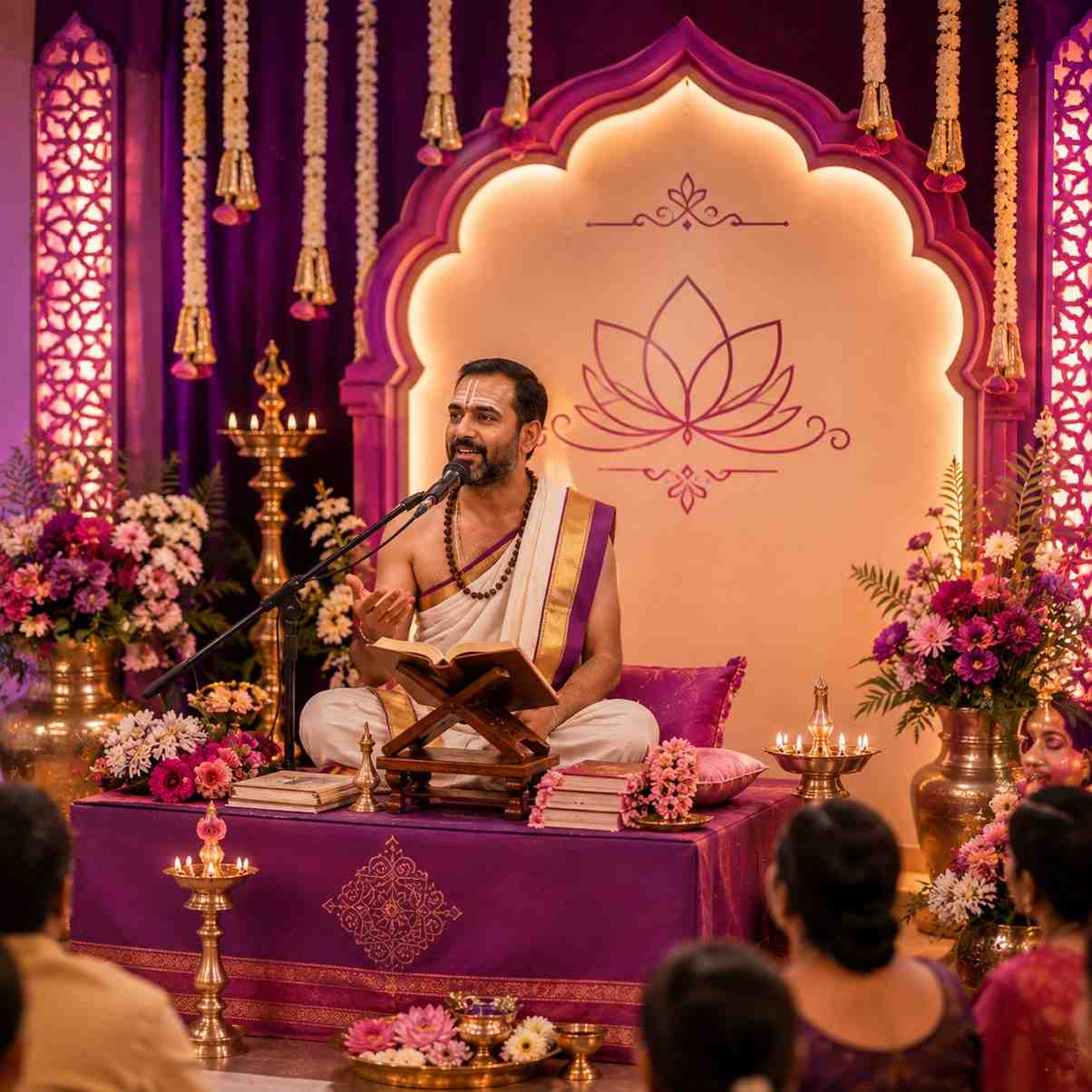
Upanyasam Wedding Ritual
Bring deeper meaning to traditional wedding ceremonies with Upanyasam featuring spiritual discourses, explanations of Hindu rituals, cultural traditions, sacred practices, and devotional insights for weddings and religious gatherings.
Explore Religious Ceremony Experiences
Explore Other Experiences




Explore by Occasion
Upanyasam Wedding Ritual Explanation for Hindu Discourse, Religious Narration & Ceremony Guidance in India
◆Upanyasam Wedding Ritual Explanation is a traditional devotional and educational service in which a knowledgeable speaker, scholar, priest, or religious narrator explains the meaning and significance of Hindu wedding rituals, customs, mantras, stories, and spiritual traditions. It can help couples, families, and guests understand the cultural and religious significance behind the ceremonies performed during a Hindu marriage.
Hindu weddings often include numerous rituals, each carrying its own symbolism, prayers, customs, and traditional narratives. An Upanyasam can provide context around these practices while helping guests understand why particular rituals are performed and how they relate to Hindu scriptures, traditions, and family customs.
Wedding Upanyasam programs can be conducted before or during a marriage ceremony, depending on the family's preferences and the priest's guidance. The narration may focus on the meaning of specific rituals, traditional stories, devotional teachings, marriage values, or the spiritual significance of the relationship between the bride and groom.
A religious discourse may be delivered in Tamil, Telugu, Kannada, Malayalam, Hindi, Sanskrit, or other regional languages depending on the speaker's expertise and the audience's preference.
The content of a wedding Upanyasam can be adapted to the family's tradition. Tamil, Telugu, Kannada, Malayalam, North Indian, and other Hindu wedding customs may have different rituals, terminology, stories, and ceremonial sequences.
Wedding ritual explanation can help guests understand ceremonies such as Kanyadaan, Pheras, Saptapadi, Mangalya Dharana, Panigrahanam, Agni rituals, Laja Homam, Oonjal, Kashi Yatra, Jeelakarra Bellam, Talambralu, and other regional customs where applicable.
The speaker may explain the symbolism of the sacred fire or Agni, which is an important element of many Hindu marriage traditions. The explanation can describe its traditional role as the witness to the marriage and the significance of offerings and prayers performed around it.
Saptapadi, or the seven steps, may be explained as a significant marriage ritual in which the couple takes seven symbolic steps while traditional mantras and vows are recited. The precise interpretation and sequence can vary according to the family's tradition.
Pheras may also be discussed as part of North Indian and other Hindu wedding traditions. The discourse can explain the traditional significance of the couple's movement around the sacred fire and the associated vows.
Kanyadaan can be explained as a traditional ceremony involving the bride's parents or designated family members. The speaker can provide cultural and religious context while acknowledging that practices differ between communities.
Mangalya Dharana or the tying of the Thali or sacred marriage thread is particularly significant in many South Indian wedding traditions. An Upanyasam can explain its traditional symbolism and role within the marriage ceremony.
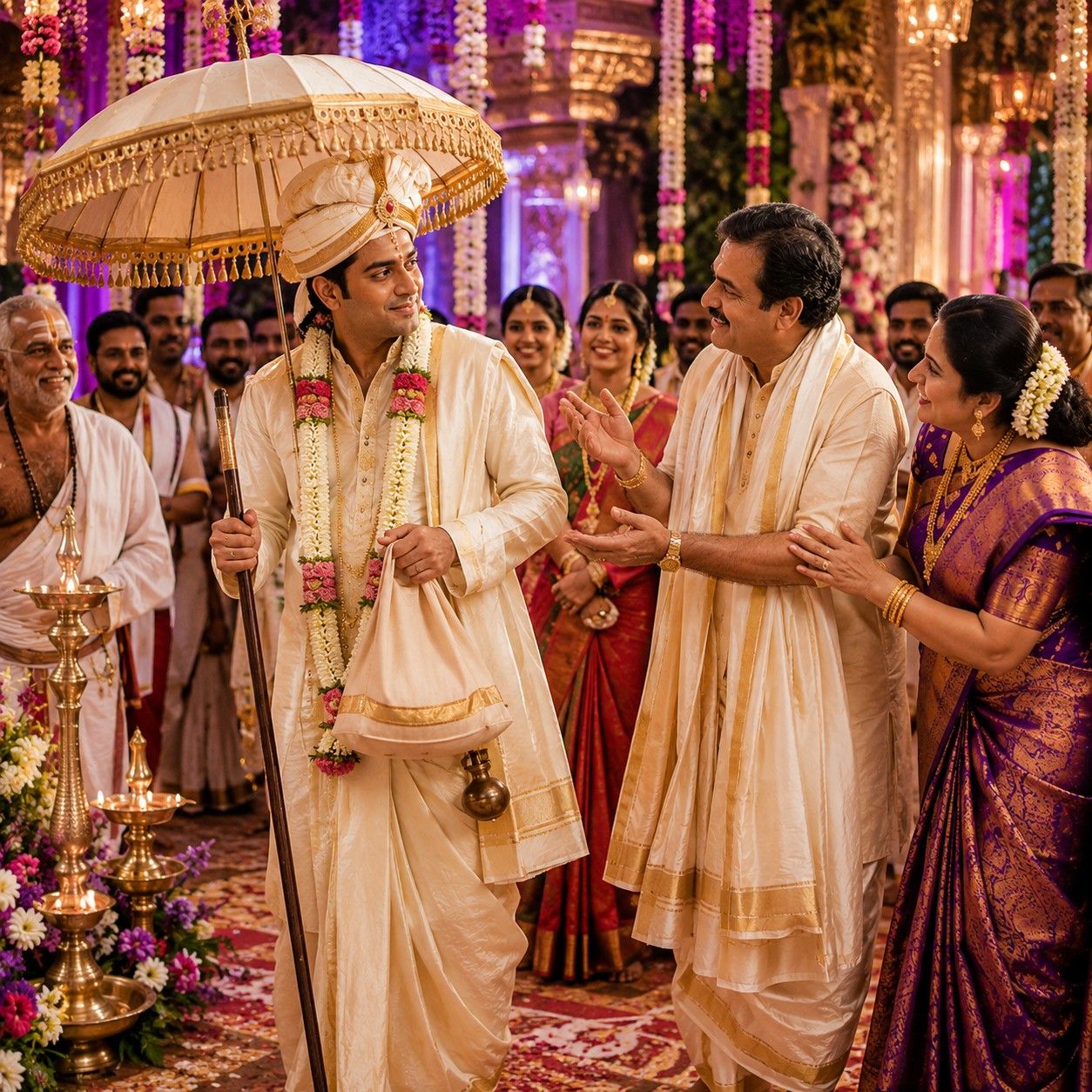
Regional customs can be introduced through stories and traditional narratives. For example, a Tamil wedding discourse may explain Oonjal, Kashi Yatra, Thaali Kettu, or other customs according to the family's community.
A Telugu wedding discourse may include explanations of Jeelakarra Bellam, Talambralu, Madhuparka, Kanyadanam, and other traditional practices.
A Kannada wedding discourse may discuss Dhare, Saptapadi, Mangalya Dharana, Muhurtha, and other customs followed by the family.
A Kerala Hindu wedding discourse may explain Thalikettu and other regional marriage practices depending on the family's community and tradition.
Religious storytelling is another important part of Upanyasam. Speakers may use stories from the Ramayana, Mahabharata, Puranas, Itihasas, devotional literature, or other traditional sources to explain values associated with marriage, family life, responsibility, devotion, and Dharma.
The stories selected should be appropriate for the occasion and audience. Families can discuss preferred themes with the speaker before the event.
Marriage values may be presented through traditional narratives and teachings. Topics can include mutual respect, family responsibilities, compassion, commitment, Dharma, shared responsibilities, and the importance of supporting one another.
A wedding Upanyasam can be particularly meaningful when grandparents and older family members are present. Traditional explanations can help younger generations understand customs that may otherwise be performed without much context.
The discourse can also help guests who are unfamiliar with the family's regional tradition. Simple explanations can make the ceremony more engaging and accessible without interrupting the ritual itself.
Timing is important when incorporating an Upanyasam into a wedding schedule. A separate discourse session can be conducted before the main ceremony, during a reception, or at another suitable time.
If the explanation takes place during the wedding ritual, the speaker should coordinate closely with the priest so that the narration does not interfere with mantras, vows, Muhurtham, or other ceremonial requirements.
The priest and Upanyasam speaker may have different roles. The priest generally conducts the prescribed rituals, while the speaker explains the cultural, religious, or philosophical significance of those practices.
For elaborate weddings, an event coordinator can create a detailed schedule covering the Upanyasam, priest-led rituals, photography, music, guest movement, and dining.
Microphones and sound systems may be required for larger wedding venues. The audio setup should provide clear speech without overpowering the priest, devotional music, or ceremony sounds.
For intimate home ceremonies, the discourse may be delivered without extensive production equipment. A small microphone or simple sound system may be sufficient depending on the audience.
Stage or seating arrangements should allow guests to see and hear the speaker comfortably. For larger audiences, a raised stage, projection screen, or appropriate seating layout may improve visibility.
Visual presentations can sometimes support the discourse. Images, traditional illustrations, scriptures, or ceremony diagrams may be used when appropriate, provided they are respectful and relevant to the religious setting.
Language interpretation can be arranged for multilingual audiences. A speaker may deliver the Upanyasam in one regional language while selected explanations or summaries are provided in another language.
Families may request a speaker who is particularly knowledgeable about their Sampradaya, community, temple tradition, or regional customs.
The speaker's experience and familiarity with traditional sources should be considered when selecting an Upanyasam performer. Families can discuss the intended subject, language, duration, audience, and ceremony format before booking.
An Upanyasam can be arranged as a standalone wedding discourse or as part of a broader religious wedding program. It may complement priest services, devotional music, temple ceremonies, and traditional storytelling.
Some families may also arrange Upanyasam sessions during pre-wedding religious gatherings, engagement ceremonies, family prayer programs, or wedding-related Satsang events.
For destination weddings, the speaker may require travel, accommodation, transportation, and additional preparation time. These requirements should be confirmed before booking.
Live streaming may allow relatives who cannot attend the wedding to listen to the religious discourse remotely. Appropriate permission should be obtained if the ceremony or discourse is being broadcast.
Recording may also be arranged where permitted. A recording can preserve the discourse and traditional explanations as a family memory.
Religious sensitivity is important when presenting traditional stories and interpretations. The speaker should follow the family's customs and avoid presenting personal interpretations as universally applicable religious rules.
Different Hindu traditions may interpret rituals and stories differently. A good Upanyasam should acknowledge regional and community variations rather than suggesting that every wedding follows one identical sequence.
The discourse should complement the ceremony rather than unnecessarily extending the event. Families can agree on the expected duration, topics, and level of detail before the wedding.
Professional event planners can coordinate Upanyasam speakers with Wedding Pandits, temple authorities, decorators, audio teams, photographers, videographers, venues, and hospitality providers.
In conclusion, Upanyasam Wedding Ritual Explanation provides an engaging way to understand the stories, values, traditions, and spiritual significance associated with Hindu marriage ceremonies. Through religious narration, Vedic stories, regional customs, and explanations of wedding rituals, an experienced speaker can help couples and guests connect more deeply with the meaning behind the celebration. With appropriate coordination between the speaker, priest, family, and event team, a wedding Upanyasam can become a meaningful educational and devotional part of the marriage experience.
FAQ Section
Q1: What is an Upanyasam for a wedding?
A Wedding Upanyasam is a religious discourse in which a knowledgeable speaker explains the meaning, traditions, stories, and spiritual significance associated with Hindu marriage rituals.
Q2: What topics can be covered in a Wedding Upanyasam?
Topics may include Hindu marriage customs, Vedic traditions, Pheras, Saptapadi, Kanyadaan, Mangalya Dharana, Agni rituals, regional customs, religious stories, marriage values, and traditional teachings.
Q3: Can an Upanyasam explain specific wedding rituals?
Yes. Families can request explanations of particular rituals according to their regional and community traditions.
Q4: In which languages can Upanyasam be conducted?
Depending on the speaker, Upanyasam may be conducted in Tamil, Telugu, Kannada, Malayalam, Hindi, Sanskrit, or other regional languages.
Q5: Can an Upanyasam be conducted during the wedding ceremony?
Yes, but the timing should be coordinated carefully with the Wedding Pandit so that the explanation does not interfere with mantras, vows, Muhurtham, or other rituals.
Q6: Can an Upanyasam include stories from Hindu scriptures?
Yes. Depending on the speaker and family's preferences, traditional stories from the Ramayana, Mahabharata, Puranas, Itihasas, and devotional literature may be included.
Q7: Can the Upanyasam be arranged for a private family wedding?
Yes. An Upanyasam can be organised for intimate home weddings, temple ceremonies, banquet hall weddings, destination weddings, or larger community gatherings.
Q8: Can wedding Upanyasam be live streamed?
Yes, where permitted. Live streaming can allow distant relatives and guests to listen to the discourse remotely.
Q9: How long does a Wedding Upanyasam typically last?
The duration depends on the event format, subject, speaker, and family preference. It can range from a short ritual explanation to a longer dedicated discourse session.
Q10: How can Happiffie help arrange Upanyasam Wedding Ritual Explanation?
Happiffie helps families and wedding organisers discover trusted Upanyasam speakers, religious narrators, scholars, devotional performers, and ceremony professionals offering Hindu wedding ritual explanations, religious storytelling, Vedic discourse, regional customs, and ceremony guidance.