
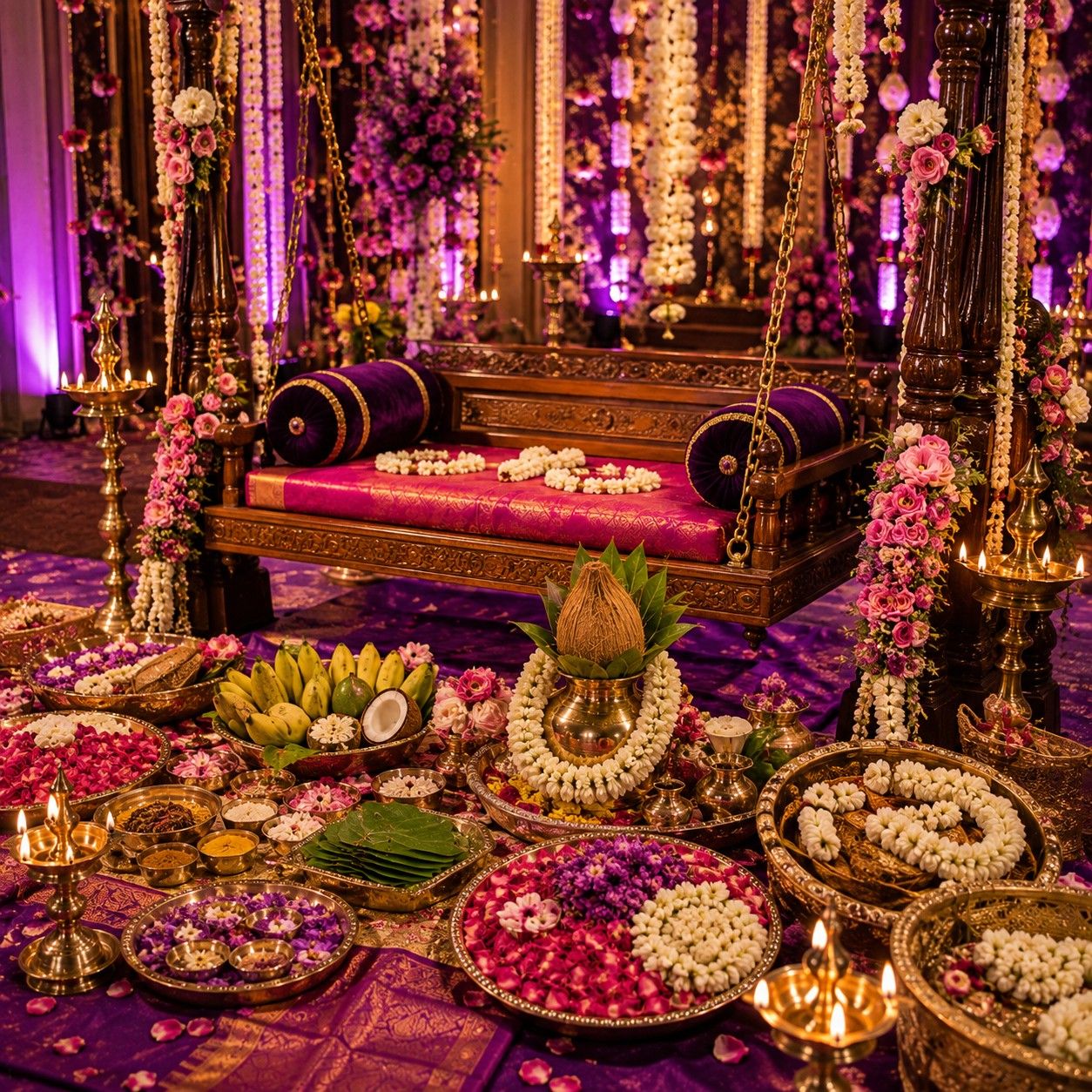
Unjal Swing Brahmin Marriage
Traditional Unjal Swing for Brahmin marriage ceremonies, designed for Iyer weddings, couple rituals, Oonjal traditions and elegant South Indian wedding decor.
Explore Religious Ceremony Experiences
Explore Other Experiences



Explore by Occasion
Unjal Swing Brahmin Marriage
◆Traditional South Indian weddings are celebrated through a combination of Vedic rituals, family customs and meaningful ceremonial traditions. Among the distinctive elements associated with many Tamil Brahmin weddings is the Unjal or Oonjal ceremony, where the bride and groom are traditionally seated together on a decorated swing.
An Unjal Swing can therefore become both a ceremonial feature and an important visual element within an Iyer wedding. Decorated with flowers, fabrics and traditional accessories, the swing can create a special setting for the couple while family members participate in the ceremony according to their customs.
The exact form and sequence of the Oonjal ceremony can vary between families and communities. The Vedic priest and family elders should always confirm the appropriate ritual arrangements.
Understanding the Unjal Swing
Unjal is a traditional swing associated with the Oonjal ceremony performed in some South Indian wedding traditions.
During the ceremony, the bride and groom may sit together on the swing while family members participate in customary rituals.
The swing can be made from wood, metal or other suitable materials, with traditional decorative elements added for the wedding.
Oonjal Ceremony in an Iyer Wedding
The Oonjal ceremony can form an important pre-wedding or wedding-stage tradition in an Iyer Kalyanam.
The bride and groom are seated together while family members perform the customary ceremonial actions according to their traditions.
The swing provides a distinctive setting for this family-centred ritual and often becomes one of the memorable visual features of the wedding.
Brahmin Marriage Swing
A traditional wedding swing can complement the cultural setting of a Brahmin marriage.
Its design may range from a simple wooden swing to an elaborately decorated structure featuring flowers, silk fabrics and traditional motifs.
The choice should consider the venue, the number of participants and the intended ceremonial use.
Couple Ritual
The Unjal ceremony provides a shared space for the bride and groom during an important stage of the wedding celebrations.
The couple's seating position and the sequence of the ritual should follow the instructions of the priest.
The swing should remain stable throughout the ceremony so that the couple can participate comfortably.
Traditional Swing Decor
Swing decoration can transform a simple Unjal into a visually distinctive wedding feature.
Fresh flowers, garlands, silk fabrics, traditional hangings and other suitable accessories can be used.
The decoration should remain balanced and should not interfere with the swing's movement or the couple's seating.
Floral Decoration
Flowers are among the most popular decorative elements for an Oonjal setup.
Garlands can be placed around the frame, while floral arrangements can be positioned behind or beside the swing.
Traditional flowers can provide a natural connection with the wider wedding décor.
Silk Fabric Decoration
Silk fabrics can add richness to the Unjal arrangement.
Traditional South Indian fabrics can be coordinated with the bride's saree, groom's attire and the colours used throughout the wedding venue.
The fabric should be attached securely so that it does not become entangled with the swing.
Traditional Iyer Wedding Styling
An Iyer wedding may feature traditional brass vessels, flowers, lamps, silk fabrics and other ceremonial accessories.
The Unjal can be styled to complement these elements.
A carefully coordinated arrangement can create a cohesive traditional appearance without making the swing excessively elaborate.
Choosing the Right Swing
The swing should be selected according to the venue and the number of people who will use it.
A strong and stable frame is particularly important because the bride and groom may sit together.
The seating surface should provide sufficient room while maintaining a comfortable posture.
Wooden Unjal
A wooden swing can provide a classic and traditional appearance.
Carved details, polished wood and traditional motifs can complement a South Indian wedding setting.
Wooden swings should be inspected before the ceremony to ensure that the frame, seat and suspension points are secure.
Decorative Metal Swing
Metal swings can offer a more contemporary interpretation of the traditional Unjal.
They can be decorated with flowers and fabrics while providing a structured appearance.
The supporting frame should be stable and capable of safely carrying the intended load.
Seating Comfort
The bride and groom may remain seated on the swing during the ceremony for a period of time.
The seating surface should therefore be comfortable and appropriately sized.
Cushions or suitable fabric coverings can be added if they are consistent with the family's ceremonial styling.
Swing Positioning
The Unjal should be positioned in a location where the priest, family members and photographers can access the couple comfortably.
There should be sufficient clearance around the swing.
The swing should not obstruct walkways, electrical equipment or other ceremonial areas.
Safety During the Oonjal Ceremony
Safety is particularly important because the swing is a moving structure.
The suspension points, frame and seat should be checked before the bride and groom sit down.
The swing should be moved gently and only according to the established ceremony practice.
Children and guests should not push or handle the swing unnecessarily.
Coordination With the Mandapam
The Unjal ceremony may take place in a separate decorated area rather than directly within the main mandapam.
The location can be decorated to visually connect with the main wedding stage.
Using similar flowers, fabrics and colours can create continuity across the venue.
Photography and Video
The Oonjal ceremony often creates memorable opportunities for wedding photography.
The couple seated together, surrounded by flowers and traditional decorations, can provide distinctive images.
Photographers can capture close-up details of the swing as well as wider photographs showing family participation.
Family Participation
Family involvement is an important feature of many traditional wedding ceremonies.
Parents, siblings, grandparents and other relatives may participate in the Oonjal ceremony according to family custom.
This creates an opportunity for different generations to share a meaningful part of the wedding celebration.
Traditional Wedding Accessories
The Unjal can be accompanied by other traditional wedding accessories such as flowers, ceremonial vessels, lamps and decorated trays.
These elements can be positioned around the swing without restricting movement.
The overall arrangement should remain practical for the ceremony.
Oonjal Ceremony Preparation
The swing and its decoration should be prepared before the ceremony begins.
The frame can be checked, the seating area cleaned and the floral decoration secured.
A designated family member or event coordinator can supervise the final setup.
Working With the Priest
The Vedic priest should confirm the sequence and requirements of the Oonjal ceremony.
Different Iyer families may follow variations in the ritual.
Following the priest's instructions ensures that the swing is prepared and positioned appropriately.
Traditional and Contemporary Styles
A classic Iyer wedding may favour a richly decorated wooden Unjal with flowers and silk fabrics.
A contemporary wedding can use a simpler swing with minimalist floral styling.
Both approaches can preserve the traditional character of the ceremony while reflecting the family's preferred wedding aesthetic.
Matching the Bride and Groom's Attire
The swing decoration can be coordinated with the couple's clothing.
Traditional silk sarees, veshti, jewellery and floral accessories can be complemented by matching colours and fabrics on the swing.
This can create a visually harmonious setting for photographs.
Large Wedding Planning
Large weddings require additional coordination because many family members may participate in the Oonjal ceremony.
The swing area should provide sufficient room for the participants and photographers.
A designated coordinator can ensure that the ceremony proceeds without unnecessary movement around the swing.
Sustainable Wedding Decoration
Reusable swing decorations can provide a practical alternative to single-use materials.
Traditional fabric hangings, brass accessories and durable floral supports can be stored for future family celebrations.
Natural flowers can complement the arrangement while maintaining a traditional appearance.
Preserving Family Traditions
An Unjal can become part of a family's collection of traditional wedding accessories.
A family-owned wooden swing may carry sentimental value if it has been used during previous generations' ceremonies.
Newly purchased or custom-made swings can similarly become part of the family's future wedding traditions.
Unjal as a Wedding Keepsake
A well-made swing can be reused for future family weddings, religious celebrations or ceremonial events.
Decorative elements can be updated for each occasion while the main structure remains unchanged.
This gives the Unjal value beyond a single wedding ceremony.
Balancing Tradition and Modern Décor
Modern wedding venues can accommodate traditional Oonjal ceremonies through carefully planned styling.
A simple swing can be surrounded by contemporary floral arrangements, while a traditional wooden swing can complement a heritage-inspired venue.
The ceremony remains the central focus rather than the decoration itself.
Complete Oonjal Setup
Preparing the Unjal Swing requires attention to structure, seating, decoration, positioning and safety.
The swing should be installed and tested before the bride and groom use it.
Floral and fabric decorations should be secured without restricting movement.
Meaningful Couple Ceremony
The Oonjal ceremony can provide a special moment for the bride and groom to participate together before or during the main wedding celebrations.
Its combination of traditional ritual, family participation and decorative presentation makes it a memorable part of many South Indian weddings.
Preserving the Iyer Wedding Experience
Iyer weddings bring together Vedic practices, family traditions and culturally significant ceremonies. The Unjal Swing can provide a distinctive setting for the Oonjal ceremony while contributing to the traditional appearance of the wedding.
The exact ritual sequence and use of the swing should always be confirmed with the Vedic priest and family elders. With a stable structure, thoughtful decoration and careful preparation, the Unjal can become a meaningful and memorable part of a Brahmin marriage celebration.
Frequently Asked Questions
1. What is an Unjal Swing in a Brahmin wedding?
An Unjal is a traditional swing used for the Oonjal ceremony in some South Indian wedding traditions.
2. What is the Oonjal ceremony?
The Oonjal ceremony is a traditional wedding ritual in which the bride and groom may sit together on a decorated swing while family members participate according to custom.
3. Is the Unjal ceremony performed at every Iyer wedding?
Not necessarily. Wedding traditions vary between families and communities.
4. How can an Unjal Swing be decorated?
It can be decorated with fresh flowers, garlands, silk fabrics, traditional hangings and other suitable wedding accessories.
5. What type of swing is suitable for an Iyer wedding?
Wooden and metal swings can both be suitable, provided the structure is stable, secure and appropriate for the ceremonial space.
6. Can the swing decoration match the wedding theme?
Yes. Flowers, fabrics and colours can be coordinated with the couple's attire and wider wedding décor.
7. Is safety important for an Oonjal setup?
Yes. The frame, seat and suspension points should be checked before the bride and groom use the swing.
8. Can a family reuse an Unjal after the wedding?
Yes. A durable swing can be preserved and reused for future weddings and traditional family occasions.
9. Where should the Unjal be placed?
It should be positioned in a clear and stable area where the priest, family members and photographers can participate comfortably.
10. Who should confirm the Oonjal ceremony arrangements?
The Vedic priest and family elders should confirm the ritual sequence and seating arrangements because customs can vary between Iyer families.