
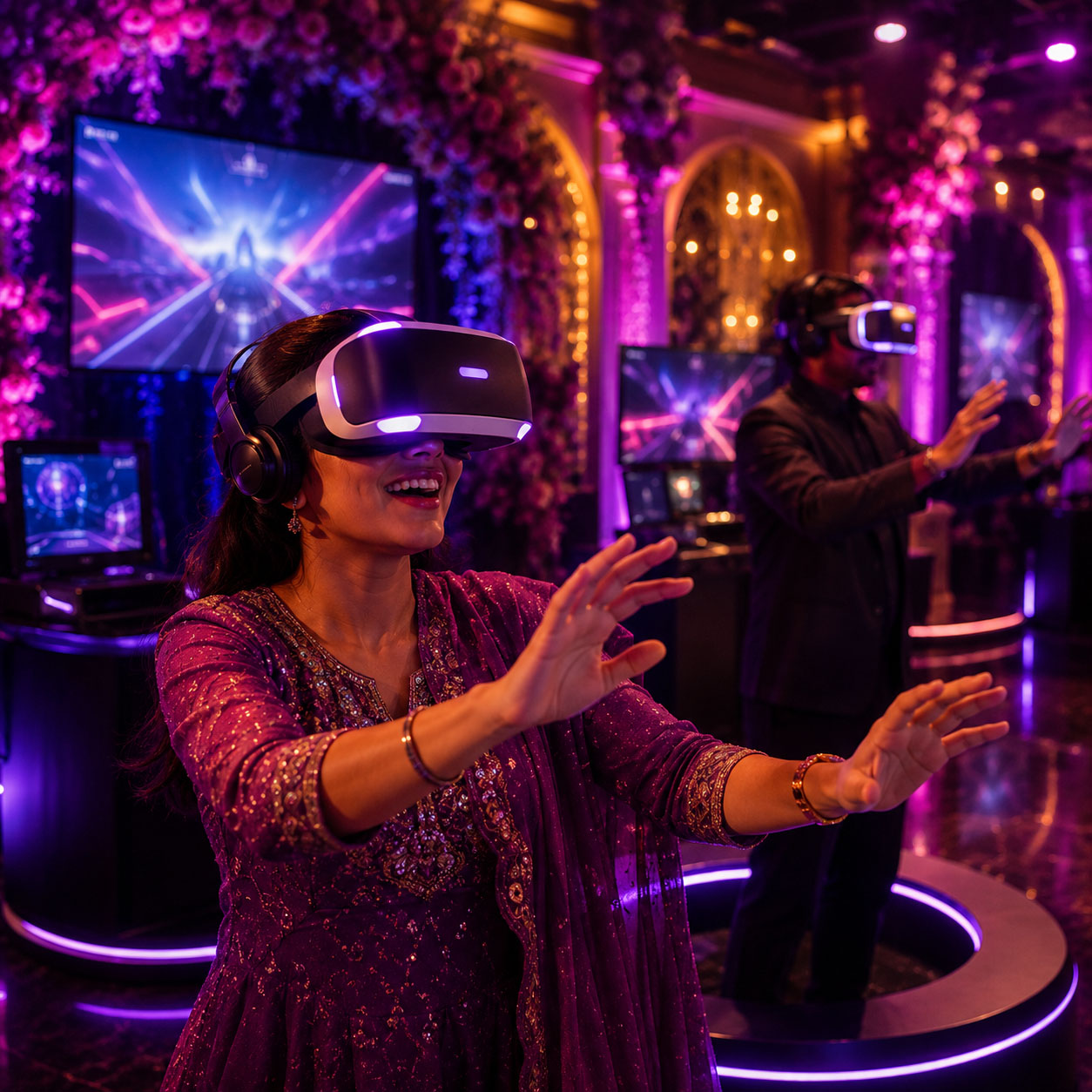
Virtual Reality Experience Zones
Create immersive guest experiences with virtual reality experience zones featuring VR headsets, interactive simulations, and engaging virtual worlds designed for product launches, exhibitions, brand activations, conferences, and memorable event experiences.
Explore Digital & Tech-Enabled Event Experiences
Explore Other Experiences





Explore by Occasion



Virtual Reality Experience Zones for Events
◆Modern events increasingly focus on creating interactive experiences that capture attention and encourage guests to participate rather than simply observe. Virtual Reality Experience Zones provide an immersive format where attendees can use VR headsets to enter simulated environments and explore interactive virtual worlds.
These experiences can be incorporated into product launches, exhibitions, brand activations, conferences, entertainment events, and other experiential environments. By combining immersive simulations with interactive technology, organizers can create memorable experiences that encourage guest participation and strengthen engagement.
Happiffie helps event organizers explore immersive event technology solutions designed around interactive guest experiences.
VR Headsets
VR headsets are central to many virtual reality experiences. They provide the visual interface through which guests can enter simulated environments and interact with virtual content.
Depending on the experience, headsets can be configured with different software, environments, and interactive elements to suit the purpose of the event.
For exhibitions and brand activations, the content can be selected to complement the overall event theme or campaign.
Immersive Simulations
Immersive simulations place guests inside digitally created environments that can replicate real-world situations, imaginative settings, or specially designed brand experiences.
The simulation can be developed around the objective of the event. Product demonstrations, educational experiences, entertainment concepts, and interactive storytelling can all be adapted for virtual reality environments.
Interactive Worlds
Interactive worlds allow participants to explore virtual environments rather than simply watch a conventional presentation.
Guests can interact with the experience according to its programmed functionality. This creates an active participation model that can make the experience more engaging.
For brand activations, interactive worlds can also provide an opportunity to present products, concepts, or stories in an unconventional format.
Virtual Reality Events
Virtual reality can be incorporated into different types of events depending on the audience and objectives.
Product launches can use VR to introduce products through immersive demonstrations, while exhibitions can use virtual environments to attract visitors to experience booths.
The technology can also be used for entertainment-oriented experiences at celebrations and large gatherings.
VR Event Experiences
VR event experiences can be designed as dedicated activity zones where attendees can participate individually or in controlled groups.
A well-planned zone can include the headset area, participant briefing space, equipment management, waiting area, and staff assistance.
This helps create an organized experience while allowing guests to participate comfortably.
Product Launch VR
Product launch VR can provide an immersive way to introduce a new product or concept.
Instead of relying entirely on physical displays, organizers can use virtual environments to demonstrate product features, explore product concepts, or present experiences that may not be practical to recreate physically.
The virtual experience can be aligned with the product launch's broader communication strategy.
Immersive Event Technology
Immersive event technology can transform a conventional event area into an interactive environment.
Virtual reality is one approach to immersive engagement, allowing guests to explore simulated spaces through dedicated equipment.
The experience should be designed around the event's audience, venue conditions, available space, and intended duration.
VR Brand Activation
VR brand activation can help companies create interactive experiences around a brand or campaign.
A branded virtual environment can introduce guests to products, concepts, stories, or experiences in a memorable format.
The virtual content should remain relevant to the brand message rather than functioning solely as a standalone technological attraction.
Interactive VR Experiences
Interactive VR experiences encourage guests to participate directly.
Depending on the programmed experience, participants may explore virtual locations, interact with digital objects, complete activities, or experience simulated scenarios.
The level of interaction can be adapted according to the event's objectives and audience.
Virtual Reality Exhibitions
Exhibitions can use virtual reality to create attraction points within busy event environments.
A VR experience booth can provide visitors with an opportunity to interact with immersive content while learning more about a product, service, concept, or brand.
This can add an experiential layer to conventional exhibition displays.
VR Experience Booths
VR experience booths can be structured as dedicated spaces within exhibitions, trade shows, launches, and other events.
A typical setup may include VR headsets, appropriate equipment, software, staff assistance, participant briefing, and controlled access to the experience.
The booth layout should allow sufficient space for safe participant movement and efficient guest flow.
Immersive Product Demonstrations
Virtual reality can make product demonstrations more experiential.
Products that are difficult to transport, demonstrate physically, or explain through conventional displays can potentially be presented through virtual simulations.
This can help guests understand concepts through exploration rather than relying entirely on verbal explanations.
Brand Storytelling Through VR
Virtual reality can also support experiential storytelling.
A carefully designed virtual environment can guide guests through a sequence of scenes or interactions connected to a brand, product, destination, campaign, or concept.
This creates an opportunity for brands to communicate through experience rather than static displays.
Exhibition Visitor Engagement
Busy exhibitions often compete for visitor attention.
A VR experience booth can provide an interactive attraction that encourages visitors to stop, participate, and explore.
The experience should remain simple enough for guests to understand quickly, particularly when visitor turnover is high.
Guest Participation
The success of a VR zone depends partly on how easily guests can participate.
Clear instructions, appropriate assistance, and a straightforward onboarding process can help participants understand what to expect.
Staff can guide users through equipment use and explain the basic interaction process before the experience begins.
VR Experience Management
Organizers should plan the operational side of the experience alongside the technology itself.
Important considerations include equipment availability, participant rotation, staff assistance, content loading, waiting times, space allocation, and technical support.
A structured process can help maintain a consistent experience throughout the event.
Safety and Space Planning
VR experiences require suitable physical space.
Participants may not always be fully aware of their surroundings while using a headset, so the activity area should be organized appropriately and monitored by trained staff.
Equipment should be used according to the manufacturer's instructions, and the setup should account for participant movement and venue conditions.
Interactive Technology for Product Launches
Product launches can benefit from interactive technology when the objective is to create stronger audience engagement.
A virtual environment can allow guests to explore product concepts or demonstrations that extend beyond the physical launch space.
This can make the technology an integrated component of the product presentation.
Benefits for Event Organizers
Virtual Reality Experience Zones can provide several potential advantages:
- Interactive guest participation
- Immersive product presentations
- Memorable brand experiences
- Attraction within exhibition spaces
- Innovative event entertainment
- Experiential storytelling
- Flexible virtual environments
- Increased engagement opportunities
The results depend on the quality of the content, technology, event design, and audience engagement.
Benefits for Guests
Guests can experience environments that may be difficult or impossible to recreate physically.
VR can provide a sense of exploration and participation while giving attendees something distinctive to experience during an event.
The most effective experiences are generally easy to understand, comfortable to use, and relevant to the event's purpose.
Choosing Virtual Reality Experience Zones
When selecting Virtual Reality Experience Zones, consider the type of VR headsets, available content, immersive simulations, interaction design, physical space, participant capacity, staffing, technical support, equipment management, and event objectives.
For product launches and brand activations, the virtual content should also align with the product or campaign message.
Why Choose Happiffie?
Happiffie helps event organizers explore Virtual Reality Experience Zones, VR headsets, immersive simulations, interactive worlds, VR event experiences, product launch VR, immersive event technology, and VR brand activation solutions.
For exhibitions, launches, and experiential events, a carefully designed VR zone can provide guests with an engaging way to interact with digital environments.
Happiffie helps organizers discover event technology solutions that can turn available event space into an interactive experience.
Conclusion
Virtual reality can transform event participation by placing guests inside immersive digital environments. Instead of simply viewing a presentation or display, attendees can actively explore interactive worlds through VR technology.
Virtual Reality Experience Zones can support product launches, exhibitions, brand activations, events, and other experiences through VR headsets, immersive simulations, interactive worlds, and dedicated experience booths.
With Happiffie, organizers can explore immersive event technology designed to create memorable guest experiences while aligning virtual content with the purpose and audience of the event.
Frequently Asked Questions
1. What are Virtual Reality Experience Zones?
Virtual Reality Experience Zones are dedicated event areas where guests can use VR equipment to explore immersive simulations and interactive virtual environments.
2. What equipment is used in a VR experience zone?
VR headsets and compatible supporting equipment are commonly used. The exact equipment depends on the selected experience and technology platform.
3. Can VR be used for product launches?
Yes. Product launch VR can provide immersive demonstrations, virtual product exploration, and interactive brand experiences.
4. Are VR experience booths suitable for exhibitions?
Yes. VR experience booths can attract exhibition visitors and provide an interactive alternative to conventional displays.
5. What are immersive simulations?
Immersive simulations are digitally created environments designed to place participants inside a simulated scenario or experience.
6. Can VR experiences be customized for brands?
Yes. Virtual environments can be developed around brand messages, products, campaigns, stories, or specific event objectives.
7. How long should a VR event experience last?
The appropriate duration depends on the experience, audience, equipment, venue, and expected visitor volume. Shorter experiences can be useful when many guests need to participate.
8. Can multiple guests use a VR zone?
Yes. A VR zone can be organized for multiple participants through scheduled turns, multiple stations, or controlled participant rotation.
9. What should organizers consider when setting up a VR zone?
Organizers should consider physical space, equipment, content, staffing, participant flow, technical support, safety, waiting areas, and venue requirements.
10. Is staff assistance required for VR experiences?
Staff assistance is recommended to help with participant instructions, equipment handling, onboarding, and operational support.
11. Can VR be used for brand activations?
Yes. VR brand activation can provide an immersive way to introduce guests to a product, service, campaign, or brand story.
12. Why choose Happiffie for VR event experiences?
Happiffie helps organizers explore VR experience zones, immersive simulations, interactive worlds, product launch VR, exhibition experiences, VR brand activations, and other immersive event technology solutions.