
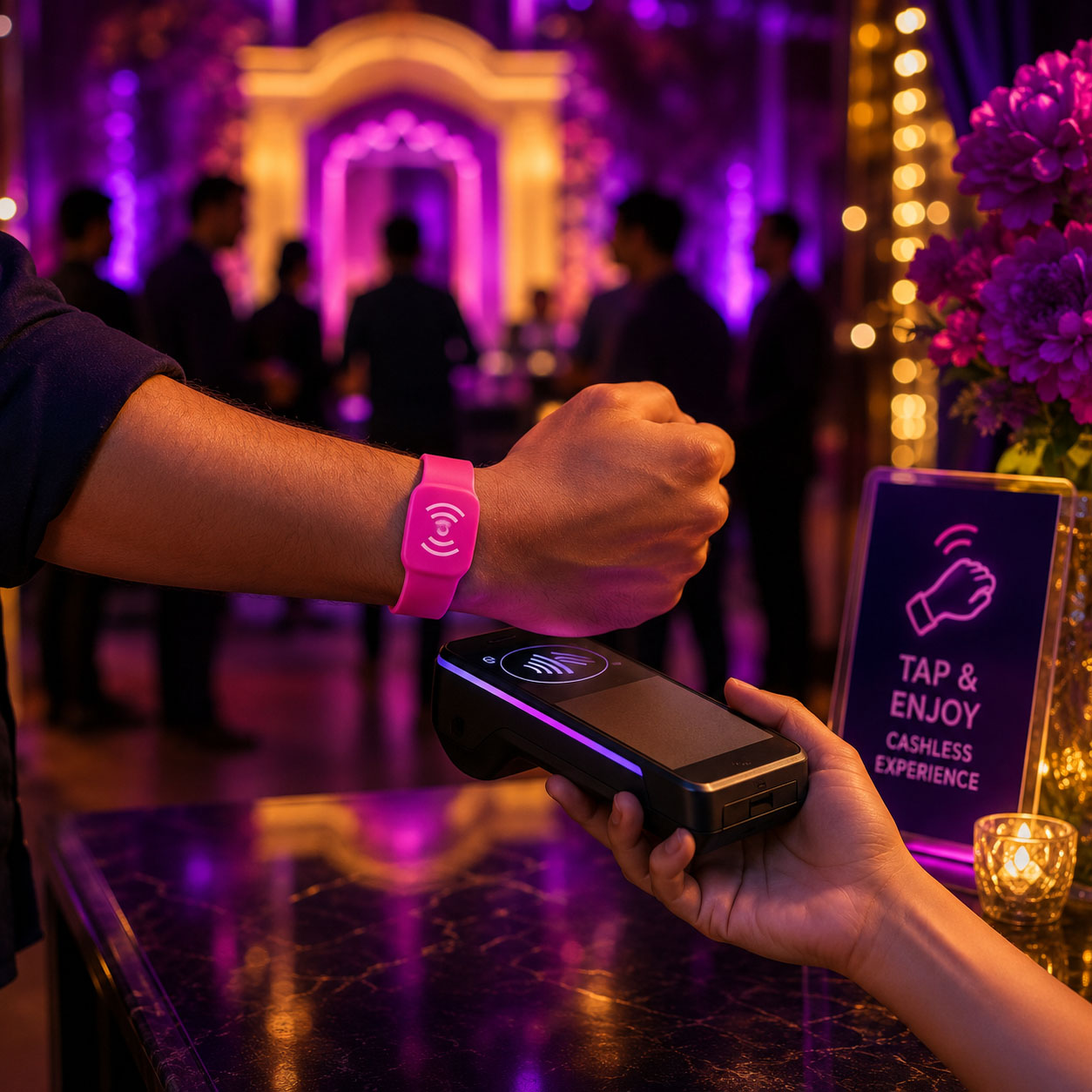
RFID Wristbands Cashless Payments
Streamline event entry and transactions with RFID wristbands and cashless payment solutions featuring contactless transactions, access control, rechargeable bands, and convenient attendee management for music festivals and large-scale events.
Explore Digital & Tech-Enabled Event Experiences

Explore Other Experiences
















Explore by Occasion






RFID Wristbands Cashless Payments for Music Festivals
◆Large festivals and high-footfall events need efficient ways to manage entry, payments, and attendee movement. Traditional tickets, cash transactions, and manual verification can create queues and increase operational complexity.
RFID Wristbands Cashless Payments combine RFID event wristbands with contactless transactions, access control, and rechargeable payment functionality. These systems can help connect attendee identification, venue access, and cashless purchasing through a wearable format.
For music festivals and large events, RFID wristbands can provide a convenient way for attendees to access designated areas and make supported purchases without repeatedly handling physical tickets or cash.
RFID Event Wristbands
RFID event wristbands use radio-frequency identification technology to connect a wearable wristband with an attendee record or event account.
Depending on the event system, the wristband may be used for entry verification, access permissions, cashless purchasing, or other attendee-related functions.
The exact capabilities depend on the RFID platform and infrastructure selected by the organizer.
Cashless Event Payments
Cashless event payments allow attendees to make supported purchases through an event payment system rather than relying on physical cash.
When integrated with RFID wristbands, attendees can use their registered bands at participating payment points.
This can help create a more streamlined purchasing experience across busy festival environments.
Contactless Transactions
Contactless transactions allow supported payments or identification actions to take place through compatible RFID-enabled systems.
Attendees can present their wristband at an appropriate reader, allowing the system to process the associated transaction or access request.
This can reduce the need for repeated physical handling of cash or conventional tickets.
Access Control
RFID wristbands can also support event access control.
Different wristbands or account permissions can be configured for specific areas, depending on the event's access requirements.
For example, organizers may use RFID technology to distinguish general admission, VIP, backstage, staff, or other authorized access categories.
Rechargeable Bands
Rechargeable bands can allow attendees to add funds to their event account and use the available balance at supported locations.
The specific recharge process depends on the event payment system.
Organizers should clearly communicate available top-up methods, balance management, refund policies, and payment terms before the event.
Music Festival Wristbands
Music festival wristbands can combine admission identification with additional event functions.
A single wearable can potentially support entry, designated-area access, cashless purchasing, and attendee identification.
This can be particularly useful at large festivals where attendees move between multiple stages, food areas, merchandise points, and activity zones.
RFID Payment Bands
RFID payment bands connect the physical wristband with a compatible event payment account.
When the band is presented to a payment terminal, the system can identify the associated account and process the transaction according to the configured payment rules.
This provides a wearable alternative to repeatedly presenting physical payment methods.
Festival Access Control
Festival access control can become more organized when attendee credentials are linked to RFID wristbands.
Organizers can configure access permissions according to ticket categories, staff roles, designated zones, or other event requirements.
This can help support controlled movement across restricted areas.
Contactless Event Technology
Contactless event technology can be used across different parts of the attendee journey.
RFID wristbands may support entry verification, cashless payments, access permissions, and other event functions through compatible readers and systems.
Using one wearable credential for multiple purposes can reduce the number of physical items attendees need to manage.
Event Payment Systems
An event payment system typically connects attendee accounts, payment terminals, RFID credentials, transaction records, and account management functions.
For a large event, organizers should consider transaction capacity, connectivity, reader availability, account security, reporting, and support procedures.
The system should be tested thoroughly before attendee operations begin.
RFID Entry Bands
RFID entry bands can be used as wearable credentials for admission verification.
Depending on the setup, the band can be associated with a particular ticket or attendee profile.
Readers positioned at entrances can then verify the relevant credential according to the configured access rules.
Cashless Festival Experience
A cashless festival experience can make purchasing more convenient by allowing attendees to use a connected RFID wristband at supported payment points.
Food vendors, merchandise counters, beverage outlets, and other participating vendors can potentially accept RFID-based payments when integrated with the event's payment infrastructure.
Attendee Registration
Before an RFID wristband can be used for event services, attendee registration and account setup may be required.
The registration process can associate the wristband with the appropriate attendee or payment account.
Organizers should provide clear instructions for activation, account setup, balance management, and wristband collection.
Wristband Activation
Activation connects the physical wristband with the relevant event account or attendee record.
Depending on the system, activation may happen during registration, online before arrival, or at a designated event counter.
The organizer should provide attendees with clear instructions so that wristbands can be activated efficiently.
Wristband Top-Up
A top-up system can allow attendees to add funds to their cashless event account.
Available options may include online recharge, designated top-up counters, or other supported payment methods.
The event should clearly communicate minimum top-up amounts, transaction rules, and refund procedures where applicable.
Payment at Festival Vendors
Once activated and funded, RFID wristbands can be used at participating payment terminals.
The attendee presents the wristband to the compatible reader, and the transaction is processed against the associated account.
Vendors can benefit from an organized payment workflow while attendees can avoid repeatedly handling cash.
Transaction Records
Digital transaction records can help organizers and attendees track activity associated with the cashless system.
Depending on the platform, attendees may be able to view balances and transaction history, while organizers may have access to operational reporting.
Accurate transaction records can also support reconciliation and event financial management.
Benefits for Event Organizers
RFID wristband systems can combine several event functions into one wearable credential.
Potential operational advantages include:
- Faster attendee identification
- Organized access control
- Cashless purchasing
- Reduced dependence on physical tickets
- Centralized transaction records
- Support for different access categories
- Simplified attendee credential management
The actual benefits depend on the system's design and event implementation.
Benefits for Attendees
For attendees, RFID wristbands can provide a convenient wearable format for event access and supported payments.
Participants may be able to enter the venue, access authorized areas, and make purchases using the same wristband.
This can reduce the number of physical items they need to carry throughout the festival.
Security and Account Management
RFID wristband systems should include appropriate account and transaction management processes.
Organizers should establish procedures for lost or damaged wristbands, account protection, unauthorized use, refunds, and balance management.
Attendees should follow the event's instructions for protecting their account and reporting problems.
Lost or Damaged Wristbands
A clear replacement process is important for cashless wristband events.
If a wristband is lost or damaged, the organizer may need to deactivate the original credential and issue a replacement.
The specific process depends on how the event's RFID payment and access system is configured.
Choosing RFID Wristbands Cashless Payments
When selecting RFID Wristbands Cashless Payments, consider RFID compatibility, payment functionality, access control, wristband durability, reader infrastructure, account management, recharge options, transaction reporting, connectivity, security, and attendee support.
The system should be capable of handling the expected number of attendees and transactions throughout the event.
Why Choose Happiffie?
Happiffie helps event organizers explore solutions for RFID Wristbands Cashless Payments, contactless transactions, access control, rechargeable bands, RFID event wristbands, cashless event payments, and festival access management.
For music festivals and large events, integrated RFID technology can help connect attendee access and supported payment functions through a single wearable credential.
Happiffie helps organizers discover event technology solutions that can contribute to a more organized and convenient attendee experience.
Conclusion
Large festivals require reliable systems for managing access, payments, and attendee movement. RFID wristbands can combine several of these functions into one wearable credential.
RFID Wristbands Cashless Payments can support contactless transactions, festival access control, rechargeable balances, RFID entry, and cashless purchasing through compatible event infrastructure.
With Happiffie, organizers can explore RFID and cashless event technology designed to support smoother attendee experiences across music festivals and large-scale events.
Frequently Asked Questions
1. What are RFID wristbands used for at festivals?
RFID wristbands can be used for event entry, access control, attendee identification, and cashless payments when supported by the event's RFID system.
2. How do RFID wristband payments work?
The wristband is linked to an attendee account or payment profile. When presented to a compatible reader, the system identifies the account and processes the supported transaction.
3. Can RFID wristbands replace physical tickets?
They can function as wearable event credentials for entry when the event's admission system supports RFID technology.
4. Can attendees recharge RFID wristbands?
Yes, if the event's payment platform supports rechargeable balances. Top-up methods depend on the selected system.
5. Can RFID wristbands control access to VIP areas?
Yes. RFID access control can assign different permissions to different attendee categories where the system supports zone-based access.
6. Can RFID wristbands be used for food purchases?
Yes, participating food and beverage vendors can accept RFID payments when their payment terminals are integrated with the event system.
7. Can RFID wristbands be used for merchandise purchases?
Yes. Merchandise vendors can accept RFID-based cashless payments when compatible payment infrastructure is available.
8. What happens if an attendee loses a wristband?
The event should have a procedure for reporting lost bands, disabling the original credential, protecting the associated account, and issuing a replacement where applicable.
9. Are RFID wristbands suitable for large music festivals?
Yes. RFID systems can be designed to support large attendee volumes, multiple entry points, access zones, and participating payment locations.
10. Can attendees check their transaction history?
Some event payment platforms provide balance and transaction-history functionality. Availability depends on the selected system.
11. What should organizers consider when selecting an RFID payment system?
Organizers should evaluate RFID compatibility, transaction capacity, access control, recharge functionality, security, reader infrastructure, reporting, connectivity, support, and attendee account management.
12. Why use Happiffie for RFID wristband solutions?
Happiffie helps organizers explore RFID wristbands, cashless payment systems, contactless transactions, festival access control, rechargeable bands, and RFID entry technology for music festivals and large events.