
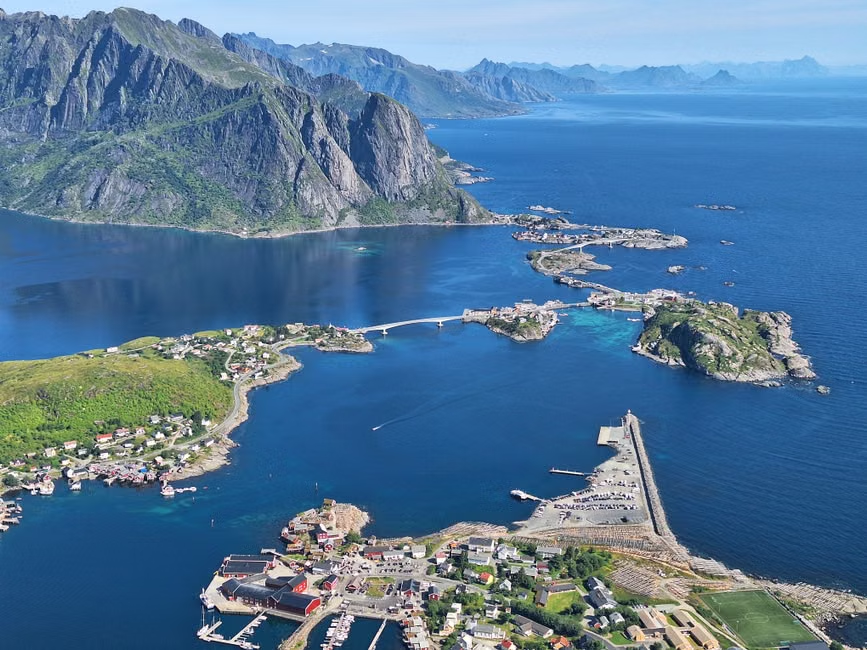
Why Lofoten Islands is Perfect for Your Celebration
- Midnight sun in June–August creates 24-hour golden-hour lighting for photography and outdoor events
- Dramatic fjord and mountain backdrops unlike any other European wedding destination
- Intimate scale of the islands naturally suits small, exclusive guest groups of 20–80 people
- Authentic Norwegian rorbuer (fishermen's cabins) and boutique lodges offer unique, character-rich accommodation
- Near-total absence of crowds and commercial noise creates a genuinely private celebration atmosphere
- Strong local seafood and Nordic culinary culture gives catering a distinctive, memorable character
Compare Lofoten Islands with Other Top Destinations
Frequently Asked Questions
Is Lofoten Islands a good destination for a wedding?
Yes, particularly for small, intimate weddings of 20 to 60 guests. Lofoten offers genuinely extraordinary natural scenery — fjords, Arctic peaks, and midnight sun — that creates a deeply memorable ceremony backdrop. It suits couples who prioritise atmosphere, privacy, and a nature-immersive experience over large-scale formal infrastructure. It is not well-suited to weddings requiring large banquet halls or guest lists above roughly 80 to 100 people.
What is the best time of year to hold a celebration in Lofoten?
June, July, and August are strongly recommended. During these months, the midnight sun provides continuous golden-hour light, temperatures are at their most comfortable (typically 12°C–18°C), all roads are accessible, and the local hospitality and vendor ecosystem is fully operational. Outside this window, polar night, storms, and reduced services make event planning significantly more difficult.
How do guests travel to the Lofoten Islands?
All guests require a multi-leg journey. The most common route is flying into Oslo and connecting to Svolvær Airport (Helle) or Leknes Airport on the islands. Alternatively, guests can reach Bodø by train and take a ferry across. There is no direct railway connection to Lofoten. Event planners should provide guests with detailed travel guidance and build buffer time into itineraries for potential weather delays.
What size of guest group can Lofoten realistically accommodate for an event?
Lofoten works best for groups of 20 to 80 guests. The boutique rorbuer complexes and waterfront lodges that host events here typically have seated dinner capacity in the 30 to 80 range. Guest lists above roughly 100 people will find the local venue and accommodation inventory genuinely stretched, and large-format events are not well-supported by the existing infrastructure.
What kinds of venues are available for events in Lofoten?
The most distinctive venues are converted traditional rorbuer — historic Norwegian fishermen's cabins set directly on the water or on piers above the fjord — adapted for modern hospitality. Boutique waterfront lodges and small resort properties with private dining rooms are also available. Outdoor ceremony spaces — fjordside lawns, mountain meadows, and village squares — are widely used in summer. There are no large banquet halls or convention-style venues.
Is the midnight sun actually useful for a wedding or event, or is it just a novelty?
It is genuinely useful, not just a novelty. From late May through late July, the sun remains above or near the horizon throughout the night, meaning outdoor ceremonies and photography at 9pm or 11pm are lit by the same warm, golden light as late afternoon. This eliminates the usual pressure of timing events around sunset and gives photographers extraordinary, consistent conditions throughout a long celebration day.
What local activities can be built into a multi-day celebration in Lofoten?
Summer in Lofoten offers a strong range of activities that work well as event programming: midnight sun hikes on well-marked trails, sea kayaking through the fjords, guided fishing excursions, boat trips along the coastline, and visits to historic fishing villages. These activities give multi-day celebrations a natural, memorable programme that is genuinely specific to this destination rather than generic resort entertainment.
How far in advance should I book venues and accommodation in Lofoten for a summer event?
12 to 18 months in advance is strongly advisable for peak summer dates, particularly July. The islands have a limited number of boutique properties with event capacity, and summer is their busiest season. Popular rorbuer complexes and waterfront lodges can be fully booked well over a year ahead for weekend dates in June and July. Early booking also gives vendors — some of whom may need to travel from the mainland — adequate lead time.
Are there local wedding coordinators or event planners in Lofoten?
Yes, a small number of local coordinators with specific Lofoten experience do operate on the islands. Engaging one is strongly recommended — they carry practical knowledge of seasonal vendor availability, outdoor ceremony permit requirements, and the logistical realities of remote Arctic event planning that mainland planners cannot fully replicate. For creative vendors like florists or AV production, mainland suppliers from Bodø, Tromsø, or Oslo may need to be brought in.
What is the local food and catering like for events in Lofoten?
Catering is a genuine strength. The local seafood supply is exceptional — Arctic cod, king crab, and fresh salmon are regional staples — and several local chefs and catering operations have built strong reputations around Nordic cuisine using hyper-local ingredients. Events that lean into this regional culinary identity typically find the food becomes one of the most memorable elements of the celebration. Conventional international menus can be arranged but are less distinctive.
Is Lofoten safe for international guests attending a destination event?
Yes. Norway consistently ranks among the safest countries in the world, and Lofoten specifically has very low crime rates and a stable, well-governed environment. The main safety considerations for guests are practical rather than security-related: weather conditions can change quickly, and some hiking trails and coastal areas require appropriate footwear and awareness. For the event itself, guests can travel and move around the islands with confidence.

Ready to explore venues in Lofoten Islands?
Lofoten Islands: Destination Wedding & Celebration Venues in Arctic Norway
◆The Lofoten Islands in Nordland County, Norway, are best suited to small, intimate destination weddings, elopements, milestone birthday celebrations, and private retreats for groups typically between 20 and 80 guests. The primary vibe is nature and wilderness — raw Arctic scenery, deep fjords, jagged mountain peaks, and historic fishing villages define every event held here. The best season is summer (June, July, August), when the midnight sun provides extraordinary natural light around the clock. Accessibility requires planning: guests must connect through Oslo or other Norwegian hubs before taking regional flights or ferries, making this a destination for committed, adventure-minded groups rather than large, mixed-travel-ease guest lists.
Lofoten Islands at a Glance
| Category | Detail |
|---|---|
| Best For | Intimate Weddings, Elopements, Milestone Birthdays, Private Retreats |
| Primary Vibe | Nature & Wilderness |
| Other Vibes | Romantic, Adventurous, Secluded, Nordic Heritage |
| Best Season | Summer (Jun, Jul, Aug) |
Why Choose Lofoten Islands?
- Midnight sun photography: From late May through late July, the sun does not fully set, giving outdoor celebrations and wedding photography a continuous golden-hour quality that is genuinely impossible to replicate elsewhere in Europe at this latitude.
- Unmatched scenic drama: The combination of steep Lofoten peaks rising directly from the sea, mirror-flat fjord waters, and brightly painted rorbuer (traditional fishermen's cabins) creates a backdrop that requires no additional decoration to be visually extraordinary.
- Natural privacy and exclusivity: The islands' relatively small permanent population and limited tourist infrastructure mean that a private event group can feel genuinely secluded — there is no sense of competing with mass tourism or large hotel conference crowds.
- Distinctive Nordic culinary identity: Local seafood — particularly Arctic cod, king crab, and fresh salmon — gives catering menus a genuinely regional character that guests from outside Norway find memorable and distinctive.
- Authentic heritage accommodation: Converted rorbuer and traditional Norwegian lodges offer character-rich, non-generic accommodation that becomes part of the event experience itself, rather than simply a place to sleep.
- Adventure activities as event programming: Sea kayaking, midnight sun hikes, fishing excursions, and Northern Lights viewing (in shoulder season) give multi-day celebrations a natural activity programme that most urban destinations cannot offer.
Which Celebrations Work Best in Lofoten Islands?
- Intimate destination weddings: Lofoten is particularly well-suited to couples who want a small, deeply personal ceremony — typically 20 to 60 guests — where the landscape itself is the primary aesthetic. The islands reward couples who prioritise atmosphere and experience over scale and formality.
- Elopements and micro-weddings: For couples considering just immediate family or a witness-only ceremony, Lofoten offers some of the most dramatic natural ceremony settings in Europe, with fjordside locations, mountain viewpoints, and historic village squares all accessible without requiring large event infrastructure.
- Milestone birthday celebrations: A significant birthday — 30th, 40th, 50th — celebrated in Lofoten carries a genuine sense of occasion. The remoteness and natural grandeur make the trip itself feel like a gift, and the intimate scale of local venues suits a close group of friends or family rather than a large party.
- Private retreats and corporate off-sites: Small leadership teams or creative groups seeking a genuinely immersive, distraction-free environment find Lofoten's combination of natural beauty, limited connectivity in remote areas, and strong local hospitality well-suited to focused, meaningful gatherings.
- Anniversary celebrations: The midnight sun season, in particular, lends itself to romantic anniversary trips for couples who want to mark a significant year with an experience rather than a conventional party.
Venues & Event Spaces
The venue landscape in Lofoten is defined by its authenticity rather than its scale. The most characteristic event spaces are converted traditional rorbuer — historic Norwegian fishermen's cabins, typically painted in deep red or ochre, set directly on the water's edge or on wooden piers above the fjord. These properties have been thoughtfully adapted for modern hospitality while retaining their original architectural character, and they provide an event setting that is genuinely unlike anything found in mainland Europe.
Beyond rorbuer complexes, the islands offer boutique waterfront lodges and small resort properties, some of which have dedicated dining rooms or private event spaces suitable for seated dinners of 30 to 80 guests. Outdoor ceremony spaces — fjordside lawns, mountain meadows, and historic village squares — are widely used during the summer season, when weather is at its most stable and the midnight sun eliminates any concern about fading light during an evening ceremony.
It is important to note that Lofoten does not have large-scale banquet halls, convention centres, or the kind of purpose-built wedding venue infrastructure found in more established destination wedding markets. Events here are typically designed around the natural environment and the intimate spaces of boutique properties, which is precisely what makes them distinctive — but it does mean that guest lists above roughly 80 to 100 people will find the local venue inventory genuinely stretched.
Best Time to Celebrate
The real curated best season — June, July, and August — is the clear and strongly recommended window for events in Lofoten, for several concrete reasons beyond simply "the weather is nicer."
During these months, the midnight sun phenomenon means that the sun remains above or just below the horizon throughout the night, producing extraordinary soft light for outdoor photography and ceremonies at any hour. A wedding ceremony at 10pm in July in Lofoten is photographed in the same warm, golden light as one at 6pm — a genuinely unique advantage. Temperatures in summer typically range from around 12°C to 18°C, which is cool by most standards but comfortable for outdoor events with appropriate planning (light layers, covered outdoor spaces).
Roads across the archipelago — including the famous scenic routes connecting the main islands — are fully accessible in summer, making guest movement between accommodation and event venues straightforward. Local vendors, boat operators, and hospitality staff are at their most available and experienced during this peak season.
September sees rapidly shortening days, increasing storm frequency, and the beginning of the transition toward autumn conditions. While the early part of September can still be beautiful, the unpredictability makes it a risky choice for outdoor event planning. October through March brings polar night (the sun does not rise above the horizon at all in the depths of winter), heavy snowfall, storm risk, and the closure or reduced operation of many local businesses and accommodation properties. April and May are transitional months — snow can linger, roads in more remote areas may still be affected, and the vendor ecosystem is not yet fully operational for the season. These months are generally not recommended for events requiring reliable outdoor access and full local hospitality support.
Getting There & Local Connectivity
Reaching Lofoten requires a multi-leg journey for virtually all guests, regardless of their origin. The most common routes involve flying into Oslo Gardermoen Airport and then connecting to one of the two small regional airports serving the islands — Svolvær Airport (Helle) in the east or Leknes Airport in the west. Direct flights from a small number of Norwegian cities also serve these airports seasonally. Alternatively, guests can travel by train to Bodø on the Norwegian mainland and then take a ferry across to the islands, which is a scenic but time-consuming option.
There is no railway connection to Lofoten itself — the islands are not linked to the Norwegian rail network, and the nearest rail terminus on the mainland requires an onward flight or ferry. This is a genuine logistical consideration for event planners: guests should be given clear, detailed travel guidance well in advance, and multi-day itineraries should build in buffer time for potential weather-related delays, which are more common here than at mainland European destinations.
Once on the islands, the main road — the E10, which runs the length of the archipelago — connects the principal villages and most accommodation properties. Driving is the primary mode of local transport, and car hire is available at both airports. For groups, private minibus transfers can typically be arranged through local operators during the summer season. The distances between villages are manageable, but the winding, scenic roads mean journey times can be longer than the raw kilometres suggest.
Local Vendor & Hospitality Ecosystem
Lofoten has a genuine, if modest, event hospitality ecosystem that has developed alongside the growth of destination wedding and boutique tourism in the region. Local wedding coordinators and event planners with specific experience of the islands' logistics do exist, and engaging one early is strongly advisable — they carry knowledge of seasonal vendor availability, permit requirements for outdoor ceremonies, and the practical realities of operating events in a remote Arctic environment that no mainland planner can fully replicate.
Catering is a particular strength: the local seafood supply is exceptional, and several local chefs and catering operations have built reputations around Nordic cuisine using hyper-local ingredients. Couples and event hosts who lean into this — rather than trying to replicate a more conventional international menu — typically find the culinary experience becomes one of the most memorable elements of the event.
Floristry, photography, and music are areas where the ecosystem is thinner. While talented local and regional photographers who specialise in Arctic and fjord landscapes are available (and often highly skilled at working with the midnight sun), other creative vendors may need to be sourced from Bodø, Tromsø, or even Oslo and brought to the islands — which adds logistical complexity and cost. Event planners should factor in accommodation and travel for any vendors travelling from the mainland.
The overall hospitality standard at the better boutique properties is high — Norwegian service culture is professional, understated, and genuinely guest-focused — but the scale of operations is small. Properties that can accommodate 50 guests for a seated dinner are doing so at or near their maximum capacity, and there is limited redundancy if something goes wrong. This reinforces the importance of working with experienced local coordinators who know the specific capabilities and limitations of each property.
Pros & Things to Consider
Why Lofoten Islands Works Well
- Midnight sun provides extraordinary, continuous natural light for summer events and photography
- Dramatic, genuinely unique scenery that requires no artificial enhancement to be visually spectacular
- Natural privacy and seclusion — no mass tourism crowds competing with your event
- Authentic Nordic heritage venues (rorbuer, waterfront lodges) that are memorable in themselves
- Exceptional local seafood and Nordic culinary culture gives catering a distinctive regional identity
- Rich activity programming (hiking, kayaking, fishing, Northern Lights in shoulder season) for multi-day celebrations
- Very safe destination with low crime and a stable, well-governed environment
Things to Consider
- Multi-leg travel is unavoidable for all guests — this is not a destination with easy direct international access, and some guests may find the journey genuinely demanding
- Venue capacity is limited — guest lists above 80 to 100 people will find the local inventory genuinely stretched, and large-format events are not well-supported
- Weather is variable even in summer — temperatures are cool (12°C–18°C), wind is common, and rain is possible; outdoor events need contingency planning
- The vendor ecosystem is thin in some creative categories (floristry, entertainment, AV production), requiring mainland suppliers to be brought in
- The summer season is short and popular — accommodation and venue availability should be secured well in advance, ideally 12–18 months ahead for peak July dates
- Norway's general cost level means this is not a low-cost destination; all elements of an event here — accommodation, catering, vendor travel — reflect a high-income-country pricing environment
When Lofoten Islands May Not Be the Right Fit
- Large guest lists: If your celebration involves more than 80 to 100 guests, the local venue and accommodation inventory will be genuinely insufficient to host everyone comfortably in one place — a destination with larger resort or hotel infrastructure would serve you better.
- Guests with limited travel flexibility: If your guest group includes elderly relatives, young children, or people who find multi-leg international travel difficult, the journey to Lofoten — which typically involves at least two flights and potentially a ferry — may be genuinely prohibitive for a meaningful portion of your list.
- Outdoor-focused plans outside the summer window: If your preferred dates fall outside June–August, the combination of polar night, storm risk, and reduced vendor availability makes outdoor event planning in Lofoten genuinely unreliable rather than merely challenging.
- Guests expecting conventional luxury hotel amenities: Lofoten's most characterful properties are boutique and heritage in nature — they offer genuine quality and atmosphere, but not the full-service spa, large ballroom, or international chain amenities that some guests expect from a destination event. If your group strongly values that kind of conventional luxury infrastructure, a different destination would be a better match.