
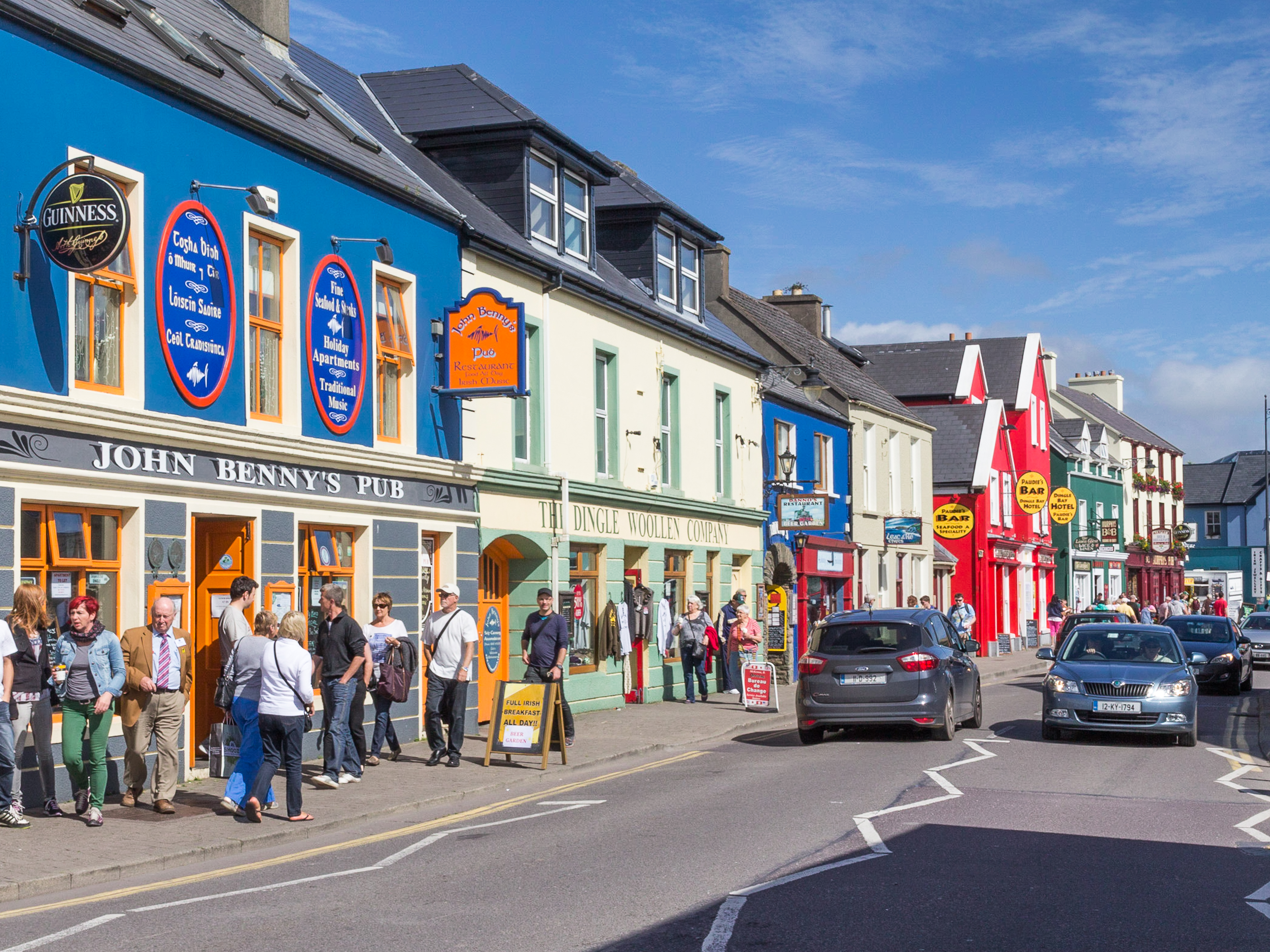
Why Dingle is Perfect for Your Celebration
- Dramatic Atlantic coastal scenery — cliffs, sandy beaches, and mountain backdrops — provides naturally stunning ceremony settings
- Authentic Gaeltacht (Irish-speaking) culture and traditional music sessions give celebrations a genuinely unique local character
- Small, intimate scale of the town suits elopements and micro-weddings where privacy and exclusivity matter
- Summer months (May–September) offer Ireland's longest daylight hours, with golden evening light lasting past 9 pm
- Locally rooted hospitality — family-run hotels, artisan food producers, and traditional pubs — creates a warm, personal event atmosphere
- The Dingle Peninsula's Wild Atlantic Way scenery provides exceptional photography backdrops unavailable in any urban venue

Compare Dingle with Other Top Destinations
Frequently Asked Questions
Is Dingle a good destination for a small wedding?
Yes. Dingle is particularly well-suited to intimate weddings, typically up to around 150 guests. The combination of dramatic Atlantic coastal scenery, a warm local hospitality culture, and a genuine Irish-speaking heritage gives small weddings here a distinctive, personal character that larger resort destinations rarely match. It is one of Ireland's most established small-wedding destinations.
What is the best time of year to hold a wedding or celebration in Dingle?
May through September is the clear best window. This period offers Ireland's longest daylight hours — up to 17 hours in June — the most stable Atlantic weather, and full availability of local vendors and hospitality businesses. July and August are peak months; May, June, and September offer slightly quieter conditions with generally good weather. October through April brings frequent storms, heavy rain, and very short days.
How do guests typically get to Dingle for a destination event?
Most guests arrive via Kerry Airport (approximately 50 km away) or Cork Airport (approximately 150 km away), then travel onward by road. There is no railway station in Dingle — the nearest rail connection is at Tralee, about 50 km away. A private car or pre-arranged group transfer is essential for every guest. Event planners should coordinate group transport as a standard part of logistics, not an optional extra.
How far in advance should we book vendors and venues for a summer celebration in Dingle?
Ideally 12 to 18 months ahead for July and August dates. Dingle's local vendor pool — photographers, musicians, caterers, florists — is small relative to summer demand, and popular dates fill quickly. Leaving planning to six months or less before a peak summer date significantly reduces the available options across all supplier categories.
What kinds of ceremony and reception spaces are available in Dingle?
The venue offer includes harbour-front hotel function rooms, exclusive-use heritage guesthouses, and outdoor coastal settings across the peninsula — cliff-top locations, beach settings, and farmland with mountain backdrops. There are no large purpose-built banquet halls or convention centres. The character of available spaces is consistently intimate and rooted in the local landscape and built environment.
Can we hold an outdoor ceremony in Dingle?
Yes, outdoor ceremonies are possible and can be visually spectacular, particularly on the Dingle Peninsula's clifftops and beaches. However, Ireland's Atlantic climate means a credible indoor contingency plan is always essential, even in summer. Experienced local planners and venues will expect this as standard and can advise on the most practical backup arrangements for your chosen outdoor location.
Is there enough accommodation in Dingle for a larger guest group?
For groups up to around 80–100 guests, accommodation within the town itself is generally manageable across a combination of properties. Larger groups will need to spread across nearby villages and towns on the peninsula, which requires coordinated transport planning. Early booking — well ahead of the summer season — is essential, as total accommodation capacity in the immediate area is genuinely limited.
What makes Dingle's local food and music offer distinctive for a celebration?
Dingle has a disproportionately strong artisan food scene for its size — locally caught Atlantic seafood, Kerry lamb, and craft spirits from the local distillery are genuine regional specialities, not generic catering. Traditional Irish music is a living part of daily life here, not a tourist performance, and professional traditional musicians are readily available for event bookings, giving celebrations an authentic cultural dimension.
Is Dingle suitable for an elopement or micro-wedding?
Yes — it is among Ireland's strongest options for elopements and micro-weddings. The combination of extraordinary natural settings, a town that does not feel overwhelmed by wedding tourism, exclusive-use guesthouse options, and a genuinely intimate atmosphere makes it particularly well-suited to couples wanting a small, intentional ceremony with just a handful of witnesses.
How safe is Dingle for international guests attending a destination event?
Very safe. Dingle is a low-crime, welcoming community with a long history of international tourism. International guests — including those unfamiliar with Ireland — can move around the town and peninsula comfortably. The main practical consideration for international guests is travel logistics rather than safety: the remote location requires careful transport planning, particularly for those arriving without a hire car.
What local transport options are available for moving guests around during an event?
Public transport on the Dingle Peninsula is very limited and not suitable for coordinating event guest movements. Pre-booked private minibuses and coaches are the standard solution for moving groups between accommodation, ceremony venues, and reception spaces. Local taxi availability is limited, particularly for simultaneous large-group movements, so dedicated transport arrangements should be built into the event plan from the outset.

Ready to explore venues in Dingle?
Dingle: Destination Wedding & Intimate Event Venues on Ireland's Wild Atlantic Way
◆Dingle is a small harbour town on the Dingle Peninsula in County Kerry, Ireland, and one of the country's most distinctive destinations for intimate weddings, elopements, and private celebrations. Its primary vibe is peaceful and secluded — dramatic Atlantic coastline, mountain scenery, and a genuine Irish-speaking (Gaeltacht) cultural identity set it apart from generic resort destinations. It suits small to medium guest groups best; the local venue inventory is not designed for large-scale events. Summer (May through September) is the clear window for outdoor celebrations, offering the longest daylight hours and the most stable weather Ireland can offer. Accessibility requires planning — guests typically arrive by road from Kerry or Cork airports — but that same remoteness is precisely what makes Dingle feel exclusive.
Dingle at a Glance
| Category | Detail |
|---|---|
| Best For | Intimate Weddings, Elopements, Anniversary Celebrations, Small Private Parties |
| Primary Vibe | Peaceful & Secluded |
| Other Vibes | Coastal, Heritage, Romantic, Authentic |
| Best Season | Summer (May, Jun, Jul, Aug, Sep) |
Why Choose Dingle?
- Unmatched natural scenery: The Dingle Peninsula offers some of Ireland's most photographed landscapes — Slea Head cliffs, Inch Beach, Brandon Mountain, and the harbour itself — providing ceremony and photography backdrops that no purpose-built venue can replicate.
- Genuine cultural identity: Dingle sits within the Kerry Gaeltacht, Ireland's largest Irish-speaking region. Traditional music sessions, local storytelling, and a living folk culture give celebrations here an authenticity that is genuinely rare among Irish event destinations.
- Intimate scale by design: The town's small size is a feature, not a limitation. Couples and planners who want exclusivity, privacy, and a celebration that feels personal rather than transactional will find Dingle naturally suited to that ambition.
- Long summer evenings: At this latitude, summer daylight extends well past 9 pm, giving outdoor ceremonies and receptions a golden-hour quality that lasts for hours — a significant practical and aesthetic advantage for photography and outdoor dining.
- Locally rooted hospitality: Dingle's accommodation and food scene is dominated by independent, family-run businesses with deep local knowledge. Artisan food producers, local seafood, and craft beverages are genuinely embedded in the hospitality offer here, not imported for show.
- Wild Atlantic Way access: The town sits on Ireland's flagship coastal touring route, meaning guests who arrive early or stay on after an event have a ready-made, world-class scenic experience on their doorstep — a meaningful bonus for destination guests travelling from abroad.
Which Celebrations Work Best in Dingle?
- Intimate Weddings (up to ~150 guests): Dingle's venue inventory and overall character are best matched to smaller weddings. The harbour setting, coastal ceremony options, and warm local hospitality create a wedding atmosphere that feels genuinely personal rather than produced. Couples seeking a dramatic natural backdrop without a large-scale resort feel will find this particularly well-suited.
- Elopements & Micro-Weddings: For couples wanting a ceremony with just a handful of witnesses, Dingle is among Ireland's strongest options. The combination of legal ceremony venues, extraordinary natural settings, and a town that does not feel overwhelmed by wedding tourism makes it ideal for very small, intentional celebrations.
- Anniversary & Milestone Celebrations: The peaceful, secluded character of the peninsula makes it well-suited to private milestone gatherings — a significant anniversary, a landmark birthday, or a family reunion — where the experience of the place itself is as important as the event programme.
- Small Corporate Retreats & Private Parties: Groups seeking a genuinely off-the-beaten-path retreat with strong local character — traditional music evenings, coastal walks, local food experiences — will find Dingle a credible and memorable choice, provided group size is modest and logistics are planned carefully in advance.
Venues & Event Spaces
Dingle's event venue landscape is characterised by harbour-front hotels with dedicated function rooms, intimate guesthouse properties suited to exclusive-use bookings, and outdoor coastal settings that can be used for ceremonies with appropriate permissions and weather contingency planning. The town does not have large purpose-built banquet halls or convention-style event centres — the venue offer is deliberately small-scale and rooted in the local built environment.
Harbour-view function rooms are the most common indoor setting, typically accommodating seated dinners for between 50 and 200 guests depending on the property. Exclusive-use bookings of smaller heritage guesthouses are increasingly popular for micro-weddings and elopement packages, where a couple and their guests take over an entire property for one or more nights. Outdoor ceremony spaces — cliff-top locations, beach settings, and farmland with mountain views — are available across the peninsula, though all outdoor plans require robust weather contingency arrangements given Ireland's Atlantic climate. Traditional pub venues in the town centre are well-suited to informal post-ceremony gatherings and céilí-style evening receptions with live traditional music.
Best Time to Celebrate
The curated best season for Dingle is Summer: May, June, July, August, and September. This window is the clear choice for several concrete reasons beyond simply "better weather."
- Daylight: June and July in particular offer daylight from approximately 5 am to 10 pm, giving outdoor ceremonies and receptions an extraordinary amount of usable natural light. Evening receptions on a harbour terrace or clifftop in late July, with the sun setting over the Atlantic, are among the most visually dramatic experiences available at any Irish event destination.
- Business availability: Many of Dingle's independent restaurants, activity providers, and specialist vendors operate seasonally, with reduced hours or full closure from October through April. Planning a celebration in summer ensures the full local ecosystem — catering, music, transport, floristry — is available and operating at capacity.
- Reduced storm risk: While no Irish weather is guaranteed, the Atlantic storm frequency that characterises the peninsula from October through March drops significantly in summer. May and September are shoulder months with generally acceptable conditions but a higher chance of unsettled spells than July and August.
- October through April brings frequent Atlantic low-pressure systems, strong winds, heavy rainfall, and very short days (as few as 8 hours of daylight in December). Outdoor events are not realistically viable, and the reduced local hospitality capacity makes large group logistics significantly harder to manage.
Getting There & Local Connectivity
Dingle is a genuinely remote destination by Irish standards, and guest travel logistics require more advance planning than most Irish event locations. The nearest commercial airport is Kerry Airport, roughly 50 km from the town centre by road — a journey of approximately one hour depending on conditions. Cork Airport, a larger hub with more international connections, is approximately 150 km away and represents a two-hour drive. Dublin Airport, Ireland's primary international gateway, is approximately 320 km away — a journey of three to four hours by road, or a combination of flight to Kerry and onward road transfer.
There is no railway station in Dingle. The nearest rail connection is at Tralee, approximately 50 km away, which is served by trains from Dublin Heuston and Cork. From Tralee, guests must continue by road — either by private car, taxi, or pre-arranged group transfer. For destination wedding groups arriving from overseas, the most practical approach is typically a coordinated group transfer from Kerry Airport or a self-drive arrangement from a larger hub.
Within the Dingle Peninsula itself, private car or pre-booked minibus transfers are the only realistic option for moving groups between accommodation, ceremony venues, and reception spaces. Public transport on the peninsula is very limited. Event planners should budget for and arrange dedicated local transport as a standard part of the event logistics, not an afterthought.
Local Vendor & Hospitality Ecosystem
Dingle's vendor ecosystem is small but genuinely experienced in the specific demands of destination weddings and intimate celebrations. The town has a well-established reputation as a wedding destination within Ireland, and local suppliers — photographers, florists, musicians, and caterers — are accustomed to working with couples and planners who are not based locally and who are coordinating events remotely.
The food and beverage offer is a particular strength. Dingle has a disproportionately strong restaurant and artisan food scene for a town of its size, with locally caught seafood, Kerry lamb, and craft beverages (including the well-known Dingle Distillery's whiskey and gin) available as genuine local elements of a celebration menu rather than generic catering. Traditional Irish music is deeply embedded in the local culture — live sessions in local pubs are a nightly occurrence in summer — and professional traditional musicians are readily available for event bookings.
The limitation of the ecosystem is scale. Vendors who can service a 300-person wedding with the same ease as a 60-person celebration are not typically found here. For larger events, some specialist suppliers may need to be brought in from Tralee, Killarney, or Cork, which adds logistical complexity and lead time. Early engagement with local vendors — ideally 12 to 18 months ahead for summer dates — is strongly advisable given the limited supply of experienced local professionals relative to summer demand.
Pros & Things to Consider
Why Dingle Works Well
- Extraordinary natural scenery that functions as a built-in event backdrop — cliffs, beaches, harbour, and mountain views within minutes of the town centre
- Authentic Irish cultural identity — traditional music, Gaeltacht heritage, and local food — gives celebrations a genuinely distinctive character
- Small scale creates natural exclusivity; a group booking a harbour-front hotel or exclusive-use guesthouse effectively has the venue to themselves
- Long summer daylight hours (up to 17 hours in June) are a significant practical advantage for outdoor ceremonies and evening receptions
- Very safe, low-crime environment; guests — including international visitors unfamiliar with Ireland — can move around the town and peninsula comfortably
- The remoteness that makes logistics harder also means the destination feels genuinely special to guests, particularly those travelling from abroad
Things to Consider
- Guest travel requires significant planning — there is no direct rail access, the nearest airport has limited routes, and a car or transfer is essential for every guest
- Venue capacity is limited; groups larger than approximately 150–200 guests will find the local inventory genuinely stretched, and the overall character of the destination does not suit large-scale events
- Irish Atlantic weather is unpredictable even in summer — outdoor ceremonies and receptions always require a credible indoor contingency plan
- The local vendor pool is small; popular dates in July and August book out well in advance, and late-stage planning significantly reduces options
- Accommodation capacity in the town itself is limited; larger guest groups will need to spread across multiple properties or consider nearby towns, which adds coordination complexity
When Dingle May Not Be the Right Fit
- Large guest lists (200+): If your celebration requires a single venue accommodating a large seated dinner or a full-scale production event, Dingle's existing venue inventory will not comfortably support it. A destination with larger resort infrastructure would serve that need better.
- Guests with limited travel flexibility: If a significant portion of your guest list cannot drive, has mobility constraints that make multi-transfer journeys difficult, or is travelling from locations with no convenient connection to Kerry or Cork airports, the logistical burden of reaching Dingle may be genuinely prohibitive for some attendees.
- Autumn or winter celebrations: If your preferred dates fall between October and April, Dingle's Atlantic climate, reduced vendor availability, and very short daylight hours make it a poor match for outdoor or semi-outdoor events. An indoor-focused venue in a more accessible Irish city would be a more practical choice.
- Couples or planners seeking a fully managed, large-resort experience: Dingle's hospitality ecosystem is rooted in independent, smaller-scale businesses. Those expecting the seamless, single-point-of-contact event management infrastructure of a large international resort brand will find the local offer requires more active coordination from the planner's side.