
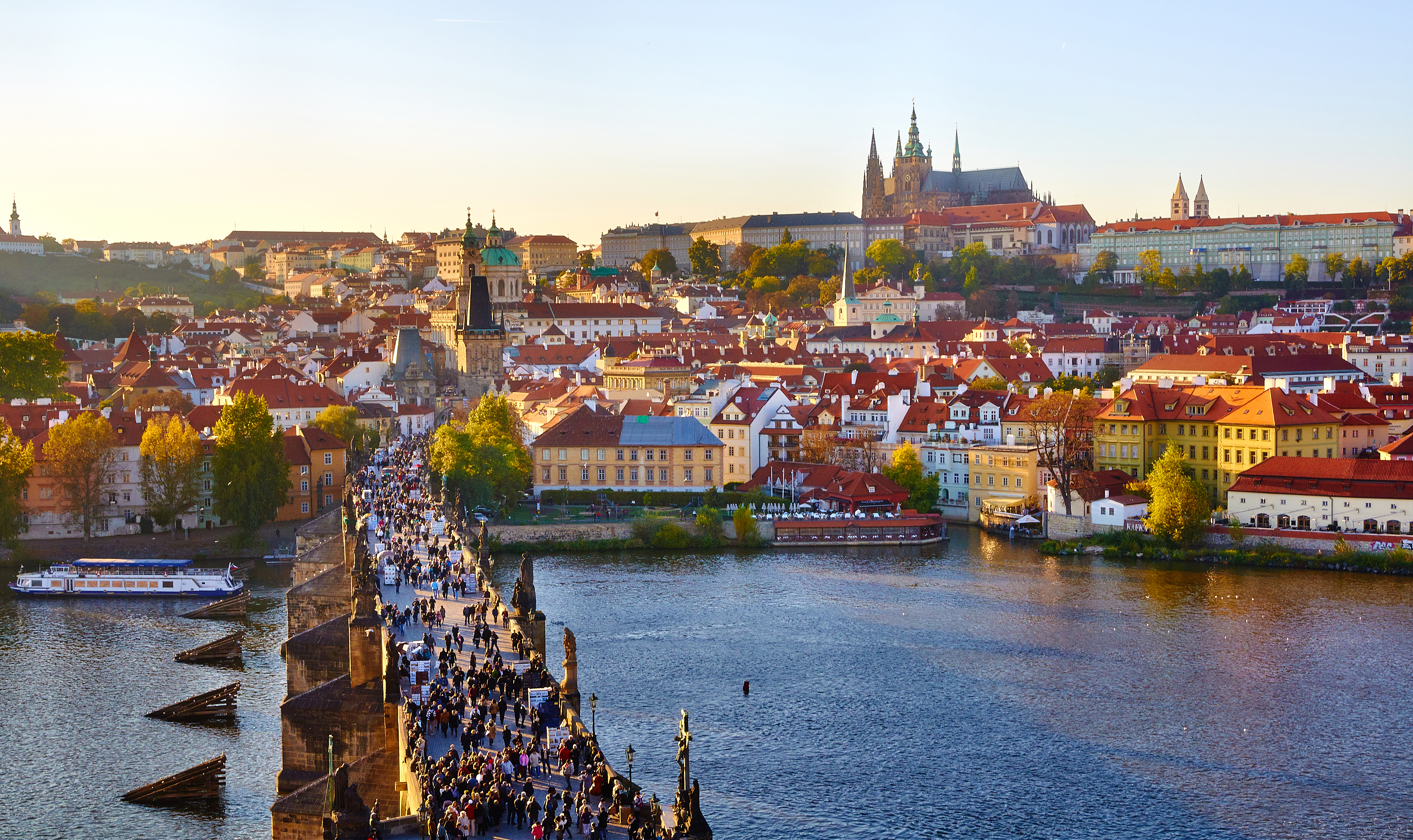
Why Prague is Perfect for Your Celebration
- UNESCO-listed historic centre provides unmatched architectural backdrops — Gothic, Baroque and Art Nouveau all within walking distance
- Prague Castle complex offers one of Europe's most iconic event settings, with grand halls and panoramic city views
- Charles Bridge and the Vltava River create naturally cinematic settings for ceremonies and photography
- Warm, long-daylight summers (May–Sep) allow full use of outdoor terraces, castle courtyards and riverside lawns
- Mature international hospitality industry with experienced multilingual wedding and event planners
- Excellent direct flight connections from across Europe, the Middle East, North America and Asia make guest travel straightforward

Compare Prague with Other Top Destinations
Frequently Asked Questions
Is Prague a good destination for a wedding?
Yes. Prague is particularly well-suited to destination weddings for couples seeking a European heritage setting. Its UNESCO-listed historic centre, castle halls, riverside terraces, and Baroque courtyards provide a naturally dramatic backdrop. The city has a mature wedding planning industry with multilingual vendors experienced in international briefs, making the logistics of organising from abroad more manageable than in less-established destinations.
What is the best time of year to hold a wedding or event in Prague?
May through September is the recommended window. This period offers warm daytime temperatures, long daylight hours — particularly valuable for outdoor ceremonies and evening receptions — and the most reliable conditions for using Prague's outdoor venues, terraces, and castle courtyards. May and September are especially pleasant, with comfortable temperatures and slightly fewer tourists than peak July–August.
How do guests typically travel to Prague for a destination event?
Most international guests fly into Václav Havel Airport Prague, which has direct connections to most major European cities and links to North America, the Middle East, and Asia. Guests from neighbouring Central European countries often travel by rail, as Prague's main station has direct international services to Vienna, Berlin, and Budapest. The airport is approximately 17 km from the city centre, with taxis and private transfers widely available.
What kinds of venues are available for events in Prague?
Prague offers a genuinely diverse range: grand hotel ballrooms at international luxury properties, historic palace and monastery halls, Baroque courtyard spaces, riverside terraces, rooftop venues with city skyline views, and intimate boutique hotel gardens. The city suits both large-scale corporate events and smaller, more intimate wedding ceremonies, with venue character ranging from medieval Gothic to Art Nouveau.
How large a guest group can Prague realistically accommodate for a single event?
For a single-venue event, most of Prague's characterful heritage spaces comfortably accommodate 100–400 guests. Larger hotel ballrooms and congress facilities can handle several hundred to over a thousand for corporate formats. For very large wedding guest lists of 600 or more expecting a single atmospheric heritage space, the local inventory may require creative solutions or a split across multiple venues.
Is Prague suitable for corporate events and conferences, not just weddings?
Yes. Prague is an established MICE destination with purpose-built congress facilities, large hotel ballrooms, and historic venues available for gala dinners and product launches. Its central European location makes it a practical meeting point for pan-European teams, and the city's hospitality infrastructure — AV, catering, event staffing — is well-developed for professional events of varying scales.
What is it like to move a large guest group around Prague during an event?
Generally straightforward. The historic centre is compact, and many guests staying in Old Town or Lesser Town hotels can walk between accommodation and event venues. For transfers between the airport, hotels, and venues, private minibus and coach hire is widely available and routinely coordinated by local event planners. Prague's public metro and tram network is also efficient for guests exploring independently.
How experienced are Prague's local vendors with international destination weddings?
Quite experienced. Prague has hosted international weddings and corporate events for decades. Local planners, caterers, florists, photographers, and AV suppliers are accustomed to working with non-Czech-speaking clients, and many operate primarily in English. For South Asian or Indian wedding programmes specifically, demand has grown in recent years, though couples should verify cultural-specific expertise directly with any vendor they consider.
Is Prague safe for international guests attending a wedding or event?
Yes. Prague is consistently rated among Europe's safer capital cities. Violent crime is rare, the city is well-policed, and the hospitality sector is experienced with international visitors. Standard urban precautions apply in busy tourist areas, but the overall environment is comfortable and reassuring for guests travelling from a wide range of countries.
Can Prague accommodate multi-day wedding programmes across different venues?
Yes, and this is one of Prague's genuine strengths. The compact historic centre means that different venues — a courtyard for a pre-wedding dinner, a castle hall for the ceremony, a riverside terrace for the reception — can all be used across a multi-day programme without requiring long transfers. Local event planners are experienced in designing and coordinating multi-venue, multi-day itineraries for international groups.
What language and currency considerations should event planners be aware of?
Czech is the official language, but English is widely spoken across Prague's hospitality and event sector, so communication is rarely a barrier for international planners or guests. The local currency is the Czech Koruna (CZK); while many hotels and larger venues accept major international cards, planners should note that not all vendors accept euros directly, so currency exchange planning is advisable for guests and suppliers alike.

Ready to explore venues in Prague?
Prague: Destination Wedding & Corporate Event Venues in the Czech Republic
◆Prague is one of Europe's most compelling destinations for weddings, corporate events, and milestone celebrations. Its UNESCO-listed historic centre delivers a rare combination of Gothic, Baroque, and Art Nouveau architecture within a compact, walkable city — making it genuinely practical as well as visually extraordinary. The destination suits intimate ceremonies and large-scale corporate gatherings alike, with a mature international hospitality industry, strong multilingual vendor networks, and excellent direct air connectivity from across Europe, the Middle East, and beyond. Summer (May through September) is the clear peak season for outdoor events, offering long daylight hours and reliably warm temperatures. Prague sits in a mid-to-upper cost bracket for a European capital, though it generally remains more accessible than Paris or London for comparable quality.
Prague at a Glance
| Category | Detail |
|---|---|
| Best For | Destination Weddings, Corporate Events, Pre-Wedding Celebrations, Social Galas |
| Primary Vibe | Cultural & Timeless |
| Other Vibes | Romantic, Historic, Grand, Cosmopolitan |
| Best Season | Summer (May, Jun, Jul, Aug, Sep) |
Why Choose Prague?
- Unrivalled architectural backdrop: Prague's historic centre — spires, cobbled lanes, Baroque palaces, and the iconic Charles Bridge — provides a naturally cinematic setting that requires minimal additional decoration to feel extraordinary.
- Prague Castle as an event anchor: The castle complex, one of the largest ancient castle complexes in the world, offers grand ceremonial halls and panoramic city views that are genuinely difficult to replicate elsewhere in Europe.
- Vltava River settings: Riverside terraces, boat receptions, and waterfront hotel venues along the Vltava add a distinctive, romantic dimension to events that few European capitals can match so centrally.
- Mature, multilingual event industry: Prague has hosted international weddings and corporate events for decades; local planners, caterers, florists, and AV suppliers are experienced with non-Czech-speaking clients and international logistics.
- Excellent international connectivity: Václav Havel Airport Prague operates direct routes to most major European cities and has connections to North America, the Middle East, and Asia, making guest travel straightforward from a wide range of origins.
- Compact city geography: The main event districts — Old Town, Lesser Town, and New Town — are all within easy walking or short taxi distance of each other, simplifying group logistics for guests staying across multiple hotels.
Which Celebrations Work Best in Prague?
- Destination Weddings: Prague is particularly well-suited to couples seeking a European fairy-tale setting. The combination of castle halls, riverside terraces, historic palace courtyards, and boutique hotel gardens creates a wide range of ceremony and reception environments. The city's photogenic streets also make it a natural choice for couples who prioritise visual storytelling across their wedding weekend.
- Corporate Events & Conferences: Prague is an established MICE (Meetings, Incentives, Conferences, Exhibitions) destination with large-capacity hotel ballrooms, purpose-built congress centres, and historic venues that can be hired for gala dinners and product launches. Its central European location makes it a logical meeting point for pan-European teams.
- Pre-Wedding Celebrations (Mehendi, Sangeet, Rehearsal Dinners): The city's variety of intimate courtyard spaces, wine cellars, and rooftop terraces makes it well-suited to multi-day celebration programmes, where different venues can be used for each event within a short radius.
- Social Galas & Milestone Celebrations: Landmark birthdays, anniversaries, and private galas benefit from Prague's heritage venue inventory — vaulted Gothic halls and Baroque salons lend a sense of occasion that is hard to manufacture in a modern ballroom.
Venues & Event Spaces
Prague's event venue landscape is genuinely diverse. At the top end, international luxury hotel brands operate grand ballrooms and riverside terraces capable of hosting several hundred guests in a single space. Heritage properties — including converted monasteries, Baroque palaces, and Art Nouveau civic buildings — offer atmospheric alternatives to conventional hotel ballrooms, with vaulted ceilings, frescoed walls, and historic courtyards that serve as natural focal points for ceremonies and receptions.
Outdoor event spaces are a particular strength during the summer season. Castle courtyards, riverside lawns, and rooftop terraces with panoramic views of the city's skyline are all available for hire. For smaller, more intimate gatherings, Prague's stock of boutique hotels and historic townhouses provides private dining rooms, wine cellars, and garden terraces that suit groups of 20 to 80 guests very well.
For large-scale corporate events and conferences, the city has purpose-built congress facilities alongside hotel ballrooms that can accommodate audiences of several hundred to over a thousand. The combination of historic character and modern technical infrastructure — reliable AV, high-speed connectivity, professional event staffing — is a genuine differentiator for Prague compared with smaller European heritage cities that may have the aesthetics but lack the operational capacity.
Best Time to Celebrate
The curated best season for Prague events is Summer: May through September. This window offers the most reliable conditions for outdoor ceremonies and receptions, with average daytime temperatures typically ranging from the mid-teens in May to the mid-to-upper twenties Celsius in July and August. Daylight hours are long — Prague in June sees sunset well after 9 pm — which extends the usable window for outdoor photography, garden receptions, and riverside dinners considerably.
May and September are particularly attractive shoulder months within this window: temperatures are comfortable rather than hot, tourist crowds are somewhat lighter than peak July–August, and outdoor venues remain fully usable. June through August is the warmest and most reliably sunny stretch, though it is also the busiest period for tourism generally, which can affect venue availability and accommodation rates.
Outside this window, the picture changes significantly. October sees temperatures drop quickly and daylight hours shorten, making outdoor events increasingly risky from mid-month onward. November through February brings cold, grey conditions with sub-zero nights common in January and February — outdoor ceremonies are generally not viable, and the city's famous atmospheric mist, while photogenic, comes with genuine logistical challenges for guests. March and April can be pleasant on good days but are characterised by unpredictable cold snaps and rain; outdoor events in this period carry meaningful weather risk. For planners committed to an outdoor or semi-outdoor event, the May–September window is the only genuinely reliable choice.
Getting There & Local Connectivity
Prague is served by Václav Havel Airport Prague (PRG), located approximately 17 km from the city centre. The airport operates direct routes to most major European cities, as well as connections to North America, the Middle East, and several Asian hubs, making it one of Central Europe's better-connected international airports. For guests travelling from within Europe, flight times are typically under three hours from most western and northern European capitals.
Rail connectivity is also strong. Praha Hlavní Nádraží (Prague Main Station), centrally located, provides direct international rail connections to Vienna, Berlin, Budapest, and other major Central European cities, as well as a dense domestic network. For guests travelling from neighbouring countries, the train is often a practical and comfortable alternative to flying.
Within the city, Prague's public transport network — metro, tram, and bus — is efficient, well-maintained, and easy to navigate for international visitors. For event groups, private minibus and coach transfers between hotels, venues, and the airport are widely available and routinely arranged by local event coordinators. The compact geography of the historic centre means that many guests staying in Old Town or Lesser Town hotels can walk between their accommodation and event venues, which simplifies logistics considerably for multi-day programmes.
Local Vendor & Hospitality Ecosystem
Prague has a well-developed event vendor ecosystem built over decades of hosting international weddings, corporate events, and diplomatic functions. Local wedding planners and event management companies are experienced in working with non-Czech clients, and many operate primarily in English, German, or French. Catering standards at the upper end of the market are genuinely high, with access to both Czech culinary traditions and international cuisine; kosher, halal, and other dietary-specific catering can be arranged through specialist suppliers, though advance planning is advisable.
Floral design, photography, videography, live music, and entertainment vendors are plentiful and experienced with international briefs. The city's art and design community also means that bespoke décor, lighting design, and creative production are available at a level of sophistication that matches the venue quality. For South Asian or Indian destination weddings specifically, Prague has seen growing demand in recent years, and a small but growing number of local planners have experience coordinating multi-day Indian wedding programmes, though couples should verify specific cultural expertise with any vendor they engage.
Hotel hospitality standards at the international brand properties are consistent with global expectations. English is widely spoken across the hospitality sector, and front-of-house staff at major hotels are accustomed to managing large international guest groups with varied needs.
Pros & Things to Consider
Why Prague Works Well
- Extraordinary architectural variety — Gothic, Baroque, Art Nouveau — within a compact, walkable area
- Strong international air connectivity makes guest travel manageable from most global origins
- Long summer daylight hours maximise outdoor event time during the best season
- Mature, multilingual event industry with experienced planners, caterers, and creative vendors
- Diverse venue inventory spanning intimate boutique spaces to large hotel ballrooms and historic palace halls
- Very safe city with reliable infrastructure, good public transport, and high hospitality standards
Things to Consider
- Peak summer months (July–August) coincide with high general tourism, which can affect venue availability, accommodation rates, and the general busyness of the historic centre
- The Czech Koruna (CZK) is the local currency — guests and planners from eurozone countries will need to account for currency exchange, as not all vendors accept euros directly
- Outdoor events outside the May–September window carry real weather risk; Prague's winters are genuinely cold and grey, not merely "cool"
- Cobblestone streets throughout the historic centre, while beautiful, can be challenging for guests with mobility limitations or for moving large quantities of event equipment
- Prague is not a beach or resort destination — couples or planners seeking a poolside, tropical, or coastal atmosphere will find the city's offering fundamentally different in character
When Prague May Not Be the Right Fit
- Outdoor-focused events planned outside May–September: If a couple or planner is committed to an outdoor ceremony or garden reception and cannot schedule within the summer window, Prague's autumn and winter climate makes this a genuinely risky choice.
- Very large guest lists requiring a single venue: While Prague has large hotel ballrooms and congress facilities, couples expecting to seat 800–1,500+ guests in a single heritage or characterful space may find the local inventory limiting compared with purpose-built resort destinations.
- Guests with significant mobility challenges: The historic centre's cobblestone streets and multi-level heritage venues can present real accessibility difficulties; planners with guests who have significant mobility needs should verify venue accessibility carefully before committing.
- Guests travelling from regions with limited direct connectivity: While Prague's airport is well-connected for European travellers, guests originating from smaller cities in South Asia, Southeast Asia, or Latin America may face long connecting journeys; for a predominantly non-European guest list, a destination with broader long-haul direct routes may be more practical.