
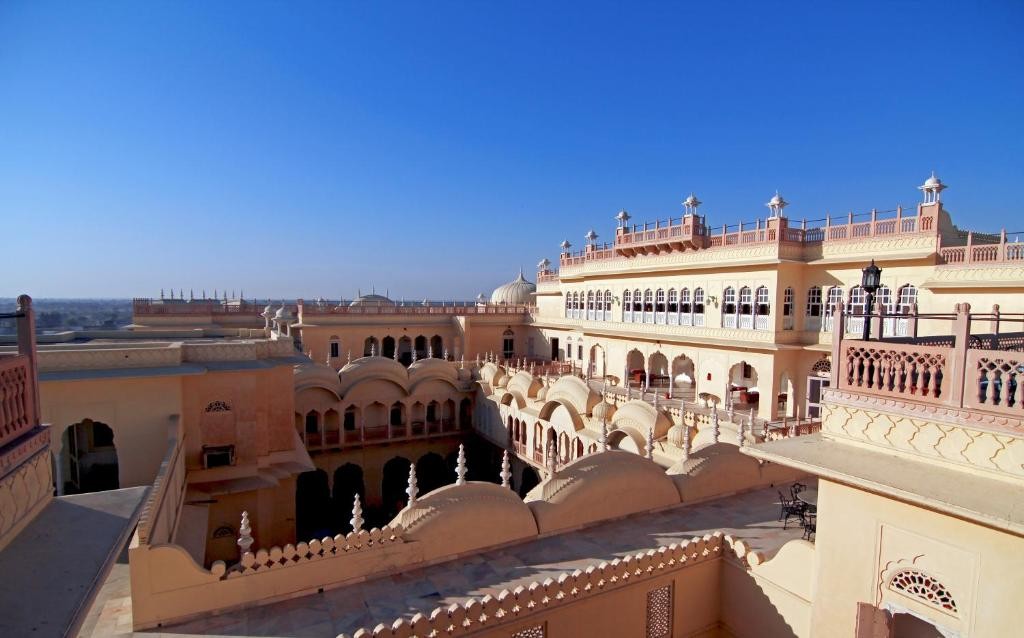
Why Alsisar is Perfect for Your Celebration
- Home to Alsisar Mahal, a genuine 19th-century palace offering exclusive buyout for weddings and private events
- Shekhawati region's painted havelis and desert landscape provide a naturally cinematic backdrop unique to this area
- Intimate scale of the town ensures privacy and exclusivity — ideal for closed, curated guest lists
- Strong cultural calendar including Teej, Gangaur, and local folk festivals that can be woven into event programming
- Cool, dry winter climate (November–February) is near-perfect for outdoor courtyard and lawn celebrations
- Relatively undiscovered compared to Jaipur or Udaipur, giving events a genuinely off-the-beaten-path royal character
Top Venues in Alsisar
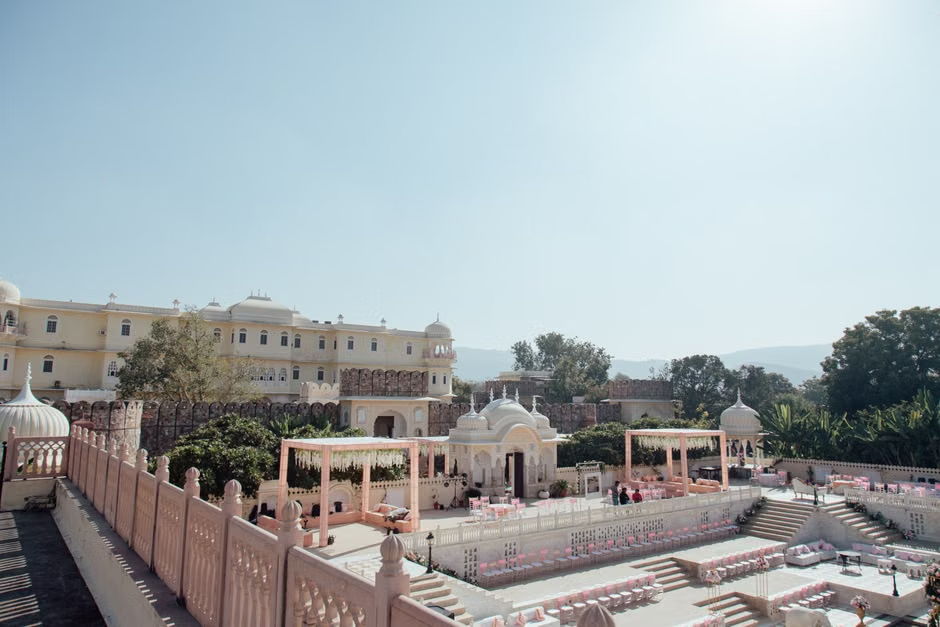
Alsisar Mahal
Compare Alsisar with Other Top Destinations
Frequently Asked Questions
Is Alsisar a good destination for a palace wedding?
Yes. Alsisar is particularly well-suited to palace weddings. The town's heritage palace can typically be taken on an exclusive basis, giving a wedding party full use of its courtyards, lawns, dining halls, and terraces across multiple days. The Shekhawati setting — with its frescoed architecture and desert landscape — provides a distinctive royal atmosphere that is genuinely difficult to replicate elsewhere in Rajasthan.
What is the best time of year to hold a wedding or event in Alsisar?
November through February is the strongly recommended window. The desert climate during these months is cool and dry, with comfortable daytime temperatures and clear, starlit evenings — ideal for outdoor ceremonies and receptions. The rest of the year is significantly less suitable: March–May brings rapidly rising heat, and June–September combines extreme temperatures with dust storms.
How do guests typically travel to Alsisar?
Most guests fly into Jaipur or Bikaner — the two nearest airports with regular commercial services — and then travel to Alsisar by road, a journey of roughly three to four hours from Jaipur. Alsisar has a small railway station, but train services are limited. For wedding groups, chartered coaches or coordinated car transfers from Jaipur or Bikaner are the most practical arrangement.
What guest-group sizes can Alsisar realistically accommodate?
Alsisar is best suited to intimate-to-medium guest lists, typically in the range of 80–300 guests. The palace property has a finite number of rooms, and larger groups will need overflow accommodation in nearby heritage guesthouses across the Shekhawati area. Groups significantly above 300 guests will require careful multi-property logistics planning and early booking.
Can Teej or Gangaur celebrations be incorporated into an event in Alsisar?
Yes, and this is one of Alsisar's genuine strengths. Both Teej and Gangaur are celebrated with authentic local participation in the Shekhawati region — processions, folk music, and traditional rituals. Event planners can work with the venue to weave these cultural elements into a wedding or private celebration's programme, creating an experience that is deeply rooted in the local heritage rather than staged for tourists.
What kinds of event spaces are available at a heritage palace in Alsisar?
A heritage palace in Alsisar typically offers a variety of spaces within a single estate: formal courtyards for ceremonies, open lawns for receptions and sundowners, ornate dining halls for seated dinners, and terrace areas for cocktail gatherings. This variety within one property makes it well-suited to multi-day wedding programmes where different functions benefit from distinct settings.
Are local folk performers and cultural entertainment available in Alsisar?
Yes. The Shekhawati region is one of Rajasthan's strongest areas for authentic folk performance — dhol players, kalbeliya dancers, fire artists, and traditional puppet shows are genuinely local to this area. Incorporating live folk entertainment into an event programme is straightforward and is one of the areas where Alsisar's vendor ecosystem is particularly strong.
Do I need to bring vendors in from outside Alsisar for a large event?
For standard requirements — catering, basic décor, folk entertainment, and logistics — the palace property's established local vendor network is generally sufficient. For more specialised needs such as high-end floral design, large-scale audio-visual production, or international-style catering, vendors will typically need to be sourced from Jaipur or Delhi and transported in. This is standard practice for Shekhawati destination events.
Is Alsisar suitable for a private party or corporate retreat, or is it mainly a wedding destination?
Alsisar works well for private parties and exclusive retreats, not just weddings. The palace buyout model — where a group has the entire property to themselves — is equally well-suited to milestone birthday celebrations, anniversary gatherings, and high-privacy corporate retreats. The intimate scale and attentive hospitality make it a strong choice for any event where exclusivity and a distinctive setting are priorities.
What is the internet and mobile connectivity like in Alsisar?
Connectivity in Alsisar is more limited than in larger Rajasthani cities. Mobile data and Wi-Fi are available but not always reliable. This is worth factoring into event planning — particularly for live-streaming ceremonies, digital check-ins, or vendor coordination that depends on consistent connectivity. It is advisable to discuss connectivity arrangements with the venue in advance and build in contingency plans.
Is Alsisar a good fit for a sundowner or outdoor evening event?
Yes, particularly during the winter months. The desert terrain around Alsisar produces dramatic, unobstructed sunsets, and the cool, dry evenings from November through February are well-suited to outdoor sundowner parties, terrace cocktail gatherings, and starlit dinners. This format — an outdoor evening event against a desert palace backdrop — is one of the most distinctive experiences the destination offers.

Ready to explore venues in Alsisar?
Alsisar: Palace & Heritage Wedding and Event Destination in Shekhawati
◆Alsisar is a small heritage town in Rajasthan's Shekhawati region, best known as a destination for palace weddings, intimate private celebrations, and cultural festival gatherings. Its primary draw is a genuine 19th-century palace that can be taken on an exclusive basis, making it one of the few destinations in North India where a small-to-medium guest group can feel they have an entire royal estate to themselves. The destination suits winter events (November–February) most strongly, when the desert climate is cool and dry. Accessibility requires advance planning — guests typically fly into Jaipur or Bikaner and travel onward by road — making Alsisar best suited to curated, committed guest lists rather than large, dispersed ones.
Alsisar at a Glance
| Attribute | Detail |
|---|---|
| Best For | Teej & Gangaur Celebration, Palace / Heritage Wedding, Private Party, Intimate Wedding |
| Primary Vibe | Royal & Heritage |
| Other Vibes | Desert Rustic, Cultural & Folk, Exclusive & Private |
| Best Season | Winter (November–February) |
Why Choose Alsisar?
- Genuine palace exclusivity: Unlike larger heritage cities where palace venues are shared with other guests or tourists, Alsisar's scale allows for a full estate buyout, giving wedding parties and private event groups a truly exclusive environment.
- Shekhawati's painted heritage: The Shekhawati region is renowned across India for its elaborately frescoed havelis and merchant mansions. This visual richness provides a naturally photogenic backdrop that requires no additional décor to feel extraordinary.
- Intimate scale suits curated guest lists: The town's compact character means that a group of 100–300 guests can feel immersed in the destination rather than lost in it — a quality that larger wedding cities cannot easily replicate.
- Living cultural calendar: Festivals such as Teej and Gangaur are celebrated with genuine local participation in Shekhawati, allowing event planners to incorporate authentic folk music, processions, and rituals into a celebration's programming.
- Relatively undiscovered: Alsisar has not yet reached the saturation levels of Jaipur or Jodhpur as a wedding destination, which typically translates to greater attention from venue staff and a more personalised hospitality experience.
- Desert landscape for sundowners and outdoor events: The flat, open desert terrain around the town is particularly well-suited to sundowner parties, outdoor receptions, and starlit dinners during the winter months.
Which Celebrations Work Best in Alsisar?
- Teej & Gangaur Celebration: These are among the most visually spectacular festivals in the Rajasthani calendar, and Shekhawati's towns celebrate them with processions, folk performances, and traditional rituals. Alsisar is an especially fitting venue for a celebration timed around these festivals, where the local cultural atmosphere becomes part of the event itself.
- Palace / Heritage Wedding: The destination's defining strength. A multi-day wedding hosted within a palace estate — with courtyards for ceremonies, lawns for receptions, and ornate interiors for dinners — is what Alsisar does most naturally and most memorably.
- Private Party: The exclusivity of a palace buyout makes Alsisar well-suited to high-privacy private gatherings — milestone birthdays, anniversary celebrations, or corporate retreats — where the setting itself is the statement.
- Intimate Wedding: For couples who want a deeply personal ceremony without the scale and logistics of a large destination wedding, Alsisar's compact venue inventory and attentive hospitality make it a strong choice for guest lists under 150.
- Sundowner / Sunset Party: The desert horizon around Alsisar produces dramatic, unobstructed sunsets. An outdoor sundowner on a palace terrace or lawn, with folk musicians and the Shekhawati skyline as backdrop, is a format that works exceptionally well here.
- Wedding Reception: The palace's formal dining and banquet spaces, combined with outdoor lawns, provide a versatile setting for a reception that can move between intimate indoor toasts and larger outdoor celebrations within the same estate.
Venues & Event Spaces
Alsisar's venue landscape is anchored by its heritage palace, which is the town's primary and most significant event property. The palace typically offers a range of spaces within a single estate: formal courtyard areas suited to ceremonies and pheras, open lawns for receptions and sundowners, ornate dining halls for seated dinners, and terrace spaces for cocktail gatherings. This variety within one property is a key advantage for multi-day wedding programmes, as different functions can be held in distinct settings without guests needing to travel between venues.
Beyond the palace itself, the broader Shekhawati region contains restored havelis and smaller heritage guesthouses that can serve as overflow accommodation or as secondary event spaces for more informal functions such as welcome dinners or morning-after brunches. Outdoor desert settings — open land around the town — are also used for bonfires, folk performance evenings, and informal gatherings, particularly during the cooler winter months. Event planners working in Alsisar typically design programmes that use the palace as the centrepiece and layer in these surrounding heritage and natural spaces for supporting functions.
Best Time to Celebrate
The curated best season for Alsisar is Winter (November–February), and this recommendation is well-grounded in the destination's desert climate. During these months, daytime temperatures are typically comfortable — ranging from the mid-teens to the mid-twenties Celsius — and evenings are cool and clear, making outdoor events genuinely pleasant. The dry air and low humidity mean that décor, floral arrangements, and outdoor setups hold up well. Starlit skies over the desert are a particular feature of winter nights in Shekhawati, adding a natural spectacle to evening events.
The Teej and Gangaur festivals, which fall in the monsoon and spring seasons respectively, are culturally significant — Gangaur in particular falls in March–April — and event planners who wish to incorporate these festivals into a celebration's theme should note that the festival timing does not always align with the most comfortable weather window. March can still be manageable, but April begins to warm quickly.
The rest of the year presents genuine challenges. March through May sees temperatures climb rapidly, often exceeding 40°C by April and reaching 45°C or above in May — conditions that make outdoor events impractical and uncomfortable even for guests who are accustomed to Rajasthan's climate. June through September brings the desert heat to its peak, along with occasional dust storms (andhi) that can disrupt outdoor setups; while Alsisar does not receive heavy monsoon rainfall in the way that wetter regions do, the combination of heat, dust, and unpredictable weather makes this period largely unsuitable for events. October is a transitional month — temperatures begin to ease but can still be warm enough to make outdoor evening events uncomfortable. November is generally when conditions become reliably pleasant, and the window through to late February is the destination's clear sweet spot.
Getting There & Local Connectivity
Alsisar is located in the Jhunjhunu district of Rajasthan's Shekhawati region. It does not have a major commercial airport, and guests travelling from outside Rajasthan will typically fly into either Jaipur or Bikaner — both of which are connected to major Indian cities — and then travel onward by road. The road journey from Jaipur takes approximately three to four hours depending on traffic and route, while Bikaner is somewhat closer. For guests arriving from Delhi, a direct road journey is also feasible, as Alsisar lies roughly within a day's drive of the capital via the Shekhawati highway corridor.
Alsisar does have a small railway station on the Sikar–Loharu line, which connects it to the broader Rajasthan rail network, but train services are limited and the station is not well-served by express trains from major cities. Most event planners arrange chartered coaches or coordinated car transfers from Jaipur or Bikaner for guest groups, which is the most practical approach for a wedding or large private party. Once guests are in Alsisar, the town's compact size means that movement between the palace, accommodation, and any secondary venues is straightforward and typically managed by the event property itself.
Mobile connectivity and internet access in Alsisar are more limited than in larger Rajasthani cities. This is worth factoring into event logistics — particularly for live-streaming ceremonies, digital check-ins, or vendor coordination that relies on reliable data connectivity. It is advisable to confirm connectivity arrangements with the venue well in advance and to have contingency plans for communication during the event.
Local Vendor & Hospitality Ecosystem
Alsisar's vendor ecosystem is smaller and more specialised than that of larger Rajasthani wedding destinations. The palace property itself typically has established relationships with trusted local and regional vendors — caterers, decorators, folk performers, and logistics providers — who are experienced in working within the specific constraints and opportunities of a heritage palace setting. For couples and event planners who are comfortable working within a venue-led vendor framework, this can actually simplify planning considerably.
For more specialised requirements — high-end floral designers, international-style catering, large-scale audio-visual production, or celebrity entertainment — vendors will generally need to be sourced from Jaipur or Delhi and brought in for the event. This is a standard practice for destination weddings in Shekhawati and is well-understood by experienced planners, but it does add a logistical layer that should be accounted for in the planning timeline.
Folk performers — dhol players, kalbeliya dancers, fire artists, and puppet shows — are genuinely local to the Shekhawati region and are among the most authentic and high-quality in Rajasthan. Incorporating local cultural performance into an event programme is one of the areas where Alsisar's vendor ecosystem is genuinely strong, and it is an element that distinguishes celebrations here from those held in more urbanised heritage destinations.
Accommodation for large guest groups requires advance planning. The palace property has a finite number of rooms, and overflow guests will need to be accommodated in nearby heritage guesthouses or in properties in the broader Shekhawati area. Coordinating this across multiple properties is manageable but requires early booking, particularly during the peak winter season when demand across Shekhawati rises.
Pros & Things to Consider
Why Alsisar Works Well
- Exclusive palace buyout creates a genuinely private, immersive event environment
- Shekhawati's fresco heritage and desert landscape provide a visually distinctive backdrop
- Authentic local folk culture — music, dance, festivals — integrates naturally into event programming
- Intimate scale suits small-to-medium guest lists seeking a personalised experience
- Cool, dry winter climate is well-suited to multi-day outdoor celebrations
- Less commercially saturated than larger Rajasthani wedding cities, resulting in more attentive service
Things to Consider
- No major commercial airport nearby — guests require a multi-hour road transfer from Jaipur or Bikaner, which adds travel time and coordination complexity
- Limited hotel inventory means large guest lists (300+) will need accommodation spread across multiple properties, requiring careful logistics management
- Specialist vendors (high-end floristry, large AV production, international catering) must be sourced from outside the region and transported in
- Internet and mobile connectivity is limited — not ideal for events with significant digital or live-streaming requirements
- The destination's appeal is strongly tied to its heritage character; couples or planners seeking a contemporary, urban-luxury aesthetic may find the options here less flexible
When Alsisar May Not Be the Right Fit
- Very large guest lists: If your event requires accommodation and venue space for 500 or more guests within a single property or compact area, Alsisar's current venue inventory is unlikely to comfortably support that scale without significant logistical compromise.
- Guests with limited travel flexibility: For a guest list that includes elderly guests, international travellers unfamiliar with India, or attendees who cannot manage a long road transfer from a major airport, the journey to Alsisar may present a genuine barrier to attendance.
- Events planned outside the winter window: If your preferred dates fall between April and September, Alsisar's extreme heat and dust conditions make it a poor choice for any event with significant outdoor components — which is central to the destination's appeal.
- Couples seeking a contemporary luxury aesthetic: Alsisar's strength is rooted in authentic heritage character. If the vision for an event is a sleek, modern luxury experience rather than a royal-heritage one, a different destination would be a more natural fit.