
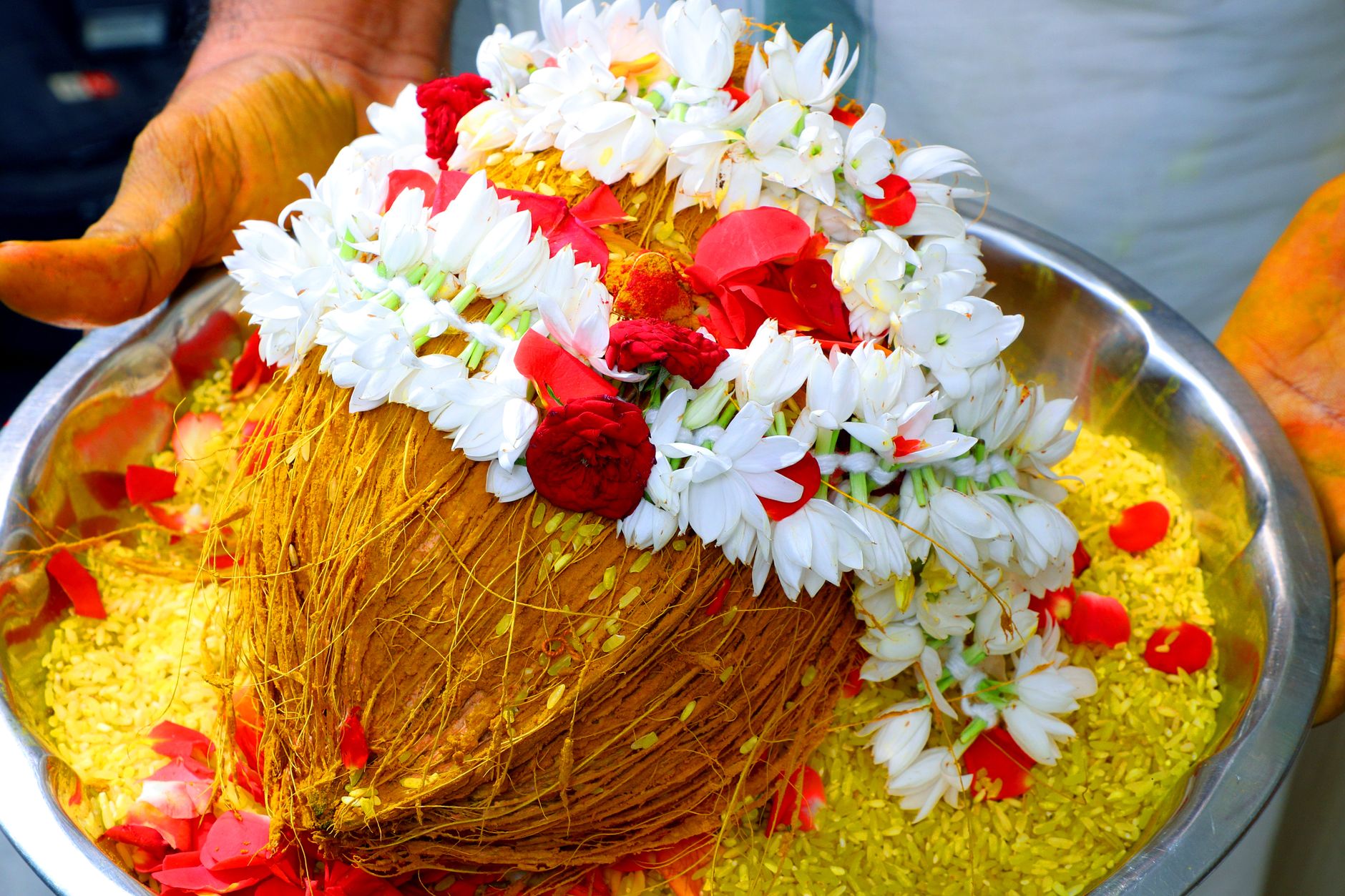
Telugu Coconut Rituals in Kolkata
Religious cermony in Kolkata
Traditional Telugu Coconut Ceremony Items: Complete Kolkata Guide
Planning a Telugu wedding or religious function in Kolkata means sourcing the right traditional Telugu coconut ceremony items — a task that feels straightforward until you realise how specific each ritual object must be. From the sacred whole coconut offered during the Sankalpam to the turmeric-coated ones used in Pellikuthuru rites, every item carries devotional and cultural weight. Families coordinating Telugu shaadi ceremony essentials from Kolkata's Burrabazar or Lake Market often discover that South Indian wedding rituals in Kolkata require advance planning, especially when sourcing items like mango leaves, betel nuts, and specific copper vessels that local Bengali markets may stock inconsistently.
Quick Answer
Traditional Telugu Coconut Ceremony Items include whole auspicious coconuts, turmeric-smeared coconuts, dry coconuts (kobbari), coconut-leaf garlands, and coconuts placed in kalasam (ritual pot) arrangements. Used across rites like Naandi, Pellikuthuru, Mangalasnanam, and Saptapadi, these items symbolise fertility, purity, and divine blessings. In Kolkata, they are sourced from South Indian grocery stores in Bhowanipore, New Market wholesale sections, and online pooja samagri suppliers delivering across the city.
What Are Traditional Telugu Coconut Ceremony Items and Why Do They Matter?
Traditional Telugu coconut ceremony items form the ritual backbone of virtually every Telugu Hindu life event — from baby showers (Seemantham) to weddings and thread ceremonies (Upanayanam). The coconut in Telugu culture represents the trimurtis: the outer shell is Brahma, the husk is Vishnu, and the inner kernel is Shiva. Offering a whole coconut without cracks or blemishes is therefore not a casual choice — it is a theologically precise act. Key items in this category include: the poorna phalam (complete whole coconut), kobbari (dry coconut), coconut placed atop a kalasam filled with water and mango leaves, turmeric-dusted coconuts for Pellikuthuru rites, and coconut-leaf torans used to line wedding mandap entrances. Telugu wedding pooja samagri lists almost always begin with coconuts because no individual ritual can proceed without them. For Kolkata families — whether Telugu migrants or those marrying into Telugu households — understanding why each coconut item differs in form and function helps prevent last-minute substitutions that priests may reject as ritually invalid.
Where to Source Coconut Ritual Supplies for Telugu Ceremonies in Kolkata
Kolkata does not have a dedicated Telugu wholesale market the way Hyderabad or Chennai does, but the city offers reliable sourcing channels if you know where to look. The Bhowanipore neighbourhood hosts several South Indian families and has grocery stores that stock coconut ritual supplies for Telugu ceremonies, including dry kobbari, coconut oil in ritual quantities, and mango leaf bunches. New Market's wholesale fruit section near Lindsay Street reliably supplies bulk whole coconuts that meet the uncracked, full-husk standard priests require. For specialised Telugu wedding pooja samagri — copper kalasam sets, silk-thread banana fibre for tying coconuts, and pre-packed Naandi ceremony coconut items — online platforms delivering within Kolkata (same-day or next-day) have become the most practical option for families with tight event timelines. Burrabazar traders also carry betel leaves and areca nuts in bulk, which accompany coconuts in the tamboolam (ritual gift) exchange. Book your supplier at least 3-4 weeks before the ceremony date to avoid festival-season stock shortages, particularly around Ugadi, Navratri, and Diwali when South Indian ritual supplies spike in demand.
How Much Do Traditional Telugu Coconut Ceremony Items Cost in Kolkata?
Budgeting for traditional Telugu coconut ceremony items in Kolkata depends on ceremony scale and the quality of individual items. A single poorna phalam coconut of ritual grade (large, uncracked, with full dry husk) costs between INR 80 and INR 150 from wholesale vendors. A standard wedding with Naandi, Pellikuthuru, and Saptapadi rites may require 25-40 coconuts across all rituals combined. Naandi ceremony coconut items — including the kalasam coconut, flanking pairs, and toran coconuts — can be sourced as a curated set from South Indian pooja samagri vendors for INR 1,200 to INR 2,500 per set. Full Telugu wedding pooja samagri kits that bundle coconuts with turmeric, kumkum, mango leaves, betel, and vessels range from INR 4,500 to INR 12,000 depending on copper versus brass vessels and organic versus standard ingredients. For Bengali-Telugu intercultural wedding planning, families often split ritual procurement: the Telugu side manages coconut and samagri items while the Bengali side manages sindoor, conch shells, and earthen pots, keeping budgets clean and culturally accurate.
Ritual-by-Ritual Breakdown: Which Ceremony Needs Which Item?
Each Telugu ceremony has a specific coconut role that cannot be freely swapped between rites. During Naandi, Naandi ceremony coconut items include one large kalasam coconut placed on a pot of water, four coconuts at the four directional corners, and one coconut offered to the priest as dakshina in kind. During Pellikuthuru and Pellipeetalu (the bride and groom's pre-wedding beautification rites), turmeric-smeared coconuts are held by the mother and circled around the child's head in an evil-eye warding gesture called drushti. The Mangalasnanam (auspicious bath) uses coconut water and coconut oil poured ceremonially. At Saptapadi, a coconut is placed at the north end of the ritual fire as witness. Post-wedding Grihapravesham (house entry) requires a coconut broken at the threshold — a practice requiring a dry kobbari that splits cleanly, not a fresh green coconut. Understanding this ritual sequence helps families source coconut ritual supplies for Telugu ceremonies in the correct forms rather than buying generic coconuts that fail the priest's inspection on the ceremony day. South Indian wedding rituals in Kolkata follow the same scriptural sequence as in Andhra Pradesh and Telangana — only the sourcing geography changes.
How Should You Verify Quality Before Buying Ceremony Coconuts?
Quality verification for traditional Telugu coconut ceremony items is a practical skill every coordinator should develop. First, shake the coconut — you should hear water sloshing, which indicates freshness and interior integrity. Second, inspect the three eyes (the soft spots at the base) — none should show mould, darkening, or soft depression, as these signal internal rot that priests consider ritually impure. Third, the husk for dry kobbari used in Grihapravesham should be completely dry and uniform brown; any green or damp patches indicate incomplete drying. Fourth, for kalasam coconuts, the tuft of husk fibres at the top must be intact, as it represents the deity's crown and is ritually required. Telugu Brahmin wedding customs are particularly strict about these quality markers — a cracked or leaking coconut is returned immediately as it is considered inauspicious. When buying in bulk from Kolkata wholesale markets, ask the vendor to hand-pick each coconut rather than accepting pre-packed boxes, and bring your own list of ritual-specific sizes. Religious ceremony decor in Kolkata for Telugu weddings increasingly incorporates coconut-leaf toran arrangements, turmeric-dipped coconut clusters, and kalasam displays as both ritual and visual elements, so quality directly affects the visual integrity of your mandap.
Traditional Telugu Coconut Ceremony Items: Sourcing Options Compared
Expert Recommendation
Best for intimate home ceremonies
Best for large Telugu wedding receptions
Best for Bengali-Telugu intercultural weddings
Best for budget-conscious families
Best for destination-style South Indian weddings in Kolkata
Best for strictly traditional Telugu Brahmin ceremonies
How to Choose the Right Option
✅ Pre-booking Checklist
- Obtain your purohit's written samagri list specifying coconut type, quantity, and ritual assignment at least 4 weeks before the event
- Confirm whether your venue mandap allows live fire (havan) — this affects which coconut-burning rites can be performed on-site
- Physically inspect or request photos of wholesale coconuts to verify uncracked shells, intact husks, and no mould on the three eyes
- Separate and label coconuts by ceremony segment (Naandi, Pellikuthuru, Saptapadi, Grihapravesham) immediately on receipt
- Purchase 15-20% extra coconuts beyond the priest's list as buffer for ritual rejections or accidental damage
- Confirm your florist or decor vendor can supply fresh mango leaf bunches and coconut-leaf torans on the ceremony day
- Verify delivery timelines for online orders allow a 2-day buffer before the ceremony for priest inspection
- Coordinate with the caterer to separate coconuts reserved for ritual use from those intended for cooking or guests
🎯 Selection Criteria
- Ritual compliance: Does the coconut type match the specific ceremony requirement as defined by your Telugu purohit?
- Physical integrity: Is the shell fully intact, husk complete, and interior water audible on shaking?
- Vendor reliability: Has the supplier delivered to Telugu religious ceremonies in Kolkata before without quality complaints?
- Lead-time fit: Can the supplier guarantee delivery with enough time for priest pre-inspection?
- Scalability: Can the vendor supply the exact volume needed without splitting orders across multiple sources?
- Price-per-unit vs. total budget: Does bulk pricing align with your overall religious ceremony budget without cutting quality?
💰 Cost / Quality Factors
- Coconut variety and origin: Locally sourced Kerala or Odisha coconuts dominate Kolkata markets; quality is high but size varies
- Organic vs. standard: Organic-certified coconuts cost 25-40% more but may be required by orthodox Telugu Brahmin customs
- Season of purchase: Coconut prices rise 15-30% during October-February wedding season and major festival clusters
- Vendor type: Wholesale markets offer lower cost; curated samagri vendors offer higher convenience and ritual accuracy
- Bundling: Buying coconuts bundled with mango leaves, betel, and turmeric in a samagri kit saves coordination time but adds cost
- Delivery vs. pickup: Delivery adds INR 200-600 convenience cost but eliminates transport damage risk for fragile husk-on coconuts
⚠️ Common Mistakes to Avoid
- Buying green fresh coconuts for rites that require dry kobbari — priests will reject them on ceremony day
- Ordering exact quantities with no buffer, leaving no margin for ritual rejection of imperfect coconuts
- Purchasing coconuts more than 5 days before the ceremony, risking spoilage, especially in Kolkata's humid climate
- Assuming Bengali wedding decor vendors understand Telugu kalasam coconut placement — always brief decorators explicitly
- Neglecting to store coconuts in a cool, dry area — Kolkata's humidity causes rapid mould on husk-on coconuts stored improperly
- Confusing tamboolam coconuts (gift exchange) with kalasam coconuts (ritual pot) and mixing them in storage before the ceremony
People Also Ask
Can I find traditional Telugu coconut ceremony items in Kolkata easily?
How many coconuts are needed for a full Telugu wedding?
What is the difference between a poorna phalam and a dry kobbari?
Are there Telugu-speaking priests in Kolkata who can guide item procurement?
What other items accompany coconuts in Telugu wedding pooja samagri?
Is religious ceremony decor in Kolkata adaptable for Telugu rituals?
How far in advance should I order Naandi ceremony coconut items?
Can Bengali-Telugu intercultural weddings combine both ritual traditions' coconut customs?
Related Experiences on Happiffie
Telugu Wedding Seer Trays — Kolkata
Telugu Wedding Coconut Rituals, Udaipur
Plan Your Mangalasnanam in Chennai
Auspicious Coconut Rituals, Done Right
Sacred Ring Holders for Every Ceremony
Authentic South Indian Wedding Decor
Frequently Asked Questions
Where exactly in Kolkata can I buy traditional Telugu coconut ceremony items?
Do Kolkata-based Telugu purohits provide a samagri list that includes coconut specifications?
Can I substitute Bengali wedding coconuts for Telugu ceremony coconuts in a pinch?
How do I store traditional Telugu coconut ceremony items in Kolkata's humid climate?
What is the significance of the Naandi ceremony coconut items specifically?
Is it possible to conduct South Indian wedding rituals in Kolkata with full authenticity?
What should a Bengali family know when marrying into a Telugu family regarding coconut customs?
Are there online platforms that deliver complete Telugu wedding pooja samagri to Kolkata?
Key Takeaways
- Traditional Telugu coconut ceremony items are ritual-specific — each ceremony from Naandi to Grihapravesham requires a different coconut type, size, and preparation
- Kolkata families can source coconut ritual supplies for Telugu ceremonies from Bhowanipore stores, New Market wholesale, or reliable online samagri platforms
- Budget between INR 80-150 per ritual-grade coconut wholesale, with full samagri kits ranging from INR 4,500 to INR 12,000 for complete Telugu weddings
- Always obtain your purohit's written samagri list before purchasing — item specifications vary by family tradition and sub-sect within Telugu Brahmin customs
- Buy 15-20% more coconuts than the list specifies to buffer for ritual rejections due to cracks, mould, or size mismatch
- For Bengali-Telugu intercultural weddings, keep ritual procurement streams separate to avoid cross-ritual substitution errors
- Order at least 3-4 weeks in advance during wedding season (November-February) when South Indian pooja samagri demand peaks across Kolkata
- Physical inspection of each coconut before ceremony day is non-negotiable — priests reject imperfect items at the ritual moment, not earlier
Plan Your Telugu Ceremony in Kolkata with Happiffie
Connect with vendors, purohits, and decor specialists who understand Traditional Telugu Coconut Ceremony Items — so nothing is missing on your most auspicious day.
Explore Ceremony Vendors
Are you a Vendor? Grow Your Business with Happiffie!
- High intent verified leads
- Reverse auction opportunities
- AI business tools & insights
- Dedicated vendor dashboard
- Grow your business, your way
It's free & takes less than 2 minutes!