
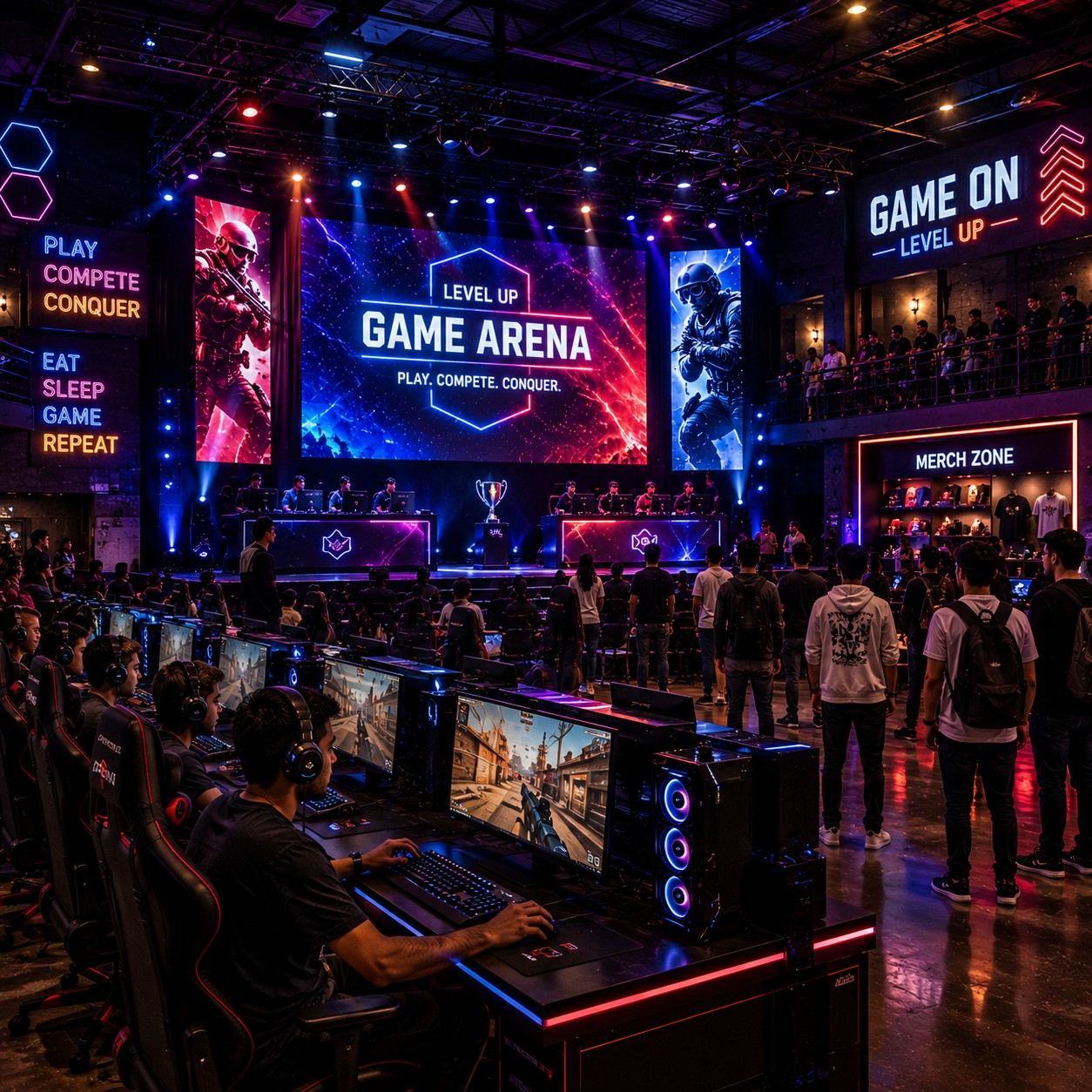
Gaming Arena Party Space
Gaming arena party spaces with esports facilities, gaming stations and tournament setups for competitive gatherings, team events and gaming celebrations.
Explore Other Venue Types
Related Experiences
Popular Cities
Gaming Arena Party Spaces for Esports & Competitive Gatherings
◆Gaming has become an increasingly popular format for social gatherings, team activities, celebrations, esports competitions, and interactive entertainment. A gaming arena party space provides a dedicated environment where participants can play together using organized gaming stations, connected systems, large displays, audio equipment, and other facilities designed for competitive or recreational gaming.
Unlike a conventional party venue, a gaming arena is built around interactive experiences. Participants can compete individually, form teams, participate in tournaments, or simply enjoy multiplayer games with friends and colleagues.
Gaming arena venues can be suitable for birthday celebrations, esports tournaments, corporate team activities, college gatherings, gaming communities, product events, and competitive social occasions. The available equipment and facilities vary between venues, so organizers should confirm the gaming platforms, titles, seating capacity, network setup, tournament facilities, operating hours, and venue policies before booking.
Gaming Stations for Group Events
Gaming stations are the foundation of most gaming arena environments. A venue may provide multiple individual or team-oriented stations equipped for multiplayer gaming.
Depending on the facility, stations may include gaming PCs, consoles, monitors, controllers, headsets, keyboards, mice, and other gaming peripherals.
For a group event, the number of available stations is an important consideration. Organizers should compare the expected number of participants with the number of stations so that the event can be structured appropriately.
Some participants may compete simultaneously, while others can rotate through different rounds. A well-planned rotation can help keep the entire group engaged when the number of guests exceeds the available stations.
Esports Facility for Competitive Gatherings
An esports facility is designed to support organized competitive gaming. These venues may include high-performance gaming systems, network connectivity, spectator screens, team seating, commentator areas, and other tournament-related infrastructure.
For competitive gatherings, the environment should provide reliable equipment and a layout that allows participants to focus on their matches.
Tournament organizers may also require registration areas, match schedules, brackets, referees or administrators, and clearly defined competition zones.
The exact capabilities of an esports facility depend on the venue and the type of tournament being conducted.
Gaming Tournament Setup
A tournament setup transforms a casual gaming session into an organized competitive event. Participants can be divided into teams or individual competitors and progress through a predetermined match structure.
A tournament may include qualifying rounds, group stages, elimination rounds, semifinals, and finals depending on the number of participants and the chosen format.
The venue can provide the gaming stations and technical infrastructure, while the event organizer may manage registration, rules, scheduling, scoring, and participant communication.
For larger competitions, tournament administration should be planned in advance to avoid delays between matches.
Multiplayer Gaming Events
Multiplayer gaming can create a highly interactive environment for social gatherings. Friends, colleagues, classmates, and gaming communities can compete or cooperate in team-based activities.
A gaming arena allows participants to play in the same physical location while using connected systems.
The game selection should consider the experience level and preferences of the participants. For mixed-skill groups, organizers may choose accessible games that allow beginners and experienced players to participate together.
The objective can be competitive, recreational, or simply social depending on the event.
Gaming Birthday Party Space
Gaming arenas can provide an alternative to traditional birthday party venues for children, teenagers, and adults who enjoy interactive entertainment.
A gaming birthday party can combine scheduled gaming sessions with food, refreshments, social time, and other approved celebration activities.
The event can be organized around individual matches, team competitions, or a mixture of different games.
For younger participants, age-appropriate game selections and suitable supervision should be considered. Parents and organizers should also confirm the venue's policies regarding food, decorations, guest numbers, and gaming content.
Corporate Gaming and Team Events
Gaming arenas can also be used for corporate team-building activities and employee gatherings. Multiplayer games can create situations where participants communicate, coordinate, make decisions, and work toward shared objectives.
A corporate gaming event can be organized as a casual recreational activity or as a structured competition between departments or teams.
The event format can include team assignments, qualifying rounds, friendly matches, and a final competition.
For companies, the gaming environment can provide a different type of social experience from traditional dinners or conference-room activities.
Gaming Team Activities
Team-based gaming can encourage communication and collaboration. Participants may need to coordinate strategies, divide responsibilities, and respond to changing situations during a match.
A gaming arena provides a physical environment where teams can compete against one another while remaining within the same event space.
Organizers can create teams in advance or allow participants to form their own groups. A balanced team structure can help make the competition more engaging when participants have different levels of gaming experience.
The emphasis can remain on participation and entertainment rather than purely on winning.
LAN Gaming Events
LAN-style gaming events allow multiple participants to play through a connected local network. This format can be useful for gaming communities, college groups, esports teams, and organized competitions.
A dedicated gaming facility may already have the network infrastructure required for multiplayer sessions.
Before the event, organizers should confirm the venue's network capabilities, supported games, number of simultaneous players, equipment specifications, and technical support arrangements.
A reliable network environment is particularly important for competitive events where connection interruptions can affect match results.
Tournament Spectator Areas
Competitive gaming can be more engaging when spectators can follow the action. Depending on the venue, a gaming arena may provide larger screens or dedicated viewing areas.
Spectators can watch tournament matches while waiting for their own rounds or supporting friends and teammates.
For larger events, the organizer may also use presentation screens, projected gameplay, live scores, or other approved audiovisual systems to make matches easier to follow.
The spectator layout should allow people to watch without obstructing participants or technical equipment.
Gaming Arena Seating and Layout
The physical layout of a gaming arena influences how comfortably participants can play and move around the venue.
Gaming stations should provide adequate space for participants, while chairs and desks should be arranged to avoid unnecessary congestion.
A separate area for spectators, refreshments, registration, or waiting can help maintain an organized event flow.
For tournaments, clear separation between active players and waiting participants can reduce distractions during important matches.
Gaming Equipment and Peripherals
Gaming performance depends partly on the equipment available at the venue. Gaming stations may include different types of computers, consoles, displays, controllers, keyboards, mice, headsets, and other peripherals.
Organizers should confirm the specifications of the equipment before booking, especially if a particular game requires specific performance capabilities.
For tournaments, consistency across stations can be important so that participants compete under comparable conditions.
The venue should also clarify whether participants can bring their own approved peripherals or whether all equipment must be supplied by the facility.
Gaming Event Technical Support
Technical issues can interrupt gaming events, particularly when many systems are operating simultaneously. A venue with appropriate technical support can help address common equipment or connectivity problems.
For a casual party, minor interruptions may be manageable. For a tournament, however, technical delays can affect schedules and match fairness.
Organizers should establish a process for handling equipment failures, network issues, game updates, or other technical problems before the competition begins.
A contingency plan can help the event continue with minimal disruption if an individual station becomes unavailable.
Gaming Competitions for Colleges and Communities
Gaming arenas can be suitable for college gaming clubs, student groups, local gaming communities, and hobby organizations.
These events can provide participants with a dedicated venue for organized competitions, casual multiplayer sessions, or community gatherings.
A college gaming event may include several games or competition categories, depending on the venue's capabilities and the organizer's objectives.
Registration and scheduling should be completed in advance when a large number of participants are expected.
Private Competitive Gatherings
Not every gaming event needs to be a formal esports tournament. Friends and gaming groups may simply want a dedicated environment where they can compete against one another.
A private gaming gathering can include friendly matches, team challenges, racing competitions, strategy games, sports games, or other multiplayer formats.
The flexible nature of a gaming arena allows the event to be designed around the group's interests rather than following a formal tournament structure.
This can make gaming venues suitable for casual celebrations as well as serious competitions.
Event Branding and Tournament Presentation
Larger gaming events may benefit from branded presentation elements. Tournament names, team names, sponsor graphics, scoreboards, event signage, and other approved visuals can help create a more professional competition environment.
A gaming arena can potentially incorporate branding into designated display areas, screens, registration points, or tournament materials depending on venue policies.
For corporate or sponsored gaming events, consistent branding can help connect the competition with the organizing company or event campaign.
Food and Refreshment Areas
Gaming sessions can last several hours, making food and refreshments an important consideration. Some gaming venues provide designated areas for snacks and beverages, while others may have restrictions on food near gaming equipment.
For private parties, organizers should confirm whether outside food or catering is permitted.
Scheduled breaks can give participants time to eat, socialize, and rest between matches.
Food areas should be separated appropriately from gaming equipment to reduce the risk of spills or damage.
Gaming Events for Different Skill Levels
Participants in a gaming event may have very different levels of experience. Some may play regularly, while others may be new to competitive gaming.
For mixed groups, organizers can select accessible games or create different competition categories.
A beginner-friendly session can help less experienced participants enjoy the event without feeling overwhelmed.
More advanced participants can take part in competitive rounds or specialized tournaments where appropriate.
Balancing the event around different skill levels can make the gathering more inclusive and enjoyable.
Planning the Tournament Schedule
Tournament timing should be planned carefully when many participants are involved. Each match requires time for setup, gameplay, results, and transition to the next round.
A schedule can be created based on the number of players, available stations, game duration, and competition format.
Organizers should also include reasonable breaks, particularly for longer events.
Clear communication of match times can help participants know when they need to be present at their assigned stations.
Why Choose a Gaming Arena Party Space?
A gaming arena party space provides a dedicated environment for interactive entertainment, competitive gaming, esports events, team activities, birthdays, college gatherings, and private gaming celebrations.
With gaming stations, esports facilities, tournament infrastructure, multiplayer capabilities, spectator areas, and technical support, a gaming venue can provide more specialized facilities than a conventional party location.
The most suitable venue depends on the number of participants, gaming platform, preferred titles, tournament format, equipment requirements, event duration, and available group facilities.
For casual gatherings, the focus can remain on entertainment and social interaction. For competitive events, organizers can introduce structured matches, teams, scoring, brackets, and tournament administration.
With appropriate planning around equipment, participant numbers, game selection, scheduling, technical support, food arrangements, and venue policies, a gaming arena can create an engaging environment for competitive gatherings and memorable gaming experiences.
Frequently Asked Questions
1. What is a gaming arena party space?
A gaming arena party space is a dedicated venue equipped with gaming stations and related facilities for multiplayer gaming, esports competitions, birthday celebrations, private gatherings, and other interactive events.
2. What facilities are available at an esports gaming arena?
Depending on the venue, facilities may include gaming PCs or consoles, monitors, controllers, headsets, network infrastructure, tournament areas, spectator screens, seating, and technical support.
3. Can a gaming arena host tournaments?
Yes. Gaming arenas can provide suitable facilities for organized tournaments, including multiple gaming stations and competition areas. Tournament rules, registration, scheduling, scoring, and administration should be planned according to the event requirements.
4. Are gaming arenas suitable for birthday parties?
Yes. Gaming arenas can be used for gaming-themed birthday celebrations, subject to the venue's age policies, game availability, guest capacity, food arrangements, and other booking conditions.
5. Can companies organize gaming team events?
Yes. Gaming arenas can host corporate team activities, friendly competitions, employee gatherings, and esports-style events that encourage communication, collaboration, and social interaction.