
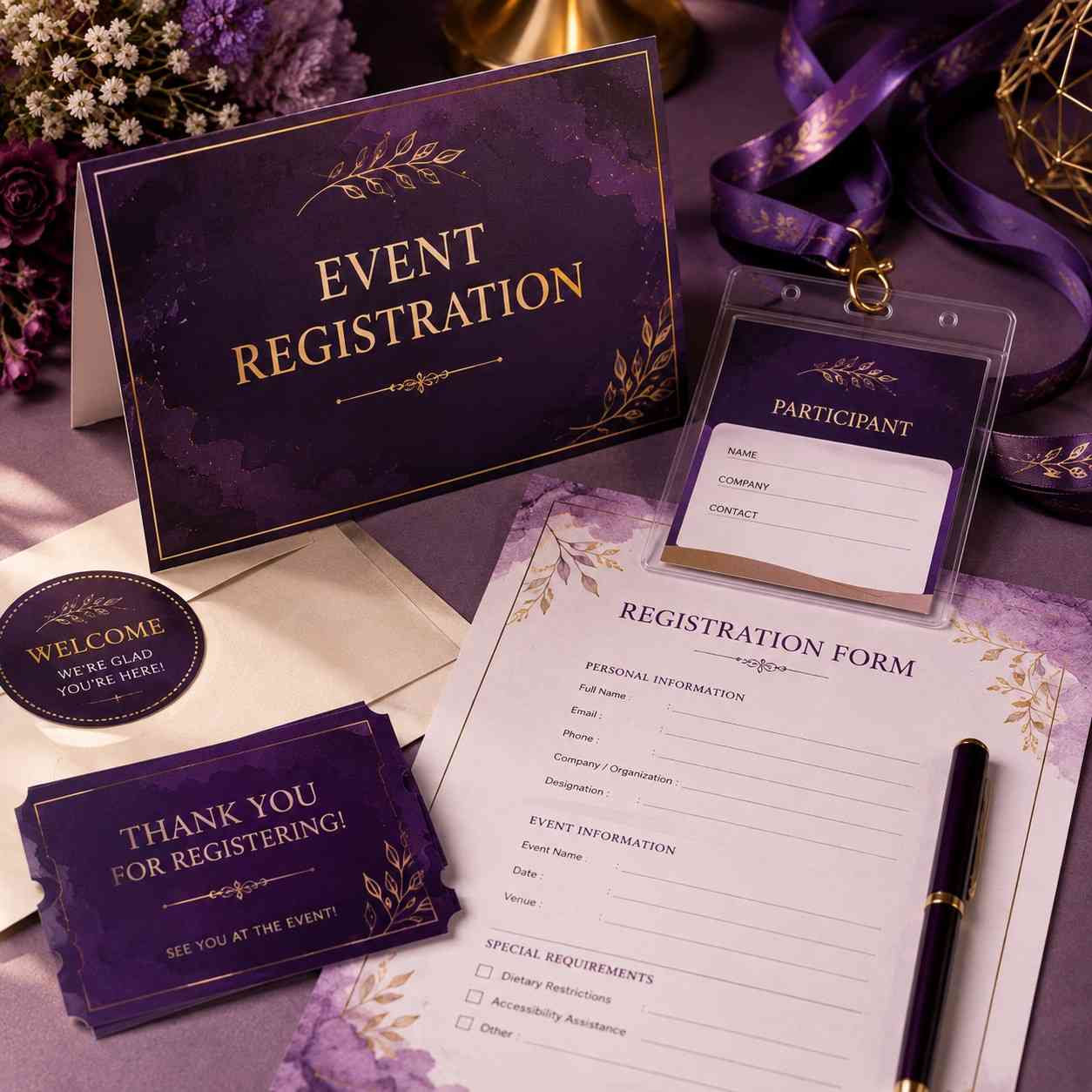
Event Registration Material
Registration Badges, Event Badges, Lanyards, Event Passes, Conference Badges, Exhibition Badges, Corporate Event Badges, Festival Passes, VIP Passes, Staff Badges, Event Identification Badges, Custom Lanyards, Personalized Event Stationery, Event Access Passes, Delegate Badges, Visitor Badges, Event Registration Materials, Conference Stationery, Exhibition Stationery, Custom Event Printing
Explore Invitation & Stationery Experiences





Explore Other Experiences
















Explore by Occasion






Registration Badges for Conferences, Exhibitions & Events in India
◆Registration badges are an essential part of professional event management, providing attendees with a simple and visible way to identify themselves and access different areas of a conference, exhibition, corporate event, trade show, seminar, workshop, festival, or large gathering. Event badges combined with lanyards, event passes, name cards, and access credentials help organisers manage guest identification, networking, security, and controlled venue access.
In India's growing conference and exhibition landscape, registration badges are widely used at convention centres, exhibition grounds, hotels, corporate venues, universities, trade fairs, networking events, product launches, and professional gatherings. A well-designed badge not only displays attendee information but also contributes to the overall branding and professional appearance of the event.
The importance of registration badges becomes especially evident at large conferences and exhibitions where hundreds or thousands of attendees may need to be identified quickly. Badges allow event staff, security teams, exhibitors, speakers, and attendees to understand who is participating and, where required, which areas or sessions they are authorised to access.
Event badges can be customised according to different attendee categories. Common categories include delegates, speakers, VIP guests, exhibitors, sponsors, media representatives, organisers, staff, volunteers, vendors, technicians, and visitors. Using different colours, labels, designs, or access indicators can make category identification faster.
Conference name badges are commonly used for professional events where networking is an important part of the experience. They may display the attendee's name, organisation, designation, country, industry, or other relevant information. Clear typography ensures that names can be read easily during conversations and networking sessions.
Lanyards provide a convenient way to wear event badges around the neck. They can be made from polyester, nylon, woven fabric, recycled materials, or other suitable materials. Lanyards can also be customised with event logos, sponsor branding, colours, taglines, or repeating patterns.
Printed event passes are another common format. Depending on the event requirements, passes may be printed on paper, PVC, synthetic materials, cardstock, or other durable media. Premium events may use professionally finished cards with laminations, special coatings, embossing, or other enhancements.
Expo access badges are particularly useful at exhibitions and trade shows. Visitors, exhibitors, buyers, media, and staff can be assigned different credentials to help manage access to exhibition halls, business lounges, meeting rooms, backstage areas, or restricted zones.
Registration badges can also support event security. Access levels can be visually indicated through colour coding, text labels, QR codes, barcodes, RFID, NFC, or other technologies. Security and event staff can use these credentials as part of a broader access-control system.
QR-coded badges are increasingly popular at conferences and exhibitions. A unique QR code can be linked to an attendee's registration record, allowing event teams to scan badges for check-in, session access, networking, lead collection, or other event-management activities depending on the registration platform.
Barcode badges offer a similar functionality. Barcodes can be printed on registration passes and scanned at designated checkpoints. They can be useful for fast entry processing, attendance tracking, session verification, and event administration.
RFID and NFC-enabled badges provide more advanced event technology options. Depending on the system, these credentials can support contactless access, session tracking, cashless event systems, exhibitor lead capture, networking interactions, or other digital event functions.
On-site badge printing can help organisers manage last-minute registrations and changes. Badge-printing systems can generate attendee credentials at registration counters using information captured through online registration platforms or event-management software.
Pre-printed badges are another option for events where attendee information is confirmed in advance. These can be prepared before the event and arranged alphabetically, by organisation, attendee category, or registration number to speed up distribution.
Badge design plays an important role in the overall event experience. Professional designs may include event logos, brand colours, attendee photographs, names, job titles, organisation details, category indicators, sponsor logos, QR codes, and directional information.
Readable design is particularly important. Attendee names should be large enough to identify easily, while secondary information such as company names and designations can use smaller but clear typography. Overcrowding the badge with excessive information can reduce usability.
Branding opportunities make event badges valuable marketing assets. Lanyards and badges can feature event sponsors, partner logos, campaign messaging, event hashtags, website information, or branded artwork. Sponsor branding can be integrated without making the primary attendee information difficult to read.
Different badge colours can help create visual access categories. For example, speakers, VIPs, exhibitors, media, staff, and general attendees can each have distinct colours or design elements. Organisers should use a clear and consistent system so staff can identify categories quickly.
Conference badges can also support networking. Names, job titles, companies, industries, and other professional information can make it easier for attendees to identify relevant contacts and initiate conversations. Some advanced systems may connect badge information to digital networking platforms.
Exhibition badges can assist exhibitors with visitor identification and lead generation. Depending on the event platform, badge scanning can allow exhibitors to capture visitor information with appropriate consent and use it for post-event follow-up.
Registration desks should be designed for efficient badge distribution. Organisers may separate counters for pre-registered attendees, on-site registration, VIP guests, speakers, exhibitors, and staff. Clear signage and queue-management systems can further reduce waiting times.
Badge holders can provide additional protection for printed credentials. Transparent plastic holders, rigid holders, clip holders, retractable badge reels, and other accessories can be selected depending on the event format. Protective holders are particularly useful for multi-day conferences and exhibitions.
Lanyard attachments also vary according to the required presentation. Common options include metal clips, plastic hooks, swivel hooks, bulldog clips, badge reels, and other connectors. The attachment should securely hold the badge while allowing comfortable use.
For outdoor events, durability becomes particularly important. Badges and lanyards may be exposed to humidity, dust, rain, frequent handling, or extended use. Water-resistant or laminated badge materials can provide additional protection where appropriate.
Sustainable badge solutions are increasingly being considered by event organisers. Recycled paper, reusable lanyards, biodegradable materials, digital credentials, and responsible printing practices can help reduce event waste. Reusable badge holders can also be collected and used again at future events.
Registration badges can be integrated with digital event systems. Attendee registration, QR codes, access permissions, session schedules, digital networking, event applications, and check-in systems can work together to create a connected registration experience.
Large-scale events may require badge production in significant quantities. Professional printing providers can manage bulk production, sorting, packaging, delivery, and last-minute reprints. Organisers should confirm artwork, attendee data, quantity, and delivery timelines before production.
Data accuracy is particularly important when printing attendee badges. Names, designations, organisation names, photographs, access categories, QR codes, and other information should be carefully verified before printing. Digital proofing and data checks can help minimise errors.
Event badges are also useful beyond registration. They can support meal access, session entry, networking lounges, VIP areas, exhibitor halls, workshops, backstage zones, and other controlled areas. The exact access system should be designed according to the event's operational and security requirements.
Rental and event-service providers can support complete badge management. Services may include badge design, printing, lanyards, badge holders, on-site printing, registration counters, scanners, access-control technology, staff support, data management, and post-event collection.
Cost depends on several factors including badge material, quantity, printing method, lanyard type, branding, QR or RFID technology, badge holders, on-site printing, staff support, event duration, and delivery requirements. Comparing providers helps organisers select the right solution.
In conclusion, registration badges are more than simple name tags—they are an important part of attendee identification, event branding, networking, security, and access management. From conferences and exhibitions to corporate events, trade shows, seminars, festivals, and professional gatherings across India, well-designed badges can create a smoother and more organised attendee experience. By selecting suitable materials, access technology, badge formats, lanyards, branding, and professional registration support, event organisers can make registration and identification simple, efficient, and professional.
FAQ Section
Q1: What are registration badges used for?
Registration badges are used to identify attendees and support entry, access control, networking, session management, security, and event administration at conferences, exhibitions, corporate events, trade shows, and other gatherings.
Q2: What information can be printed on an event badge?
Badges may include the attendee's name, designation, organisation, photograph, attendee category, event logo, sponsor branding, QR code, barcode, access information, or other relevant event details.
Q3: What are event lanyards?
Event lanyards are wearable straps used to hold registration badges around the attendee's neck. They can be customised with event branding, colours, logos, and sponsor information.
Q4: Can badges be used for conference entry?
Yes. Conference badges can be used for attendee identification and, when integrated with suitable access systems, can support entry into the venue, sessions, workshops, networking areas, or restricted zones.
Q5: Can registration badges include QR codes?
Yes. QR codes can be printed on badges and used for check-in, session access, attendance tracking, networking, or other event-management functions supported by the registration system.
Q6: Are RFID or NFC event badges available?
Yes. RFID and NFC-enabled credentials can support contactless access and other digital event functions depending on the technology platform and event requirements.
Q7: Can event badges be branded?
Yes. Badges and lanyards can feature event logos, brand colours, sponsor logos, campaign graphics, event hashtags, and other visual elements.
Q8: Can badges be printed on-site?
Yes. On-site badge-printing systems can produce credentials for last-minute registrations, attendee changes, replacement badges, and other registration requirements.
Q9: How much do registration badges cost?
Pricing depends on badge material, quantity, printing method, lanyard type, badge holders, branding, QR/RFID technology, on-site printing, staffing, and delivery requirements.
Q10: How can Happiffie help with registration badges?
Happiffie helps conference organisers, exhibition teams, corporations, event planners, trade-show organisers, and venues discover trusted registration and event-printing providers offering customised badges, lanyards, event passes, badge holders, QR-coded credentials, RFID solutions, on-site printing, and complete registration support.