
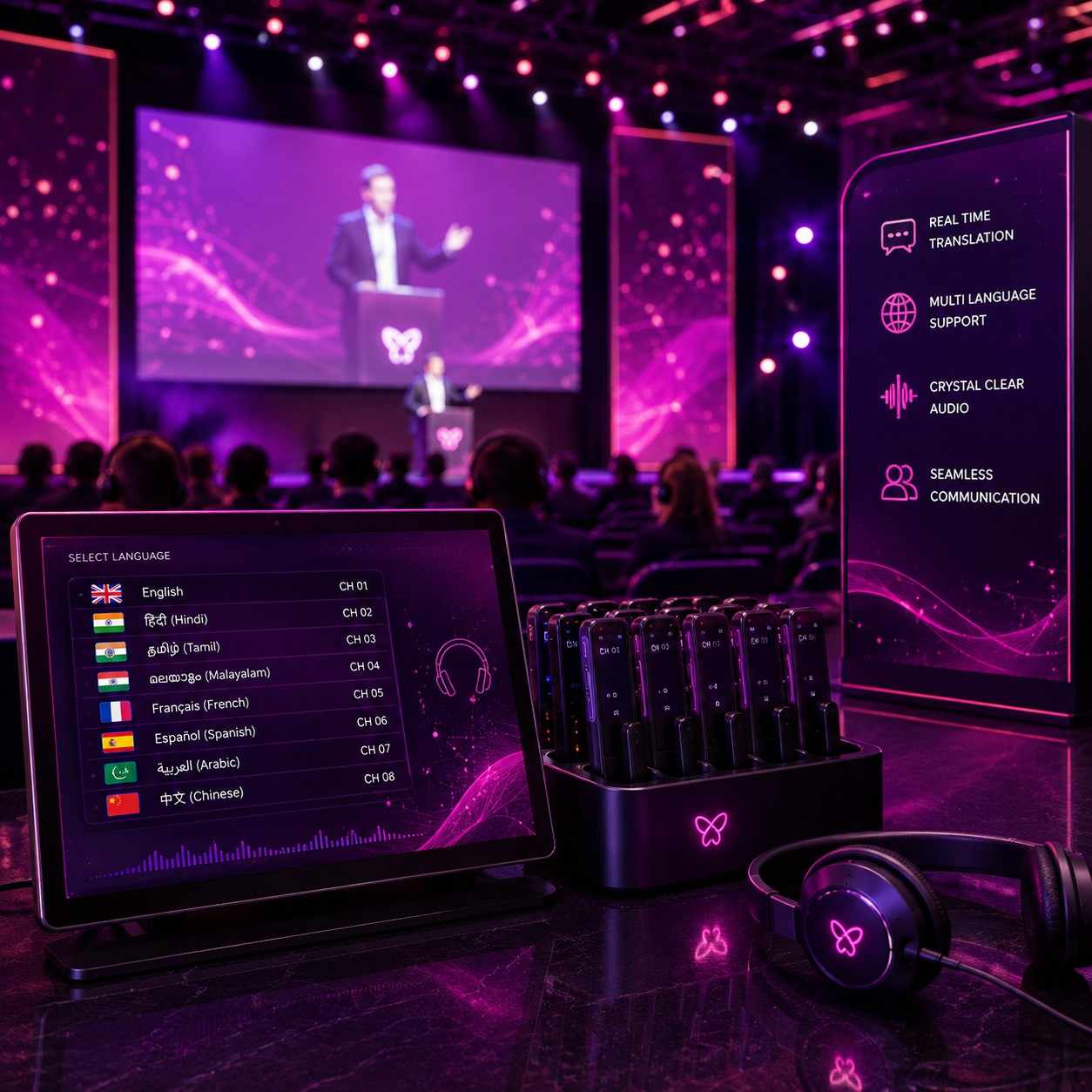
Translation Systems
Enable seamless multilingual communication with Translation Systems & Interpretation Technology Services featuring simultaneous interpretation equipment, interpreter consoles, wireless receivers, multilingual audio channels, and integrated technology for conferences, summits, exhibitions, corporate meetings, and international events.
Explore Related Audio & Lighting Experiences

Explore Other Experiences








Explore by Occasion





Translation Systems Interpretation Technology Services - Interpreter Booths, Audio Receivers - Conferences, Seminars
◆Translation Systems Interpretation Technology Services provide professional multilingual communication solutions for conferences, seminars, corporate meetings, international summits, exhibitions, academic programs, government events, cultural gatherings, and other occasions where participants speak different languages. By combining interpreter booths, audio receivers, wireless distribution systems, microphones, consoles, and professional interpretation support, these services help audiences understand live presentations and discussions in their preferred language.
Interpretation Technology enables spoken content to be translated and distributed to participants in real time. Professional systems can support multiple language channels, allowing delegates to select and listen to the required interpretation without interrupting the main speaker.
Interpreter Booths provide interpreters with a controlled environment where they can clearly hear the original speaker and deliver simultaneous interpretation. Booths may be permanent, portable, or temporary depending on the venue and event requirements.
Portable Interpreter Booths are suitable for convention centres, hotels, auditoriums, exhibition halls, universities, conference venues, and temporary event spaces where permanent interpretation infrastructure is unavailable.
Audio Receivers allow participants to listen to translated speech through dedicated channels. Delegates can select their preferred language and adjust the listening volume according to their requirements.
Wireless Interpretation Systems distribute translated audio to participants without extensive cabling across the audience area. Depending on the system, infrared, radio-frequency, or digital technologies may be used.
Infrared Interpretation Systems can provide controlled wireless audio distribution in suitable indoor venues. They are often used for conferences and formal meetings requiring dedicated language channels.
Radio Frequency Interpretation Systems can support larger spaces and wider audience coverage, subject to venue conditions, equipment specifications, and applicable operating requirements.
Digital Interpretation Systems may deliver translated audio through supported applications, smartphones, tablets, or network-based platforms, depending on the event's technical configuration.
Interpreter Consoles allow professional interpreters to receive source audio, select language channels, control microphones, and transmit their interpretation to the appropriate audience channel.
Multiple Language Channels can be configured for international conferences where delegates require several translated languages. Each language can be assigned to a dedicated channel for easy participant selection.
Simultaneous Interpretation allows interpreters to translate the speaker's words while the presentation continues. This helps international audiences follow speeches, panel discussions, presentations, and technical sessions without significant delays.
Conference Interpretation Services are commonly used for keynote speeches, panel discussions, workshops, seminars, training sessions, business meetings, and international networking events.
Seminar Interpretation Systems can support educational and professional programs where speakers and attendees come from different linguistic backgrounds.
Corporate Interpretation Services can assist multinational companies during leadership meetings, employee conferences, training programs, annual meetings, investor events, and international business sessions.
Government and Diplomatic Events may require professional interpretation for official meetings, international delegations, conferences, public programs, and formal discussions.
Academic and Research Conferences can use interpretation technology when international researchers, faculty members, students, and delegates participate in multilingual sessions.
Medical Conferences may require specialist interpreters familiar with technical terminology, medical vocabulary, and professional communication requirements.
Exhibitions and Trade Shows can use interpretation systems for product demonstrations, seminars, buyer meetings, technical presentations, and international business discussions.
Product Launch Events can use multilingual interpretation to communicate product features, demonstrations, executive speeches, and brand announcements to global audiences.
Press Conferences can use interpretation systems to help international journalists follow statements, interviews, announcements, and question-and-answer sessions.
Hybrid Event Interpretation can connect physical and remote participants through supported online platforms. Remote attendees may be able to access selected language channels while following the live program.
Live Captioning can complement interpretation systems by displaying spoken or translated text on LED screens, projection systems, confidence monitors, or digital devices.
Translated Subtitles can provide a visual alternative or additional support for audiences who prefer reading translated content during presentations.
Screen Integration allows language information, translated captions, speaker names, session details, and other event content to be displayed alongside the main presentation.
Conference AV Integration can connect interpretation systems with microphones, cameras, LED screens, projectors, presentation systems, recording equipment, and live streaming infrastructure.
Microphone Systems are essential for capturing clear source audio. Depending on the event, podium microphones, lapel microphones, headset microphones, handheld microphones, and panel discussion microphones may be used.
Audio Distribution ensures that the original speaker's voice reaches interpreters clearly while translated audio is routed to the correct language channels.
Interpreter Preparation is important for specialised conferences. Presentation slides, speaker notes, technical terminology, names, acronyms, and event schedules can be shared with interpreters before the event to support accuracy and consistency.
Professional Interpreter Teams may work in pairs or groups for longer sessions because simultaneous interpretation requires sustained concentration. The number of interpreters depends on the languages, event duration, and program structure.
Technical Rehearsals allow interpreters and production teams to test microphones, interpreter consoles, receivers, headsets, language channels, screens, audio routing, and communication systems before the event.
Audio Quality is critical to accurate interpretation. Clear source audio helps interpreters understand speakers and communicate translated content without unnecessary interruptions.
Interpreter Monitoring Systems allow technical teams to monitor source audio, interpretation channels, receiver performance, and overall system operation throughout the event.
Communication Systems can connect interpreters with event producers, stage managers, moderators, and technical teams when coordination is required.
Backup Equipment can help maintain continuity in the event of a receiver, microphone, transmission unit, power, or other technical failure.
Large conferences may require multiple interpreter booths, language channels, receivers, headsets, microphones, transmitters, audio processors, technical operators, and interpretation coordinators.
Venue Assessment is important before installation. Technical teams consider audience size, room dimensions, booth placement, seating arrangement, wireless coverage, acoustics, power availability, screen locations, and equipment access.
Outdoor events require additional consideration for wireless signal coverage, weather protection, power supply, equipment placement, interference, and audience distribution.
Indoor conference venues generally provide better control over interpretation infrastructure, but room acoustics, booth locations, equipment positioning, and signal coverage still need to be assessed.
Accessibility can be improved through translated audio, captions, clear displays, and appropriate listening equipment. Organisers should select solutions according to the needs of their audience.
Religious and Cultural Programs can use multilingual interpretation where audiences require assistance understanding speeches, discourses, ceremonies, performances, or educational content.
Tourism and Heritage Events can use interpretation systems to help international visitors understand cultural presentations, historical storytelling, exhibitions, and guided programs.
Budget planning should consider the number of languages, audience size, event duration, interpreter requirements, booth configuration, receivers, headsets, microphones, transmission technology, screens, technical crew, transportation, setup, rehearsal, operation, and dismantling.
Rental packages can be customised according to the scale of the event. Smaller seminars may require a limited number of receivers and one or two language channels, while international conferences may require a complete multilingual interpretation infrastructure.
Professional providers may offer interpreter booths, interpreter consoles, audio receivers, headsets, transmitters, microphones, language channel management, technical operators, interpreter coordination, installation, testing, live operation, and dismantling.
In conclusion, Translation Systems Interpretation Technology Services help remove language barriers and create inclusive multilingual events. From Interpreter Booths and Audio Receivers to simultaneous interpretation, wireless language distribution, digital interpretation, translated captions, and professional technical support, these solutions help Conferences, Seminars, Corporate Meetings, Exhibitions, and International Events communicate effectively with diverse audiences.
FAQ Section
Q1: What are Translation Systems Interpretation Technology Services?
These are professional technology and interpretation solutions that provide real-time multilingual communication using interpreter booths, audio receivers, language channels, microphones, consoles, and wireless or digital distribution systems.
Q2: What are Interpreter Booths used for?
Interpreter Booths provide professional interpreters with a controlled environment where they can hear the original speaker clearly and deliver simultaneous translations to the audience.
Q3: How do Audio Receivers work?
Audio Receivers allow delegates to select a required language channel and listen to the interpreter through compatible headphones or headsets.
Q4: Can multiple languages be supported?
Yes. Interpretation systems can support multiple language channels depending on the equipment configuration, number of interpreters, audience size, and event requirements.
Q5: Where are interpretation systems commonly used?
They are commonly used for conferences, seminars, corporate meetings, international summits, exhibitions, government programs, academic events, medical conferences, trade shows, and multilingual gatherings.
Q6: Can interpretation systems be used for hybrid events?
Yes. Where the selected platform supports it, interpretation can be integrated into hybrid events so remote participants can access available language channels.
Q7: Are interpreters included with the technology?
This depends on the service package. Professional providers may offer both interpretation technology and qualified interpreters, or provide equipment separately for organisers who already have interpreters.
Q8: Is a technical rehearsal necessary?
Yes. Testing microphones, interpreter consoles, language channels, receivers, headsets, audio routing, screens, and communication systems before the event helps ensure reliable operation.
Q9: Can translated content be displayed on screens?
Yes. Live captions, translated subtitles, language information, speaker details, and other visual content can be integrated with LED screens, projectors, confidence monitors, or digital devices.
Q10: How can Happiffie help arrange Translation Systems Interpretation Technology Services?
Happiffie helps conference organisers, corporations, educational institutions, exhibition teams, government programs, and event planners discover experienced interpretation and AV professionals offering Interpreter Booths, Audio Receivers, simultaneous interpretation, wireless language systems, translated captions, technical operators, equipment rental, setup, rehearsal, and complete multilingual event solutions.