
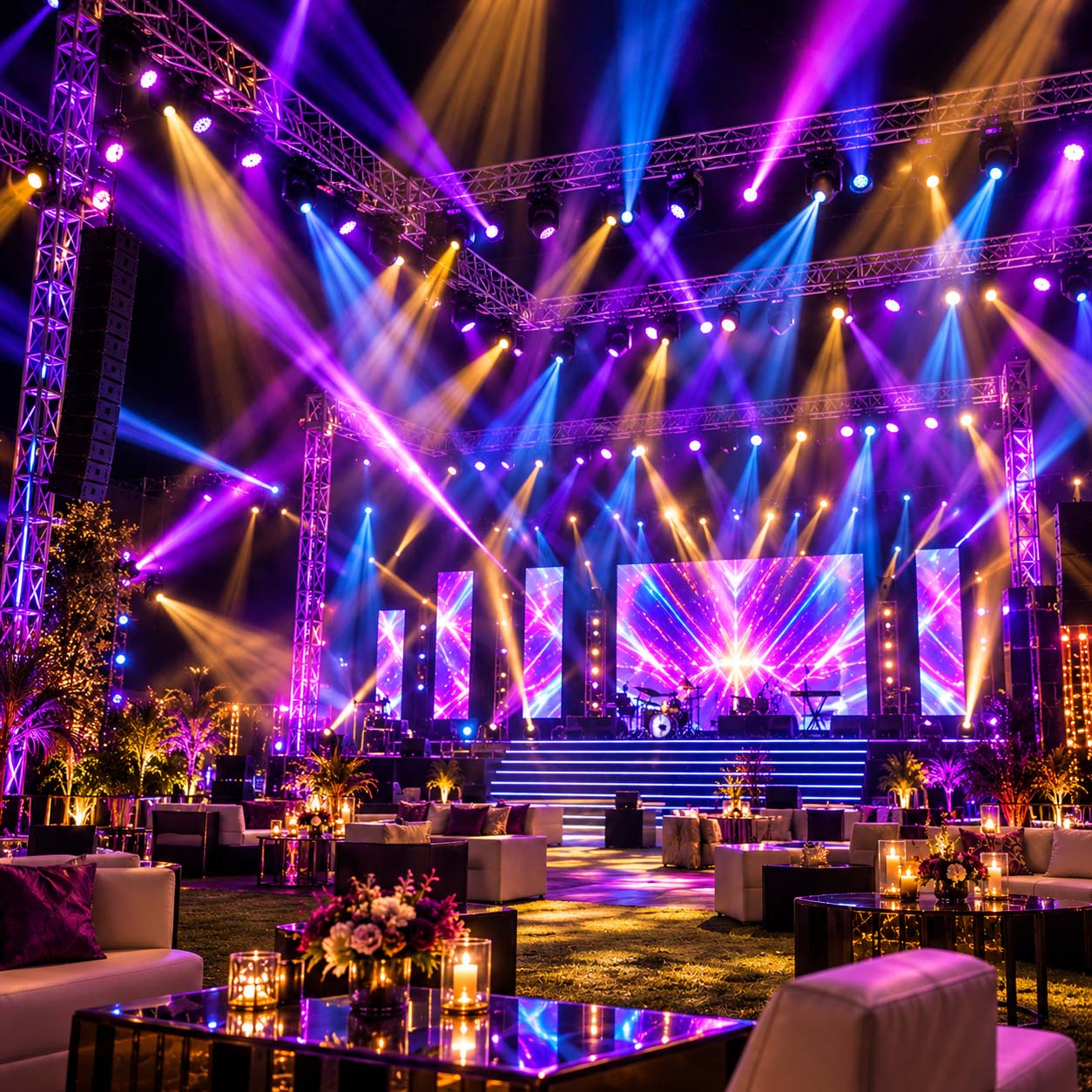
Intelligent Moving Fixture Control
Create dynamic lighting effects with intelligent moving fixture control featuring automated lighting and DMX systems designed for concerts, stage shows, theatrical performances, live productions, and professional entertainment events.
Explore Related Audio & Lighting Experiences
Explore Other Experiences

Explore by Occasion
Intelligent Moving Fixture Control for Live Productions
◆Modern stage lighting can create dynamic visual experiences by combining moving fixtures, automated control, programmed scenes, and coordinated lighting effects. Instead of operating every fixture individually, intelligent lighting systems allow technical teams to control multiple parameters through centralized control platforms.
Intelligent Moving Fixture Control provides advanced lighting management using automated lighting, DMX systems, moving light control, and intelligent lighting systems for concerts, stage shows, theatrical performances, live productions, and dynamic event environments.
Happiffie helps customers discover providers offering concert lighting control, DMX lighting control, automated stage lighting, moving fixture systems, and event lighting control.
Automated Lighting
Automated lighting systems allow compatible fixtures to perform programmed movements and lighting changes.
Depending on the fixture, automated functions can include movement, intensity, color, beam adjustment, focus, and other supported parameters.
These capabilities allow lighting designers to create coordinated sequences for different moments of a live production.
DMX Systems
DMX systems provide a common control method for compatible lighting equipment.
A lighting console or control system can send programmed commands to fixtures through the DMX network.
This allows multiple fixtures to be controlled individually or as coordinated groups according to the production requirements.
Moving Light Control
Moving light control allows intelligent fixtures to change their position during a performance.
Pan and tilt movements can direct beams across different areas of the stage or venue.
Programmed movement can be synchronized with music, performer entrances, transitions, and other production cues.
Intelligent Lighting Systems
Intelligent lighting systems combine programmable fixtures with centralized control.
They can provide greater flexibility than conventional fixed lighting because fixture parameters can be adjusted throughout a production.
Lighting designers can create scenes and sequences that change according to the event schedule.
Concert Lighting Control
Concerts frequently use moving fixtures to create dynamic visual effects.
Moving lights can change direction, color, intensity, beam characteristics, and other parameters during different parts of a performance.
The lighting control system can be programmed around the music, setlist, performer movement, and stage design.
Stage Show Lighting
Stage shows often require lighting transitions that correspond with different scenes and performance moments.
Moving fixtures can help create focused illumination, sweeping beams, dramatic transitions, and changing visual compositions.
The control system allows these changes to be programmed and operated according to the show's requirements.
DMX Lighting Control
DMX lighting control provides structured communication between control equipment and compatible fixtures.
Each fixture can be assigned appropriate control channels, allowing individual parameters to be managed from a central system.
Larger productions may use multiple fixtures and control groups to create coordinated lighting sequences.
Live Production Lighting
Live production lighting can involve concerts, theatre performances, dance shows, cultural programs, award functions, presentations, and entertainment events.
Moving fixture systems can be incorporated into the broader lighting design to support the creative direction of the production.
The configuration depends on the stage, venue, equipment inventory, and production schedule.
Automated Stage Lighting
Automated stage lighting can reduce the need for manually repositioning fixtures during a performance.
Programmable moving fixtures can change position and other supported parameters through preconfigured cues.
This can create repeatable lighting sequences for rehearsed performances.
Moving Fixture Systems
Moving fixture systems can include different types of intelligent lighting equipment.
Depending on the production, fixtures may provide beam, spot, wash, or hybrid functions.
The appropriate combination depends on the desired lighting effects, stage dimensions, fixture positions, and technical requirements.
Event Lighting Control
Event lighting control provides centralized management of compatible lighting fixtures.
The lighting operator can trigger scenes, cues, movement sequences, color changes, and other programmed effects during the event.
The system can also be adapted to different event formats and production schedules.
Lighting Programming
Programming is an important part of intelligent fixture control.
The lighting designer or programmer can configure fixture addresses, parameters, scenes, groups, effects, and cue sequences.
Programming can be developed around the running order of the event to help the operator execute changes accurately.
Lighting Cues
Lighting cues determine when programmed lighting changes occur.
A cue may activate a specific fixture group, movement pattern, color combination, intensity level, or other programmed state.
Cue sequences can be prepared for musical sections, theatrical scenes, performer entrances, presentations, and other important moments.
Fixture Movement
Movement is one of the defining features of intelligent moving fixtures.
Fixtures can be programmed to change pan and tilt positions according to the stage layout and creative design.
Movement patterns can range from subtle positioning changes to more dynamic effects during high-energy performances.
Beam Control
Certain moving fixtures provide controllable beam characteristics.
Depending on the equipment, operators may adjust beam direction, width, focus, intensity, and other available parameters.
This allows the lighting system to create different visual effects throughout the production.
Color Control
Many intelligent fixtures offer programmable color capabilities.
Lighting designers can create different color scenes for various portions of a show.
Color transitions can also be coordinated with movement, intensity, and other programmed effects.
Lighting Scenes
Lighting scenes combine multiple fixture settings into a coordinated lighting state.
A scene may define fixture positions, colors, intensities, and other parameters at a particular point in the production.
Multiple scenes can then be organized into a sequence for the live show.
Theatrical Lighting
Theatre productions can use intelligent fixtures to support scene transitions and dramatic moments.
Moving fixtures can adjust focus, position, intensity, and color as the production progresses.
The programming can be synchronized with the script, stage movement, and direction of the performance.
Dance and Performance Lighting
Dance performances often involve movement across different parts of the stage.
Moving fixtures can follow or complement performer positions while creating changing visual patterns.
Programmed cues can support choreography and transitions throughout the performance.
Outdoor Stage Lighting
Outdoor productions can use intelligent moving fixtures when the equipment and installation environment are appropriate.
The lighting setup should consider stage dimensions, environmental conditions, power availability, equipment placement, and control infrastructure.
The technical team should select equipment suitable for the intended outdoor application.
Indoor Stage Lighting
Indoor venues can provide different installation and control conditions.
Auditoriums, theatres, exhibition halls, convention centers, and event venues may have different rigging points, ceiling heights, stage dimensions, and technical infrastructure.
The lighting configuration should be designed around the actual venue.
Lighting Control for Large Productions
Large productions may use numerous intelligent fixtures operating simultaneously.
The control system can organize fixtures into groups and programmed sequences to simplify operation.
Technical planning is important to ensure that the system can manage the required number of fixtures and control parameters.
Technical Rehearsal
A technical rehearsal provides an opportunity to test programmed lighting cues before the audience arrives.
The team can verify fixture movement, colors, intensities, cue timing, signal communication, and coordination with other production systems.
Adjustments can then be made before the final performance.
Troubleshooting and Technical Support
Intelligent lighting systems involve multiple components, including fixtures, DMX connections, control consoles, networking equipment, and power systems.
Technical specialists can identify issues involving signal communication, fixture addressing, programming, or equipment operation.
Technical support during setup and live production can help reduce interruptions.
Customized Moving Fixture Programming
Every production can have different creative and technical requirements.
Customized programming can be developed according to the stage layout, fixture inventory, performance schedule, music, choreography, and desired visual effects.
This allows the lighting system to support the specific character of the production.
Choosing the Right Moving Fixture Control Service
When selecting a provider, consider experience with intelligent fixtures, DMX systems, lighting consoles, programming, live operation, and the specific type of production.
It is also useful to provide information about the venue, stage dimensions, fixture inventory, performance schedule, and desired lighting effects.
Why Choose Happiffie?
Happiffie helps customers discover providers offering Intelligent Moving Fixture Control, automated lighting, DMX systems, moving light control, intelligent lighting systems, concert lighting control, stage show lighting, and event lighting control.
Whether you are planning a concert, theatre production, dance performance, live show, or professional stage event, Happiffie helps you explore intelligent lighting solutions suited to different production requirements.
Providers may offer fixture programming, DMX configuration, lighting console operation, cue programming, technical rehearsal support, live operation, and troubleshooting assistance.
Conclusion
Intelligent lighting systems provide flexible control over moving fixtures and automated stage lighting. Through DMX systems, programmed cues, lighting scenes, movement control, color changes, and centralized operation, these fixtures can create dynamic visual environments for live productions.
Intelligent Moving Fixture Control can support concerts, stage shows, theatrical performances, dance productions, and other live events requiring coordinated automated lighting.
With Happiffie, customers can discover providers offering moving light control, DMX lighting control, automated stage lighting, concert lighting control, moving fixture systems, and professional event lighting control.
Frequently Asked Questions
1. What is Intelligent Moving Fixture Control?
It is the centralized control and programming of moving and intelligent lighting fixtures for live productions and events.
2. What are moving fixtures?
Moving fixtures are programmable lighting units that can change their position and, depending on the model, other parameters such as color, intensity, beam characteristics, and focus.
3. What is DMX lighting control?
DMX lighting control is a communication method used to control compatible lighting fixtures through a console or other lighting control system.
4. Can moving fixtures be used for concerts?
Yes. Moving fixtures are commonly incorporated into concert lighting designs to create dynamic movements, colors, beams, and programmed lighting effects.
5. Can intelligent lighting be used for theatre?
Yes. Intelligent fixtures can support theatrical scenes, transitions, performer focus, and other programmed production cues.
6. Can lighting movement be programmed?
Yes. Compatible moving fixtures can be programmed with pan and tilt movements and other supported parameters.
7. What is a lighting cue?
A lighting cue is a programmed instruction that changes one or more lighting parameters at a specific point in a production.
8. Can moving fixtures change colors?
Many intelligent fixtures provide programmable color functions. The available options depend on the specific fixture.
9. Is technical rehearsal required?
A technical rehearsal is useful for checking fixture movement, cue timing, DMX communication, programming, and coordination with the production.
10. Can moving fixture control be used outdoors?
Yes, when suitable equipment and installation methods are selected for the outdoor environment and venue conditions.
11. What information should I provide before hiring a lighting control specialist?
Provide the venue details, stage dimensions, fixture inventory, lighting console information, production schedule, and desired lighting effects.
12. Why choose Happiffie for moving fixture control?
Happiffie helps customers discover providers offering intelligent lighting systems, automated lighting, DMX programming, moving light control, concert lighting control, stage show lighting, and live production lighting services.