
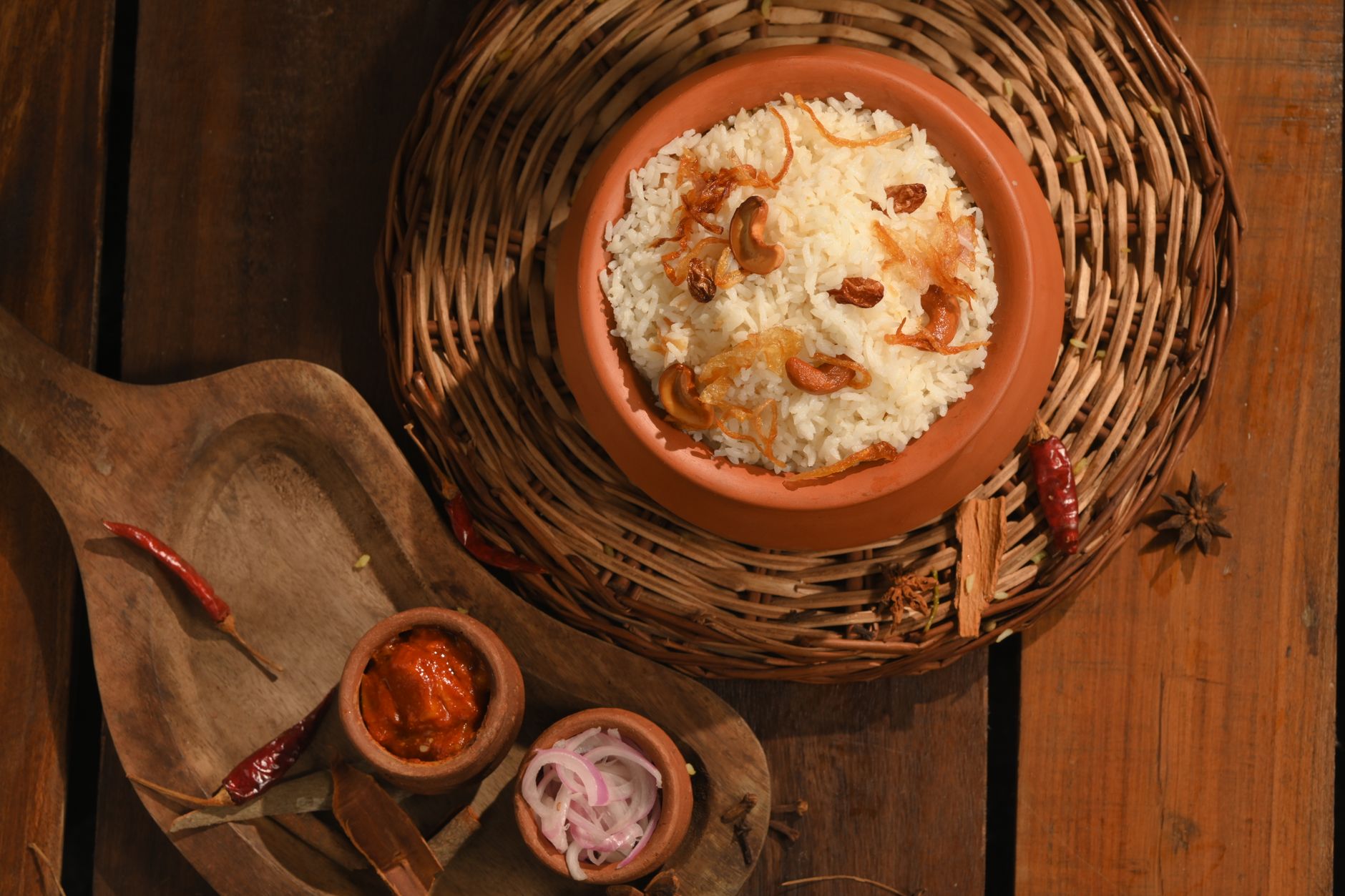
Nawabi Flavours, Live at Your Venue
Food & Beverage in Delhi
Awadhi Rice Specialty Counter for Delhi Weddings
An Awadhi Rice Specialty Counter transforms any Delhi wedding reception into a sensory celebration of Lucknow's centuries-old culinary heritage. Guests gather around large copper handis as chefs lift fragrant dum-sealed lids, releasing saffron-laced steam into the banquet hall. This format — rooted in the Nawabi tradition of slow-cooked, whole-spice-layered rice — has become one of the most-requested wedding food station Delhi setups across venues from Dwarka to Mehrauli. Whether you are planning an intimate nikaah or a 1,200-guest shaadi, a well-executed Nawabi rice catering service elevates both flavour and theatre, giving your guests a talking point long after the baraat has left.
Quick Answer
An Awadhi Rice Specialty Counter is a live, interactive food station at weddings and events where trained chefs prepare and serve traditional Lucknowi rice dishes — primarily dum biryani, Awadhi pulao, and zarda — directly from sealed handis or deg vessels. Set up at venues across Delhi, these counters combine authentic slow-cooking technique with visual theatre, offering guests freshly portioned, aromatic rice dishes in the Nawabi style. Pricing in Delhi typically ranges from ₹180 to ₹500 per plate depending on rice variety, handi size, and staffing.
What exactly is an Awadhi Rice Specialty Counter and how does it work?
An Awadhi Rice Specialty Counter is a purpose-built live station where chefs cook and serve rice dishes rooted in the Lucknow Nawabi tradition. Unlike a standard buffet tray, the counter features large copper or brass handis sealed with dough lids, keeping the dum pukht rice station environment intact until the moment of service. Chefs break the seal tableside, releasing a cloud of saffron and kewra-scented steam that immediately draws a crowd. The menu typically spans gosht dum biryani, vegetable Awadhi pulao, moti pulao, and sweet zarda rice. Each dish is prepared in measured batches so every scoop served is at peak temperature and texture. The station itself is usually dressed with a royal Nawabi aesthetic — brass utensils, floral garlands, and handwritten Urdu-script menu boards — making it a strong visual anchor for your wedding food station Delhi layout. A standard counter requires roughly 10–12 feet of linear space, two to three dedicated chefs, and a live heat source, either induction or charcoal, depending on the venue's permissions.
Why Delhi weddings are choosing live rice counters over static buffets
Delhi's wedding culture has shifted decisively toward experiential dining in recent years. Static buffet trays lose heat within minutes, and pre-portioned biryani served from chafing dishes rarely delivers the crust-to-grain ratio that defines authentic dum cooking. A live cooking counter for events solves both problems: rice is served fresh from the handi in real time, and the spectacle of a chef scooping fragrant layers directly onto a banana leaf or brass thali creates a moment guests photograph and share. Venues across South Delhi — particularly in Vasant Kunj, Chattarpur, and Sainik Farms — have reported a measurable rise in guest satisfaction scores when a live Awadhi Rice Specialty Counter is part of the menu. For North Delhi venues near Pitampura and Rohini, where large joint-family gatherings of 600 to 1,000 guests are common, the counter format also helps caterers manage portion flow more efficiently than a standard buffet line, reducing food waste by ensuring rice is cooked in timed batches rather than prepared hours in advance.
How much does an Awadhi Rice Specialty Counter cost in Delhi?
Pricing for an Awadhi Rice Specialty Counter in Delhi depends on four variables: the number of rice varieties offered, handi size, staffing headcount, and whether the caterer supplies premium ingredients like Basmati 1121, saffron, and whole spices or works with items provided by the host family. As a reliable benchmark, a vegetarian Awadhi pulao setup with one handi and two chefs costs between ₹180 and ₹280 per plate for guest counts of 300 to 500. Adding a mutton dum biryani handi pushes the catering budget per plate Delhi-side to ₹320–₹420. A full Nawabi package with three rice varieties, live bread accompaniments, raita, and salan typically lands between ₹420 and ₹500 per plate. For destination weddings at Dera Mewat or Neemrana (booked from Delhi), logistics surcharges of ₹15,000–₹40,000 apply on top of per-plate costs. Always confirm whether taxes (GST at 5% for catering contracts below ₹7,500 per person) are included in the quoted figure. A Nawabi rice catering service that appears cheap on paper can exceed budget once staffing overtime and equipment rental are added.
Choosing the right rice varieties for your counter setup
The strength of a Lucknowi biryani live counter lies in curation, not volume. Offering five rice dishes dilutes focus and strains the kitchen; three well-executed dishes create a cohesive, memorable spread. For mixed Hindu and Muslim wedding guest lists, a practical combination is: one gosht dum biryani (mutton preferred in Awadhi tradition), one paneer or vegetable Awadhi pulao, and one moti pulao made with silver-leaf-coated kofta. Murg (chicken) dum biryani is increasingly popular at South Delhi venues where guests prefer lighter protein. Zarda — the sweet saffron-cardamom rice — works beautifully as a dessert rice station and adds colour to the table. When briefing caterers, specify Basmati 1121 or Pusa Basmati for elongated grain and aroma; shorter-grain rice, however economical, undermines the visual elegance that defines a traditional Awadhi pulao setup. Ask the caterer to demonstrate the dum technique during a tasting session — the dough seal should brown evenly, and the rice should not be mushy at the base of the handi. This detail separates authentic Awadhi craft from imitation setups marketed under the same name.
What should you check before booking a caterer for this counter?
Booking an Awadhi Rice Specialty Counter for a Delhi wedding requires due diligence beyond a tasting alone. Start by asking the caterer for references from at least two events of a similar guest count held in the past six months. Request a site visit to confirm that your venue — whether a South Delhi farmhouse or a Karol Bagh banquet hall — has adequate ventilation for live charcoal or induction setups, and that the ceiling height accommodates handi steam without triggering smoke alarms. Confirm the staffing ratio: industry standard is one trained Awadhi chef per 80 to 100 covers. Verify that the caterer holds a valid FSSAI licence and that their team has experience with dum pukht rice station protocols, including safe handling of sealed vessels at high heat. Discuss contingency plans if a handi batch is undercooked — a responsible caterer maintains backup rice cooked and held in a separate steamer. Finally, check the royal Indian wedding menu proposal against seasonal ingredient availability; saffron prices spike sharply in winter wedding season (November–February), and caterers who quote a fixed rate without a clause for ingredient price changes can pass costs onto you later.
Awadhi Rice Specialty Counter Setup Types Compared
Expert Recommendation
Best for intimate celebrations (under 150 guests)
Best for large baraats (500–1,200 guests)
Best for budget-conscious hosts
Best for traditional Muslim weddings and nikaah ceremonies
Best for destination weddings near Delhi
Best for modern fusion receptions
How to Choose the Right Option
✅ Pre-booking Checklist
- Confirm venue permits live cooking (open flame or induction) and has adequate ventilation
- Request a tasting session specifically for dum pukht technique — verify grain texture and spice balance
- Clarify whether Basmati 1121 is included in the quoted price or costs extra
- Verify FSSAI licence and halal certification (if required) before signing the contract
- Confirm staffing ratio: minimum one Awadhi-trained chef per 100 covers
- Agree on batch timing schedule in writing to ensure freshness throughout the event
- Ask about backup rice held in steamers in case a handi batch is delayed or undercooked
- Get a final itemised quote including equipment rental, transport, setup, and GST
🎯 Selection Criteria
- Demonstrated experience with Lucknowi dum pukht technique, not just generic biryani
- Ability to scale from one to four handis for your specific guest count
- Quality of base ingredients: whole spices, saffron grade, and Basmati variety
- Counter aesthetics and Nawabi theming aligned with your wedding decor palette
- Clear contingency plan for equipment failure or ingredient shortages on event day
- Positive references from Delhi events of a comparable scale within the past year
💰 Cost / Quality Factors
- Rice variety and protein choice — mutton costs 30–40% more per plate than vegetarian
- Number of handis and batch frequency — more batches mean fresher rice but higher staffing costs
- Venue distance from caterer's base — locations beyond 30 km attract logistics surcharges
- Seasonal ingredient pricing — saffron and high-grade Basmati are costlier in peak wedding months
- Add-on accompaniments (raita, salan, sheermal) that may not be in the base quote
- Equipment quality — copper handis rent at a premium but deliver better heat retention than aluminium
⚠️ Common Mistakes to Avoid
- Booking based on tasting from a standard buffet setup rather than an actual dum pukht demonstration
- Underestimating space requirements and forcing the counter into a cramped layout that slows service
- Ignoring venue ventilation — smoke from charcoal setups can trigger alarms or discomfort guests indoors
- Accepting a vague per-plate quote without itemising accompaniments, staffing, and equipment separately
- Booking too late in peak season and settling for a caterer without verified Awadhi specialisation
- Overlooking guest dietary diversity — failing to offer a vegetarian handi alongside non-vegetarian options
People Also Ask
What is the difference between a regular biryani buffet and an Awadhi Rice Specialty Counter?
How much space does an Awadhi Rice Specialty Counter need at a wedding venue?
Can an Awadhi Rice Specialty Counter be set up for vegetarian weddings?
What is dum pukht cooking and why does it matter for rice quality?
How many guests can a single Awadhi Rice Specialty Counter serve per hour?
What accompaniments are typically served with an Awadhi Rice Specialty Counter?
Is an Awadhi Rice Specialty Counter suitable for corporate events in Delhi?
How far in advance should I book an Awadhi Rice Specialty Counter for a Delhi wedding?
Related Experiences on Happiffie
Live Biryani Counter — Bengaluru Events
Authentic Rice Pot Stations for Kochi Events
Shelter Your Celebrations in Vizag
Jaipur's Finest Table Service Catering
Live Food Stations for Your Mussoorie Wedding
Live Counters That Wow Every Guest
Authentic South Indian Bridal Styling in Delhi
Elegant Plated Dining for Jodhpur Weddings
Frequently Asked Questions
What makes an Awadhi Rice Specialty Counter different from a regular biryani counter at Delhi weddings?
Which Delhi neighbourhoods have banquet venues best suited for a live charcoal Awadhi counter?
Can I combine an Awadhi Rice Specialty Counter with other live food stations at my wedding?
Is it possible to get a kosher or Jain-friendly version of an Awadhi Rice Specialty Counter?
What is the minimum guest count that justifies booking an Awadhi Rice Specialty Counter?
How do I verify that a caterer genuinely specialises in Awadhi cuisine rather than offering a rebranded standard biryani?
What GST rate applies to an Awadhi Rice Specialty Counter booked through a Delhi caterer?
Can an Awadhi Rice Specialty Counter be set up for an outdoor winter wedding in Delhi?
Key Takeaways
- An Awadhi Rice Specialty Counter uses sealed dum pukht technique to serve freshly cooked Lucknowi rice dishes live at your event, offering superior flavour and strong visual theatre compared to standard buffet setups.
- Delhi wedding pricing ranges from ₹180 to ₹500 per plate depending on rice variety, handi count, protein type, and whether accompaniments are included.
- Peak season bookings (November–February) should be made 60–90 days in advance to secure experienced Awadhi chefs and premium copper handi equipment.
- Venue suitability is critical — confirm ventilation, ceiling height, fire NOC requirements, and available floor space (10–18 ft minimum) before finalising a caterer.
- A vegetarian-only dum pukht rice station is fully achievable and can be just as aromatic and theatrical as a non-vegetarian counter.
- Always request a live tasting demonstration using dum pukht technique, not pre-cooked samples, to accurately evaluate quality before booking.
- Staffing ratio matters — one trained Awadhi chef per 80–100 covers is the industry standard to maintain batch freshness and service speed.
- Accompaniments such as burhani raita, mirchi ka salan, and sheermal are integral to the Nawabi experience and should be budgeted alongside the rice counter cost.
Book Delhi's Finest Awadhi Rice Specialty Counter
Compare vetted caterers, check live availability, and get transparent per-plate quotes for your wedding or event — all in one place on Happiffie.
Explore Caterers Now
Are you a Vendor? Grow Your Business with Happiffie!
- High intent verified leads
- Reverse auction opportunities
- AI business tools & insights
- Dedicated vendor dashboard
- Grow your business, your way
It's free & takes less than 2 minutes!