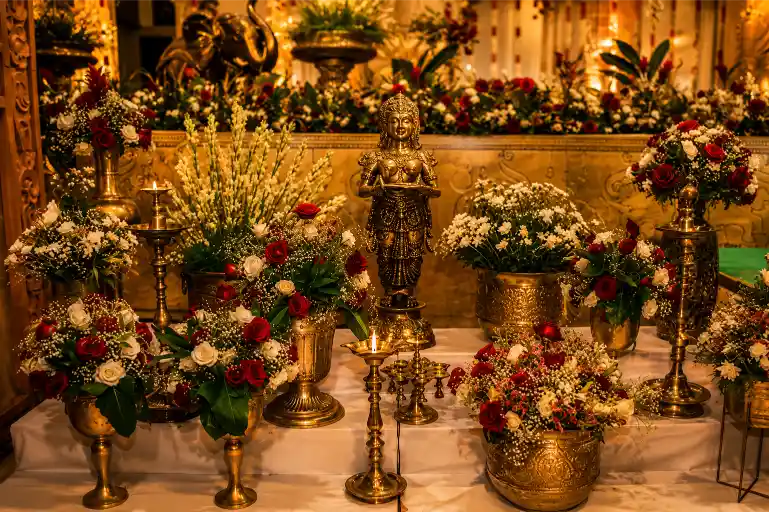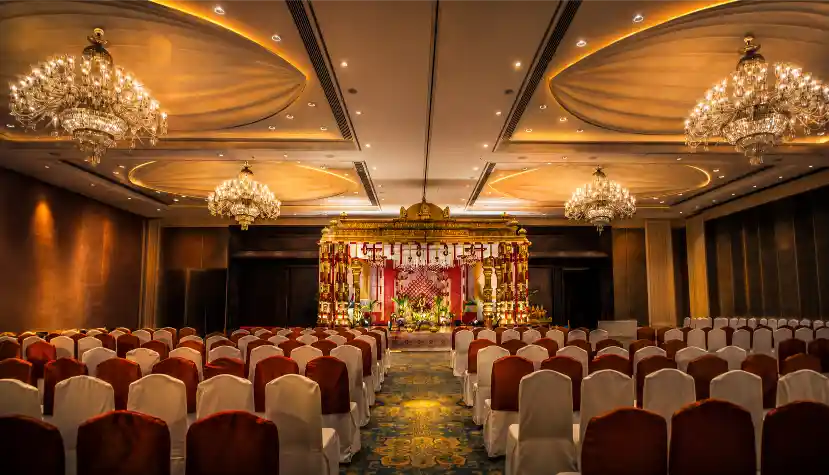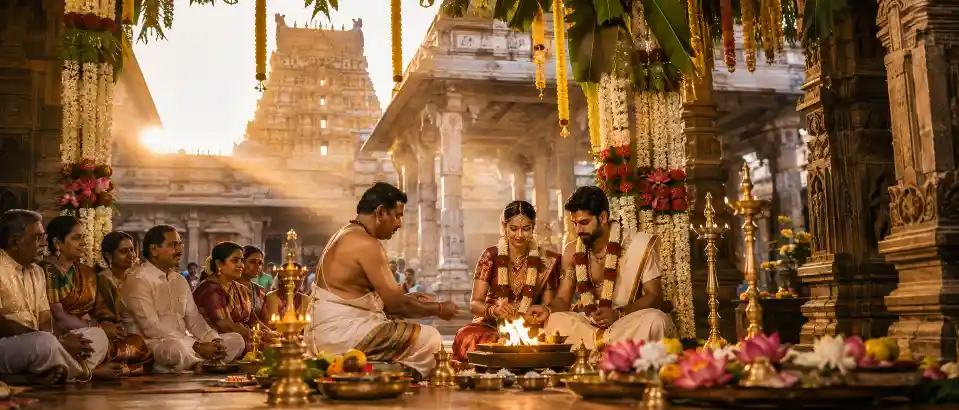
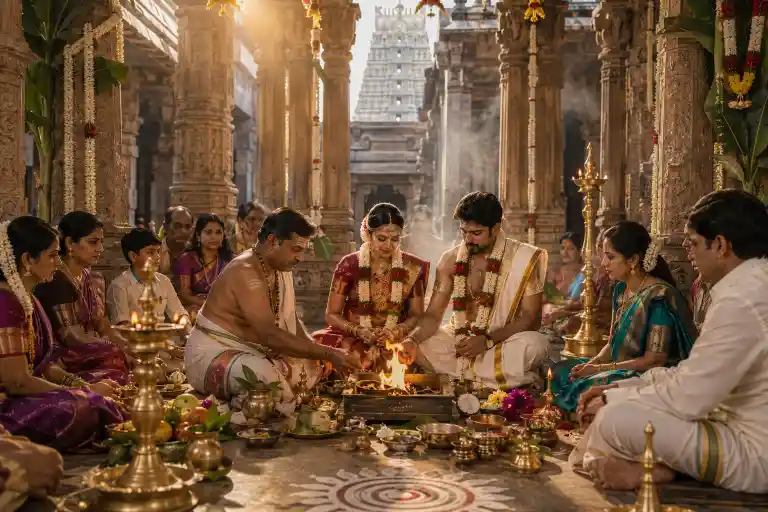
Temple wedding ceremony in India with traditional rituals and decorated mandap
Wedding Planning

Temple Wedding Experience in India: A Complete Planning Guide

Discover sacred Hindu wedding rituals, venue selection, and costs for traditional temple ceremonies across India

2026-08-01By Happiffie Editorial Team10 min read
⚡ Quick Answer

A temple wedding experience in India is a sacred celebration rooted in Hindu rituals, typically held within temple premises or dedicated marriage halls. Couples perform traditional ceremonies like Mangal Pheras and exchange vows before family and spiritual witnesses. Costs range from ₹2–8 lakhs depending on guest count, location, and catering choices, with guest counts typically between 50–300 people.

A temple wedding experience in India represents one of the most spiritually meaningful ways to celebrate marriage. These ceremonies blend sacred Hindu traditions with family customs, creating moments that resonate across generations. Whether you're planning an intimate gathering of 50 guests or welcoming 200 family members, understanding the nuances of sacred wedding rituals India helps you craft an authentic celebration. Temple weddings typically span 2–4 hours, involve multiple priests, and require careful coordination with venue management. Exploring verified temple venues and marriage halls across cities like Chennai, Bangalore, Mumbai, and Delhi ensures your ceremony honors both tradition and practicality. The temple wedding guest count planning process differs from other wedding formats—temples often have seating limits, and sacred spaces demand reverent atmosphere management that impacts logistics, catering, and decoration choices.

What defines a temple wedding experience in India?

What defines a temple wedding experience in India?

A temple wedding experience in India centers on performing sacred rituals within a consecrated space—either inside a temple sanctum or in an adjacent marriage hall—under the guidance of a trained priest. The ceremony honors Vedic customs, with the couple exchanging vows before family elders and spiritual witnesses. Guest counts typically range from 50 to 300 people, depending on temple capacity and family size.

This format differs fundamentally from banquet-hall weddings because it prioritizes spiritual authenticity over décor extravagance. Hindu temple wedding ceremonies require participants to follow dress codes, dietary restrictions (especially vegetarian menus), and behavioral protocols that reflect the sacred nature of the space. Many couples appreciate how temple weddings anchor their celebration in centuries-old tradition, creating a sense of continuity and spiritual blessing.
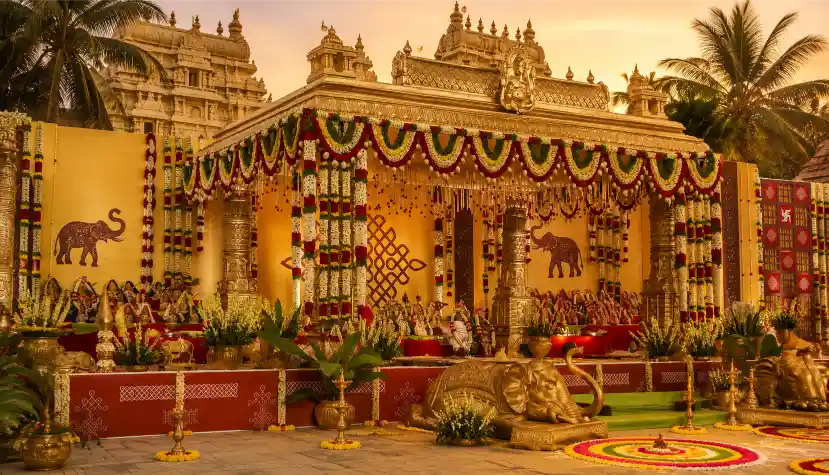
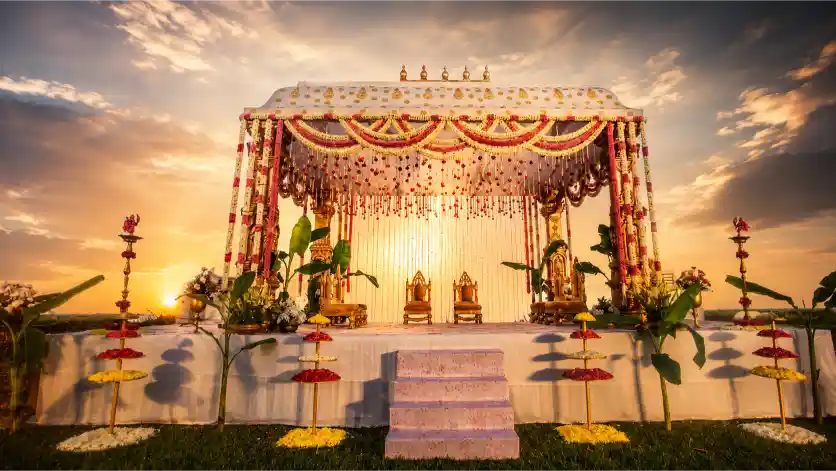
How much does a temple wedding experience cost?

How much does a temple wedding experience cost?

Temple wedding guest count planning directly impacts total expenditure. A 100-person temple wedding in tier-2 cities (Pune, Coimbatore, Indore) typically ranges from ₹2.5–4.5 lakhs, while tier-1 metros (Mumbai, Delhi, Bangalore, Chennai) see costs of ₹4–8 lakhs. Breakdown includes: temple donation/booking (₹20,000–₹50,000), priest fees (₹10,000–₹25,000), catering (₹800–₹2,000 per head), and decoration (₹1–2.5 lakhs). Photography and videography add ₹50,000–₹1.5 lakhs depending on package scope.

Off-season bookings (May–June, September–October) yield 15–20% savings, while peak festival months (November–January) command premium pricing. Couples planning a 200-person ceremony should budget ₹6–10 lakhs in metropolitan areas. Hiring experienced temple wedding coordinators through verified platforms costs ₹30,000–₹75,000 but prevents costly procedural errors.

Which Indian cities offer the best temple wedding venues?

Which Indian cities offer the best temple wedding venues?

Spiritual wedding venues India thrive across regional hub cities. Chennai hosts renowned temples like Parthasarathy Temple and Sri Veeramakaliamman Temple, with adjacent marriage halls accommodating 150–400 guests at ₹3–5 lakhs. Bangalore's Iskcon Temple and Someshwara Temple offer serene settings with ₹2.5–4 lakhs for 100–200 capacity. Mumbai's Banke Bihari Temple and Delhi's Kalkaji Mandir provide metropolitan convenience with costs between ₹3.5–6.5 lakhs.

Each city's temple network reflects regional festival calendars and auspiciousness windows. Couples booking in Hyderabad, Pune, or Jaipur typically access affordable venues (₹2–3.5 lakhs) with shorter waiting lists than metros. Comparing verified temple venues online reveals real seating capacities, catering restrictions, and priest availability—critical details that impact ceremony timing and guest experience.

What are the key rituals in a traditional temple marriage?

What are the key rituals in a traditional temple marriage?

Sacred wedding rituals India unfold across distinct phases, each carrying symbolic meaning. The ceremony opens with Varardhana (groom's welcome), followed by Mangal Pheras (circumambulation of the sacred fire), Saptapadi (seven steps), and Mangalya Bandhan (tying the sacred thread). Priests recite mantras in Sanskrit, and family members perform Aarti (ritual lamp-waving). The entire sequence typically lasts 45–90 minutes, depending on the priest's pace and regional variations.

Traditional temple marriage planning requires advance coordination with temple priests regarding ritual preferences, guest behavior expectations, and photography restrictions in inner sanctums. Many temples prohibit flash photography during sacred moments, and some require male guests to remove shirts as a mark of respect. Understanding these protocols prevents awkward mid-ceremony adjustments and ensures your celebration honors the space appropriately.

Why choose a temple wedding over other formats?

Why choose a temple wedding over other formats?

Couples select a temple wedding experience in India primarily for spiritual authenticity, cost efficiency, and cultural rootedness. Temple venues eliminate decoration costs—the sacred architecture itself provides an inspiring backdrop—allowing budget reallocation toward catering quality and guest comfort. Many families report that temple ceremonies strengthen community bonds and create a sense of divine blessing that elaborate banquet weddings cannot replicate.

Temple weddings also enforce natural guest limits, making them ideal for 50–200 person celebrations where intimacy matters. Vegetarian menus—standard in temple environments—appeal to health-conscious families and reduce catering complexity. For couples prioritizing meaningful ritual over Instagram-worthy setups, exploring temple wedding planning resources reveals how spiritual focus reshapes celebration priorities in unexpectedly fulfilling ways.

People Also Ask

What is the typical duration of a temple wedding ceremony in India?
A standard temple wedding ceremony lasts 45 minutes to 2 hours, depending on priest pace and regional ritual complexity. Mangal Pheras and Saptapadi phases consume 30–40 minutes. Adding pre-ceremony rituals and post-ceremony blessings extends the full event to 2.5–3 hours, including guest seating and gift exchanges.
Can non-Hindu guests attend a temple wedding experience?
Yes, most temples welcome non-Hindu family members and friends as respectful observers. Guests should follow dress codes (covered shoulders, knees), avoid leather footwear in sanctums, and refrain from photography during sacred moments. Temple management advises advance notice of non-Hindu guest attendance to arrange appropriate seating and etiquette briefings.
How far in advance should I book a temple for my wedding?
Advance booking for temple weddings requires 2–6 months lead time in peak season (November–January), compared to 1–3 months in off-season. Tier-1 temples in metro cities book 8–12 months ahead due to high demand and festival calendars. Early coordination with temple authorities confirms priest availability and auspicious date selection.
Are there vegetarian catering restrictions for temple weddings?
Most temples mandate vegetarian-only menus, prohibiting meat, fish, and eggs in wedding catering. Some temples permit guest beverage choices but restrict alcohol consumption within temple premises. Catering partners familiar with temple guidelines ensure compliant menus while maintaining culinary quality across 100–300 guest servings.
What photography and videography permissions exist in temple weddings?
Temple photography policies vary: some permit full coverage, others restrict cameras in inner sanctums or during specific rituals. Professional videographers must obtain temple permission beforehand and often use tripods without flash. Discussing temple rules with verified photography vendors ensures compliance and uninterrupted ceremony documentation.

Expert Recommendation

Best for intimate celebrations (50–100 guests)

Select neighborhood temples or temple marriage halls with capacity-matched seating. This format suits couples prioritizing sacred wedding rituals India with immediate family and close friends. Cost efficiency permits premium catering and photography without budget strain.

Best for extended family gatherings (100–200 guests)

Choose established temple venues in metro areas with dedicated marriage halls, professional catering ties, and parking facilities. These venues accommodate temple wedding guest count planning across multiple seatings and offer priest coordination services that prevent logistical confusion.

Best for destination temple weddings

Sacred pilgrimage cities like Haridwar, Varanasi, and Mathura offer unique spiritual wedding venues India with Vedic authenticity that destination guests find memorable. Coordinate travel, accommodation, and multi-day celebrations to justify guest travel costs.

Best for budget-conscious couples (₹2–4 lakhs total)

Tier-2 cities and off-season bookings enable affordable temple wedding experience in India without ritual compromise. Partner with verified vendors offering competitive packages to maximize catering and décor within tight budgets.

Temple Wedding Formats: A Comparison of Setup Options

Setup TypeAdvantagesLimitationsRecommended Use Case
Inner Temple Sanctum CeremonyHighest spiritual authenticity; minimal décor needed; intimate atmosphere; priest-led guidanceTight space (30–50 guests max); limited photography; restricted guest attire; no catering inside sanctumUltra-intimate weddings; couples prioritizing ritual purity over scale
Adjacent Temple Marriage HallAccommodates 150–300 guests; dedicated catering facilities; flexible photography; maintained sacred ambianceRental costs (₹1.5–3 lakhs); less direct temple proximity; requires separate décor investment100–250 guest celebrations; families wanting scale with spiritual setting
Community Temple Complex with Banquet WingCost-effective (₹2–4.5 lakhs); multi-function spaces; in-house catering; priest coordination supportLess architectural grandeur; potential ceremonial time-sharing with other weddings; commercial feelBudget-conscious couples; 100–150 guests; tier-2 city ceremonies
Destination Temple Wedding (pilgrimage city)Unique experiential value; inherent spiritual magnetism; memorable guest experience; cultural immersionHigher travel costs; logistical complexity; limited vendor familiarity; extended planning timelineDestination celebrations; affluent couples; 50–150 guests seeking transformative wedding narratives

Decision Support

Pre-Booking Checklist

  • Confirm temple availability and priest booking for your target dates 2–6 months in advance
  • Verify guest capacity limits and seating arrangements with temple management
  • Clarify photography/videography permissions in sanctum and halls before hiring vendors
  • Confirm catering restrictions (vegetarian requirements, alcohol policies) with temple authorities
  • Arrange dress code briefings for non-Hindu guests and elders unfamiliar with ceremony etiquette
  • Book experienced temple wedding coordinators to manage timing, ritual sequences, and vendor coordination
  • Secure priest fees, temple donations, and catering deposits in writing with clear itemization
  • Schedule a pre-wedding walk-through to assess parking, guest flow, and contingency spaces

Selection Criteria

  • Guest count capacity: Choose venues accommodating your target headcount with 15% buffer for last-minute additions
  • Priest availability: Confirm dedicated priest allocation on your ceremony date versus shared time-slots
  • Catering infrastructure: Assess dedicated kitchen, serving areas, and dishwashing facilities for your guest scale
  • Proximity to major city: Prioritize venues within 30-minute drive in metros, accessible via public transport or parking
  • Budget alignment: Match venue rental costs with your total budget envelope—typically 20–30% of overall spend

Cost & Quality Factors

  • Off-season discounts (May–June, September–October) typically offer 15–20% savings on venue and catering
  • Priest expertise in your regional tradition (South Indian, North Indian, Bengali, Marathi variants) impacts ceremony authenticity
  • All-inclusive packages versus itemized costs: bundled offerings simplify budgeting but may inflate unnecessary services
  • Photography restrictions in inner sanctums reduce coverage costs but limit candid ritual documentation
  • Catering cost-per-plate varies ₹800–₹2,000 depending on menu complexity and guest count economies of scale

Mistakes to Avoid

  • Booking without confirming priest availability—many couples discover last-minute priest conflicts 2 weeks before the wedding
  • Ignoring dress code and behavior protocols—uncomfortable guest experiences undermine ceremony reverence
  • Over-decorating sacred spaces against temple wishes—excess décor dishonors the venue and wastes budget
  • Assuming vegetarian menus compromise quality—experienced temple caterers deliver excellent taste within restrictions
  • Scheduling back-to-back ceremonies without buffer time—rushed transitions reduce ceremony dignity and guest comfort

Key Takeaways

  • Temple wedding experiences in India blend spiritual authenticity with cost efficiency, typically costing ₹2–8 lakhs depending on location and guest count.
  • Sacred wedding rituals India follow Vedic protocols: Mangal Pheras, Saptapadi, and Mangalya Bandhan structured across 45–120 minutes.
  • Book temple venues 2–6 months in advance; metro temples demand 8–12 months lead time during peak season.
  • Vegetarian catering is standard; coordinate with temple management regarding alcohol policies and dietary restrictions.
  • Tier-1 cities (Mumbai, Delhi, Bangalore, Chennai) command ₹4–8 lakhs; tier-2 cities offer equivalent experiences at ₹2.5–4.5 lakhs.
  • Photography restrictions in sanctums are common; discuss permissions with priests and professional vendors beforehand.
  • Temple wedding guest count planning suits 50–300 person celebrations; natural capacity limits enforce intimate yet meaningful scale.
  • Hire experienced coordinators (₹30,000–₹75,000) to navigate priest coordination, ritual sequencing, and vendor management.

Frequently Asked Questions

Couples planning a temple wedding experience in India often ask about costs, logistics, ritual meanings, and vendor coordination. Below are answers to the most common queries, designed to clarify the unique aspects of sacred wedding rituals India and help you move forward confidently.

How much does a temple wedding experience in India typically cost?
Temple wedding costs range from ₹2–8 lakhs depending on city tier, guest count, and services. A 100-guest ceremony in tier-2 cities costs ₹2.5–4.5 lakhs; metro ceremonies cost ₹4–8 lakhs. Reverse auction platforms help compare verified packages and negotiate competitive rates with multiple vendors simultaneously.
What is the typical ceremony duration for a temple wedding?
Most temple wedding ceremonies last 45 minutes to 2 hours. Core rituals (Mangal Pheras and Saptapadi) consume 30–40 minutes; pre-ceremony and post-ceremony rituals extend total time to 2.5–3 hours. Priest pace and regional tradition variations affect duration, so confirm timing expectations with temple management.
Can I customize sacred wedding rituals India for my personal beliefs?
Temple priests typically follow traditional Vedic sequences; major customization is limited to preserve ritual authenticity. Minor adjustments (ritual order, Sanskrit verses, guest participation) are negotiable with priests. Discuss preferences during initial consultation to ensure alignment before booking.
How does Happiffie help plan a temple wedding experience in India?
Happiffie's venue discovery platform lists verified temple marriage halls across 50+ Indian cities with real capacities, catering policies, and priest coordination services. Our reverse auction model lets you request quotes from multiple vendors—caterers, photographers, coordinators—and compare costs transparently, saving 15–25% on temple wedding budgets.
What dietary and behavioral restrictions apply to temple weddings?
Vegetarian-only menus are mandatory in most temples; confirm alcohol policies with management (many prohibit on-premises consumption). Guest dress codes require covered shoulders and knees; remove shoes in sanctums. Happiffie's planning guides detail temple-specific etiquette to brief guests and prevent discomfort during ceremonies.

Plan Your Perfect Temple Wedding Experience in India

Discover verified temple venues, experienced coordinators, and competitive catering packages across 50+ Indian cities. Happiffie's reverse auction platform lets you compare quotes from trusted vendors and lock in the best prices for your sacred celebration.

temple weddingHindu ceremonieswedding planning Indiasacred ritualsvenue selectionwedding budgettraditional marriagespiritual celebrations

By Happiffie Editorial Team — The Happiffie Editorial Team specializes in regional wedding and event planning content across India, combining on-ground venue insights with verified vendor data.

Happiffie mascot

Are you a Vendor? Grow Your Business with Happiffie!

  • High intent verified leads
  • Reverse auction opportunities
  • AI business tools & insights
  • Dedicated vendor dashboard
  • Grow your business, your way
1M+Active Users
300+Events Daily
High QualityLeads
FasterBookings
Join Happiffie as a Vendor

It's free & takes less than 2 minutes!