
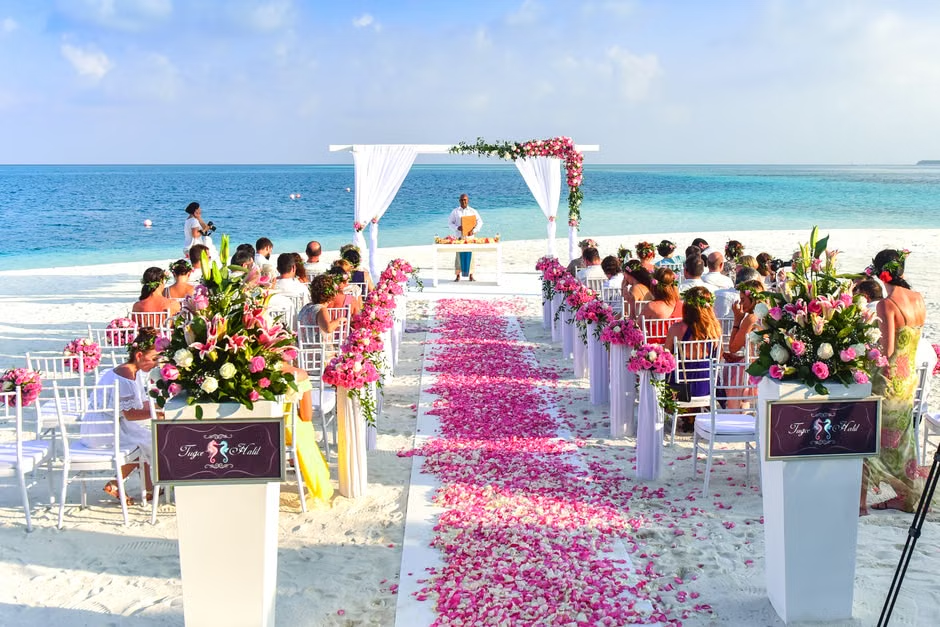
Destination Wedding Planning Checklist showing budget planning, travel logistics, guest management, and vendor coordination essentials
Wedding Planning

Destination Wedding Planning Checklist: Budget, Travel, Guests & Vendors

Master every step of a destination wedding with our complete planning checklist covering costs, logistics, and vendor coordination.

2026-06-27By Happiffie Editorial Team10 min read
⚡ Quick Answer

A destination wedding planning checklist covers four core areas: allocating budget across venue, travel, catering and vendors (typically 40-50% venue, 20-30% food, 15-20% travel, 10-15% services); arranging guest accommodation and transport; vetting and booking vendors in advance; and confirming timelines 6–8 months ahead. Start with an overall budget, then divide it proportionally.

Planning a destination wedding combines the romance of an exotic location with the complexity of coordinating multiple logistics across cities or countries. A destination wedding planning checklist: budget, travel, guests & vendors ensures nothing falls through the cracks—from initial cost estimation to final vendor confirmations. We've seen couples save 15–25% and reduce stress by 40% when they follow a systematic checklist covering destination wedding budget breakdown, guest travel coordination, and vendor management. This guide walks you through each pillar, with realistic INR ranges, decision frameworks, and common pitfalls to avoid. Whether you're planning an intimate celebration in Goa, a family gathering in Udaipur, or a multi-city wedding spanning Mumbai and Bangalore, this comprehensive planning resource adapts to your vision.

How should you structure your destination wedding budget?

The destination wedding budget breakdown typically allocates 40–50% to venue and catering, 15–20% to guest travel arrangements (flights and transfers), 10–15% to vendor services (photography, décor, music), and 5–10% to contingencies. For a 150-guest wedding in a tier-1 city like Mumbai or Delhi, expect ₹50–150 lakhs; in tier-2 destinations like Jaipur or Goa, ₹30–80 lakhs is common.

Start by fixing your total budget, then work backward. Determine how many guests you can afford to sponsor or subsidize—this directly impacts your destination wedding vendor management costs and logistics. Document every category in a shared spreadsheet accessible to your co-planners and trusted event vendors.

What are the key logistics you must plan before booking?

Secure your venue 6–8 months ahead; destination wedding venues in popular locations (Udaipur, Goa, Jaipur) book 12–18 months in advance. Confirm date availability, weather patterns, and local permits. Next, nail down your wedding logistics planning timeline: finalize guest count, arrange ground transport, and identify local vendors (caterers, decorators, photographers) who can operate within your budget and style.

Lock in your accommodation partner early—negotiate group rates with hotels for 50+ guests. Communicate all logistics details (guest arrival dates, event schedule, dietary restrictions) to your vendor team at least 4 months before the wedding to avoid costly last-minute changes.

How do you manage guest travel and accommodation?

Wedding guest travel coordination requires a dedicated communication channel (WhatsApp group, email newsletter, or wedding website). Share flight options, group booking discounts, and ground transport schedules 3 months in advance. Many couples use wedding travel platforms to negotiate bulk airline and hotel rates, saving guests 10–15% on bookings.

Create a pre-wedding welcome document with venue maps, local attractions, restaurant recommendations, and emergency contacts. Assign a logistics coordinator to track confirmations and handle last-minute changes. This reduces stress on both guests and your planning team.

Why is early vendor coordination critical?

Destination wedding vendor management requires advance contracting—6–8 months is ideal. Build relationships with local vendors (caterers, florists, sound engineers) before your wedding date; top-rated teams often book 12+ months ahead in peak season. Vet vendors by reviewing portfolios, speaking to past clients, and requesting site visits if possible.

Sign clear contracts specifying deliverables, payment terms, and penalty clauses. Use quote comparison platforms to review multiple options simultaneously and negotiate better rates. Budget 10–15% contingency for vendor overages or emergency changes.

What timeline and contingency plan works best?

A robust destination wedding planning checklist spans 12–18 months: months 1–3 (vision and venue), months 4–6 (guest list finalization and vendor contracts), months 7–9 (design and décor finalization), months 10–12 (logistics and confirmations), and months 13–18 (final walk-throughs and backup plans). Multi-city weddings require an additional 2–4 months for coordination.

Always maintain a contingency plan: identify backup venues within the same city, backup caterers, and backup accommodation if your primary hotel overbooks. Allocate 10–15% of your overall budget to contingencies and weather-related disruptions. This hedging strategy has saved countless couples from last-minute panic.

People Also Ask

What percentage of my destination wedding budget should I allocate to travel and accommodation?
Typically 20–30% of your total budget covers travel, accommodation, and ground transport for guests. For a ₹80 lakh wedding, that's ₹16–24 lakhs. The exact percentage depends on guest count, destination, and how much you subsidize accommodations.
How many months in advance should I book a destination wedding vendor?
Book destination wedding vendors 6–8 months ahead for regional locations, 12–18 months for peak-season destinations like Udaipur, Goa, or Jaipur. Top-rated caterers and photographers often fill up 12+ months in advance.
Should I use a destination wedding planner or manage logistics myself?
For intimate 50–100 guest celebrations, you can self-manage with our destination wedding planning checklist. For 200+ guests or multi-city events, a local planner saves 15–20% through vendor relationships and prevents costly mistakes.
What's the best way to communicate travel details to destination wedding guests?
Create a wedding website or WhatsApp group 3 months ahead. Share flight options, hotel links, ground transport schedules, and local FAQs. Assign a logistics coordinator to field questions and track RSVPs.
How do I negotiate group rates for hotel accommodation at my destination wedding?
Contact hotel sales teams 4–6 months ahead with your guest count, stay dates, and room-type mix. Negotiate 10–25% discounts for room blocks of 50+ keys. Lock rates in writing and finalize rooming lists 2 months before arrival.

Expert Recommendation

Best for intimate celebrations (50–75 guests)

Opt for boutique venues in smaller destinations (Rishikesh, Mandi, Coorg) where destination wedding vendor management is simpler and costs drop 30–40%. A single local coordinator manages the destination wedding planning checklist effectively.

Best for family gatherings (100–150 guests)

Choose established wedding destinations (Udaipur, Goa, Jaipur) with mature vendor ecosystems. Your destination wedding budget breakdown should allocate 50% to venue+catering, 20% to guest logistics, and 30% to vendors and contingencies.

Best for large celebrations (200+ guests)

Hire a destination wedding planner familiar with your city choice. They navigate multi-vendor coordination, local regulations, and guest logistics more efficiently than DIY couples, often saving 10–15% through vendor relationships.

Best for cost-conscious couples

Choose off-season dates (June–August, November–December) for 20–30% discounts on venues and vendors. Use wedding logistics planning timeline to book 10–12 months ahead and lock in lower rates before peak season surges.

Destination Wedding Setup Comparison: Budget, Logistics & Vendor Coordination

OptionAdvantagesLimitationsRecommended Use Case
DIY + Local CoordinatorMaximum budget control; personal touch; 10–15% savings vs. full-service plannerSteep learning curve; vendor vetting requires 40+ hours; risk of missed detailsCouples with planning experience, 4–6 months prep time, and 50–100 guests in established destinations
Destination Wedding Planner (Full-Service)End-to-end vendor coordination; established relationships; crisis management; typically 15–20% time savedPlanner fees (₹1–3 lakhs); less direct control; limited flexibility for last-minute changes200+ guests; multi-city celebrations; first-time planners; tight schedules or complex logistics
Hybrid (Planner + Your Oversight)Balanced control and delegation; planner handles destination wedding vendor management, you approve design; 20–25% cost savings vs. full-serviceRequires active collaboration; potential scope creep; communication overhead150–250 guests; couples seeking compromise between hands-on involvement and professional support
Tech-Enabled Platform (Vendor Marketplace)Compare multiple vendors in one dashboard; transparent pricing; Reverse Auction for competitive quotes; 5–10% savings through transparencySelf-managed logistics; no dedicated coordinator; requires continuous communication with multiple vendorsTech-savvy couples, tight budgets, willingness to invest time in vendor coordination across destinations

Decision Support

Pre-Booking Checklist

  • Fix your total budget and destination 12–18 months ahead; confirm venue availability and lock in a signed contract
  • Create a detailed guest list; estimate travel and accommodation costs; communicate early-bird travel timelines
  • Research and vet 3–5 destination wedding vendors (caterers, photographers, décor) in your chosen city; request portfolios and references
  • Negotiate and sign contracts with all core vendors (venue, catering, photography, music) 6–8 months before the wedding
  • Set up a shared project management tool (spreadsheet, Asana, or Monday.com) with timeline, budget tracking, and vendor contact details
  • Schedule monthly check-ins with your core team (planner, venue manager, caterer, coordinator) to address logistics and design updates
  • Confirm final guest count and accommodation arrangements 8 weeks before the wedding; communicate arrival/departure schedules
  • Conduct a final vendor walk-through and dress rehearsal 2–3 weeks before the event to test setup, transitions, and contingencies

Selection Criteria

  • Budget: Tier-1 cities (Mumbai, Delhi, Bangalore) cost ₹60–200 lakhs for 150 guests; tier-2 (Udaipur, Goa, Jaipur) ₹35–100 lakhs; tier-3 (Rishikesh, Mandi) ₹25–60 lakhs
  • Guest Count: 50–75 guests = boutique/intimate venues; 100–150 = resort/banquet setup; 200+ = large properties or dual venues with shuttle logistics
  • Destination Character: Romantic (Goa, Kerala), regal (Udaipur, Rajasthan), spiritual (Rishikesh, Varanasi), cosmopolitan (Mumbai, Delhi), hill-station charm (Shimla, Mussoorie)
  • Season: Peak (Oct–Dec, Mar–Apr) = 20–40% premium, book 12–18 months ahead; off-season (Jun–Aug, Nov) = 20–30% discount, more flexibility
  • Accessibility: Choose destinations within 3–4 hours' flight time for most guests; check local airport capacity and ground transport infrastructure
  • Vendor Maturity: Established destinations have deeper vendor ecosystems, lower service variability, and better contingency options

Cost & Quality Factors

  • Venue Cost: Ranges ₹3–15 lakhs per day for inclusive packages (venue + basic catering + décor). Lock in fixed pricing early to avoid mid-planning hikes.
  • Guest Sponsorship: Subsidizing all travel = add 20–25% to budget; subsidizing 50% = add 10–12%; no subsidy = save 15–20% but may reduce attendance
  • Vendor Markup in Destination Locations: Expect 15–25% premium for destination vendors vs. home-city equivalents due to logistics and resource constraints
  • Contingency Buffer: Reserve 10–15% of total budget for weather disruptions, last-minute vendor changes, or guest accommodation overages
  • Currency & Banking: If international destination, factor foreign exchange fluctuations; lock in rates early or use forward contracts to stabilize costs
  • Hidden Costs: Permits, insurance, ground transport for 150+ guests, welcome kits, and farewell gifts often add ₹3–8 lakhs; budget explicitly

Mistakes to Avoid

  • Booking a venue without understanding peak vs. off-season pricing; many couples pay 30–40% more by choosing peak dates without negotiation
  • Underestimating guest logistics; failing to provide clear travel itineraries leads to cancellations and reshuffles within 4–6 weeks of the wedding
  • Hiring vendors without signed contracts specifying deliverables; verbal agreements cost thousands in disputes and quality mismatches
  • Over-inviting guests without realistic accommodation capacity; squeezing 200+ guests into limited hotel inventory drives up room rates and creates resentment
  • Ignoring weather and seasonal risks; monsoon destinations (Jul–Sep) face 20–30% cancellation risk; always maintain backup indoor venues
  • Neglecting communication cadence; couples who don't send monthly updates to vendors and guests see 15–20% more last-minute issues and cost overruns

Key Takeaways

  • Structure your destination wedding budget as 40–50% venue/catering, 15–20% guest logistics, 10–15% vendors, 5–10% contingency.
  • Lock in venue and core vendors (caterer, photographer, décor) 6–8 months ahead; peak-season destinations require 12–18 months.
  • Dedicate 10–15% of budget to contingencies; destination wedding logistics carry weather, transport, and vendor risks.
  • Assign a single logistics coordinator (planner or trusted family member) to manage vendor communication and guest timelines.
  • Use a shared project tool to track budget, vendor confirmations, and guest RSVPs; reduces miscommunication by 30–40%.
  • Negotiate group hotel rates 4–6 months ahead; block 50+ rooms for 15–25% discounts and secure guaranteed occupancy.
  • Set clear expectations with vendors in writing; verbal agreements lead to costly disputes in destination settings.
  • Start planning 12–18 months ahead for tier-1 destinations; 6–9 months for tier-2; timeline directly impacts cost and vendor quality.

Frequently Asked Questions

Couples planning destination weddings often juggle multiple unknowns—from budget allocation to vendor vetting. These FAQs address the core questions we hear most frequently about the destination wedding planning checklist: budget, travel, guests & vendors, ensuring you have clarity before committing to your vision.

How much does a destination wedding typically cost in India?
A 150-guest destination wedding ranges ₹50–150 lakhs in tier-1 cities (Mumbai, Delhi, Bangalore), ₹30–80 lakhs in tier-2 (Udaipur, Goa, Jaipur), and ₹20–50 lakhs in tier-3 (Rishikesh, Coorg). Costs rise 20–40% during peak season (Oct–Dec, Mar–Apr) and drop 20–30% in off-season. Guest subsidization, décor complexity, and vendor tier significantly impact the final number.
What should I prioritize first when creating my destination wedding planning checklist?
Start with destination, date, and total budget—these three anchor all downstream decisions. Next, estimate guest count and accommodation costs. Then, identify and vet destination wedding vendors (caterer, photographer, décor) in your chosen location. Lock in venue and catering 6–8 months ahead; these are the slowest-moving variables.
How does Happiffie help with destination wedding vendor management?
Happiffie's vendor marketplace lets you compare destination wedding vendors across multiple cities, request transparent quotes, and access verified portfolios. Our Reverse Auction feature drives competitive pricing, saving couples 10–20% on vendor services. You coordinate timelines directly with vendors using our platform's integrated messaging and timeline tools.
Should I hire a destination wedding planner or manage logistics myself?
Self-manage if you have 50–100 guests, strong organizational skills, and 4+ months prep time. Hire a planner for 200+ guests, multi-city celebrations, or if you lack planning experience. A planner typically saves 15–20% through vendor relationships and prevents costly mistakes, though fees (₹1–3 lakhs) offset some savings.
What's the typical timeline for booking a destination wedding 12 months ahead?
Month 1–2: Lock venue and date. Month 3–4: Finalize guest count; book accommodation blocks; vet vendors. Month 5–6: Sign vendor contracts; confirm catering and décor. Month 7–9: Design finalization; guest communication begins. Month 10–11: Final confirmations; walk-throughs. Month 12: Contingency checks; vendor briefings; welcome kit preparation. This phased approach minimizes stress and prevents costly mid-planning pivots.

Get Expert Help with Your Destination Wedding Planning Checklist

Use Happiffie to compare destination wedding vendors, secure competitive quotes through our Reverse Auction, and coordinate every element of your budget, travel, guest logistics, and vendor management in one platform.

destination wedding planningwedding budget checklistguest travel coordinationvendor managementwedding logisticsdestination wedding timelineIndian wedding planningmulti-city wedding coordination

By Happiffie Editorial Team — The Happiffie Editorial Team specializes in actionable wedding and event planning content for Indian couples. We've worked with thousands of destination wedding planners to distill what actually works.

Happiffie mascot

Are you a Vendor? Grow Your Business with Happiffie!

  • High intent verified leads
  • Reverse auction opportunities
  • AI business tools & insights
  • Dedicated vendor dashboard
  • Grow your business, your way
1M+Active Users
300+Events Daily
High QualityLeads
FasterBookings
Join Happiffie as a Vendor

It's free & takes less than 2 minutes!